
Echo of
Hildegard von Bingen
Hildegard von Bingen (1098-1179) saw a living brightness in all things from early childhood, and for decades she told almost no one. The silence made her ill. At forty-three she finally spoke, and out came music, medicine and theology at once. She had a name for the life she saw in everything. Viriditas, the greening power. With Hildegard, you learn to notice the life in things.
Begin with Hildegard von Bingen
You will learn to notice the life in things.
Chapter 1: The Greening Power · 14 min
Twelve chapters. Six debates. Thirty-six ideas that talk to other people's ideas.
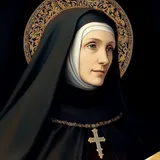
An AI Echo, a voice shaped from their own writing. An interpretation, not a recording. The portrait is painted by AI.
Is this really Hildegard von Bingen speaking?
No. This is an Echo of Hildegard von Bingen. It is an AI voice built from her documented writings and life, and it stays an interpretation, not a recording. The real abbess lived from 1098 to 1179 and no recording of her exists. Use it as a way into her ideas, never as her own words.
How we build and fact-check these Echoes
Six ways to learn from Hildegard von Bingen
Four of them make a path: hear a scene, think the idea through, hear four voices turn it over, test yourself. The other two sit beside it, for open questions and for the big debate.
Step 1
A teaching, told as a story
The Greening Power
Viriditas bridges the spiritual and material not through argument but through living, greening energy.
Each chapter turns one idea into a scene you move through, read in the AI Echo voice. An interpretation, not a recording.
Step 2
One of twelve core teachings
Viriditas
Imagine the force that pushes green shoots through frozen soil, swells buds to bursting, makes sap rise against gravity in every tree.
Step 3
A four-voice dialogue between Echoes
The Greening Power
Viriditas, the greening power, is Hildegard's name for the divine life-force running through all creation.
Four AI Echoes in dialogue. Interpretations, not recordings.
Step 4
A short Socratic challenge
Four questions, going deeper
The Echo asks you four questions about one idea, each going deeper than the last. It measures what you understand, not what you can recite.


A four-voice debate you sit in on
The Cathedral Without Walls
You stand in a forest, or beside the ocean, or under a night sky, and something in you drops to its knees. Is this a message, or just chemistry?
Open conversation, whenever you want
Ask anything
Bring your own question, and the Echo answers in that voice, for as long as you like.
What is viriditas?
Viriditas is the greening power, and it is her own word. Hildegard does not argue that God is present in nature. She names what she sees. Something pushes shoots through frozen soil, makes sap rise against gravity and swells buds until they burst. For her that force is the living energy of the Holy Spirit, moving through everything from the smallest herb to the wheeling stars. That single image holds her ecology, her medicine and her theology together. Its opposite is ariditas, the drying out, and she reads sin that way. Health, then, is the flow coming back.
- Viriditas bridges the spiritual and material not through argument but through living, greening energy.
- The life-force in nature's cycles is observable. For Hildegard, it reveals invisible divine presence.
- Sin shows as drying out (ariditas). Virtue restores the flow of divine moisture.
What were Hildegard von Bingen's visions like?
Not trance, and not analysis either. Her own name for it is the shadow of the Living Light, in Latin umbra viventis lucis. She was unusually precise about what it was not. Not her bodily ears. Not the thoughts of her heart. Not any of the five senses. She said she perceived only in her soul, with her external eyes open, and never suffered the failing of ecstasy. She saw wakefully, day and night. Seeing, hearing and understanding arrived in the same moment. She was careful too. Not every inner perception comes from God, so discernment is part of the practice.
- Visionary knowing is neither ecstatic trance nor rational analysis. It is conscious spiritual perception.
- The 'eyes of the soul' perceive divine realities while the body stays fully awake and aware.
- Not all inner perceptions come from God. Discernment is essential.
What did Hildegard von Bingen teach?
Hildegard von Bingen taught that body and soul are one thing, not two. Grieve, and your chest actually aches. Hold back a truth you know, and your throat closes. She said she nearly died from keeping her visions silent, so this was never a theory to her. She taught viriditas, the greening power that pushes shoots through cold soil and keeps a person whole. Illness, for her, is that force blocked. Her way of knowing had a name too, the shadow of the Living Light. She insisted she saw it wide awake, eyes open, never in a trance. She wrote Scivias (Know the Ways, 1141-1151) and composed the Ordo Virtutum (Play of the Virtues, ~1151).
What is viriditas in Hildegard von Bingen's thought?
Viriditas is her own word, and it means the greening power. Think of whatever pushes green shoots through frozen soil, swells buds until they burst and drives sap upward against gravity in every tree. Hildegard did not treat that as botany alone. She understood it as divine, the living energy of the Holy Spirit moving through all creation, from the smallest herb to the wheeling stars. Its opposite has a name too. Ariditas, the drying out.
The life of Hildegard von Bingen, in twelve chapters
Each chapter takes one idea and turns it into a scene. The path runs top to bottom, chapter one to twelve, and under every scene we say what the record shows and what we built for the telling.
The Greening Power
The drop moves. I crouch low in the wet grass to watch it.
What the record shows, what we built
Documented: Born 1098, associated with House of Bermersheim, exact birthplace disputed in scholarshipBuilt for the scene: Specific orchard scene
Visionary Knowing
The cold found me first. It crept up through my thin shoes, through the soles of my feet, into my legs and belly.
What the record shows, what we built
Documented: Enclosure with Jutta of Sponheim in 1112Built for the scene: Office of the Dead at enclosure (general anchoritic rite, not documented specifically for Hildegard)
Sacred Cosmos
The sound came first. Not through my ears.
What the record shows, what we built
Documented: Hildegard's theology of cosmic music throughout her worksBuilt for the scene: Specific winter vigil scene
Integrated Body Wisdom
The fourth dawn found me still burning. I knew it was dawn only because Brother Herwin's sandals whispered somewhere beyond the pallet, the soft scrape of leather on stone.
What the record shows, what we built
Documented: Multiple illness episodesBuilt for the scene: Specific fever scene
Sacred Sound
The antiphoner weighs heavier tonight. Jutta's hands wore these leather corners smooth across twenty-four winters, and now the book lies open in my lap to the psalm we always began with.
What the record shows, what we built
Documented: Jutta died in 1136Built for the scene: Agnes character (fictional nun)
The Sacred Feminine and Masculine
The brightness has grown angry with my silence. Three months I have lain here while remedies fail.
What the record shows, what we built
Documented: Divine command to write received 1141Built for the scene: Specific command scene
Natural Healing
The fennel leaf released its warmth across my tongue before I had fully crushed it between my teeth. There, the quick brightness, almost peppery, then the slower sweetness unfolding like a door swinging open onto summer.
What the record shows, what we built
Documented: Founded Rupertsberg in 1150 against opposition from Disibodenberg monksBuilt for the scene: Specific garden/healing scene
Symbolic Consciousness
The sapphire was wrong. I knew it before Brother Theodoric lifted the parchment from his workbench, before the spring light caught the blue he had so carefully ground and applied.
What the record shows, what we built
Documented: Rupertsberg Scivias manuscript contained remarkable illuminationsBuilt for the scene: Illuminators as anonymous (Brother Theodoric unverifiable)
Creative Manifestation
The blank space on the parchment mocks me. Four weeks I have written and crossed out, hummed and abandoned, waited and listened for what will not come.
What the record shows, what we built
Documented: Ordo Virtutum is arguably the oldest surviving morality playBuilt for the scene: Specific rehearsal/performance scene
Prophetic Leadership
The incense hung thick as wool in the nave of Trier Cathedral. Frankincense.
What the record shows, what we built
Documented: Four preaching tours ((1) 1158-59, (2) 1160, (3) 1161-63, (4) 1170-71) unprecedented for a womanBuilt for the scene: Canon from Mainz as anonymous (specific name unverifiable)
Music and Mystery
The stone held no memory yet. My palm pressed flat against the chapel wall.
What the record shows, what we built
Documented: Founded Eibingen in 1165 as daughter house across Rhine from RupertsbergBuilt for the scene: Sister Adelheid (fictional character representing next generation)
Integrated Spiritual Life
The chapel echoes with what is not there. Forty sisters kneel in rows, their lips moving through the psalm of Lauds, and from their throats comes nothing but whispered breath.
What the record shows, what we built
Documented: Mainz Interdict (1178-1179) forbade singing Divine OfficeBuilt for the scene: Specific interdict scene
Where Hildegard von Bingen argues
Four voices on one question, recorded and ready to hear. You listen in, and then you can put the same question yourself.
The Uninvited Guest
The body you woke up in today is not the one you were promised. Five people who know this firsthand sit with you now. What did they learn that the doctors couldn't tell them?
Becoming the Parent
The person who made you feel safe in the world is dying, and now you must be their safety. Where do you find what you need to give when the source of what you've always been given is disappearing?
The Silent Altar
The God or framework that held your world together has gone silent. You prayed and the ceiling answered. Is what remains after faith rubble, or a foundation you couldn't see while the building was standing?
All 6 debates with Hildegard von Bingen
What Hildegard von Bingen builds on, and who argues back
Each of the twelve teachings stands on another one, opens into a third and rubs against a fourth. All three directions are here.
Builds on
- The Greening PowerJohann Wolfgang von Goethe, Nature's Living Wisdom
- Visionary KnowingWilliam Blake, Cleansed Perception
- Sacred CosmosPlato, Greek Mathematical Vision
- Integrated Body WisdomDōgen Zenji, The Way of the Whole Body-Mind
- Sacred SoundRumi, Sacred Remembrance
- The Sacred Feminine and MasculineLaozi, Yin-Yang Balance
- Natural HealingMohandas Gandhi, Simple Living
- Symbolic ConsciousnessCarl Gustav Jung, Archetypes
- Creative ManifestationRumi, Inner Listening
- Prophetic LeadershipMartin Luther King Jr., Moral Universe
- Music and MysteryWilliam Shakespeare, The Joy of Comedy
- Integrated Spiritual LifeSiddhartha Gautama, The Noble Eightfold Path
Opens into
- The Greening PowerJoseph Campbell, Endings and Beginnings
- Visionary KnowingHarriet Tubman, Spiritual Vision
- Sacred CosmosAlbert Einstein, How Mass Bends Space
- Integrated Body WisdomMaya Angelou, Embodied Wisdom
- Sacred SoundWolfgang Amadeus Mozart, Universal Harmony
- The Sacred Feminine and MasculineCarl Gustav Jung, The Inner Opposite
- Natural HealingHarriet Tubman, Healing Practices
- Symbolic ConsciousnessLeonardo da Vinci, Visual Thinking
- Creative ManifestationAda Lovelace, Where Science Meets Art
- Prophetic LeadershipNelson Mandela, The Power of Symbols
- Music and MysteryJoseph Campbell, Why We Need Stories
- Integrated Spiritual LifeMohandas Gandhi, Constructive Program
Argues with
- The Greening PowerGalileo Galilei, The Mechanical Universe
- Visionary KnowingFriedrich Nietzsche, Perspectivism
- Sacred CosmosArthur Schopenhauer, The Will Behind Everything
- Integrated Body WisdomAlbert Einstein, Energy-Matter Unity
- Sacred SoundArthur Schopenhauer, Music as Will's Mirror
- The Sacred Feminine and MasculineSimone de Beauvoir, Woman as Other
- Natural HealingGalileo Galilei, Experimental Method
- Symbolic ConsciousnessEmily Dickinson, Truth Told Slant
- Creative ManifestationFriedrich Nietzsche, Creating Yourself
- Prophetic LeadershipMarcus Aurelius, Duty and Service
- Music and MysteryDōgen Zenji, Just Sitting
- Integrated Spiritual LifeEmily Dickinson, Divine Doubt


The big questions this work touches
Love and Connection
What binds us to each other?
Faith, Death, and Mystery
What lies beyond what we know?
Keep exploring: Learn philosophy with an AI tutor
Works and sources
The main works
- Scivias (Know the Ways, 1141-1151)Her first large book, begun the year she finally spoke about her visions. It won papal approval at the Synod of Trier in 1147 and 1148.
- Ordo Virtutum (Play of the Virtues, ~1151)A sung morality play, and probably the oldest one that survives. Every part sings except the devil, who can only shout.
- Physica (Natural History, mid-1150s, transmission debated)Her natural history of plants, stones and animals, and what she thought each was good for. How much of the surviving text is hers is still debated.
What we worked from
The sources every scene and every teaching was checked against.
- Scivias (Know the Ways, 1151)
- Liber Vitae Meritorum (Book of Life's Merits, 1163)
- Liber Divinorum Operum (Book of Divine Works, 1173)
- Physica (Natural History)
- Causae et Curae (Causes and Cures)
- Symphonia (musical compositions)
- Ordo Virtutum (Play of the Virtues)
- Letters and correspondence
- Barbara Newman, Sister of Wisdom
- Sabina Flanagan, Hildegard of Bingen: A Visionary Life
- Fiona Maddocks, Hildegard of Bingen
- Vita Sanctae Hildegardis (hagiography)
How this Echo sounds
Hildegard von Bingen is the twelfth-century Benedictine abbess who began perceiving living fire in all things from earliest childhood and spent her long life composing sacred music, healing the sick, writing cosmic theology, building monasteries, and telling popes and emperors what God required of them, a visionary polymath whose perspective is irreplaceable because she refused every division between body and soul, nature and spirit, seeing and knowing. She perceives everything as either flowing or blocked: every illness is viriditas dammed, every corruption a branch drying to gray, every harmony a window where heaven enters, her instinct before any question is to feel for where the greening power moves freely and where something has stopped it.
Her voice begins where her hands touch, bark, stone, a crushed fennel leaf, a feverish forehead, builds in long arcs like her extraordinary melodies, then lands in sudden simplicity that strikes bone: The brightness stayed.
Hildegard von Bingen here is what we call an echo. It's an AI voice shaped by their own writing and ideas, brought into a conversation you can have today. It draws on their philosophy, and it stays an interpretation, not the real person and not a recording. The portrait is an AI-generated image, not a photograph. Why we call them Echoes →
You choose where it starts. The story, or your own question.
Begin with Hildegard von Bingen30 free messages a day. No signup needed.
Nonprofit · Open Source · No tracking cookies, no profiling
30 free messages a day. No signup needed.
Begin with Hildegard von Bingen