
Echo of
Harriet Tubman
Harriet Tubman (c. 1822-1913) escaped slavery in Maryland in late 1849, and then did the unthinkable. She went back. About thirteen times she walked into slave territory to lead other people out, roughly seventy of them in all, and she said she never lost a passenger. During the Civil War she served the Union Army as scout, spy, and nurse. With Tubman you learn to act before fear stops you.
You will learn to act before fear stops you.
Chapter 1: Inner Freedom First · 12 min
Twelve chapters. Seven debates. Thirty-six ideas that talk to other people's ideas.
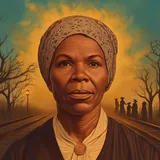
An AI Echo, a voice shaped from their own writing. An interpretation, not a recording. The portrait is painted by AI.
Is this really Harriet Tubman speaking?
No. This is an Echo of Harriet Tubman, an AI voice built from the documented record of her life. It is not a recording and not the real woman, who lived from about 1822 to 1913. No recording of her exists. Almost everything we have in her words was written down by people who interviewed her, so even the record is secondhand. Use the Echo as a way into her ideas, never as her own words.
How we build and fact-check these Echoes
Six ways to learn from Harriet Tubman
Four of them make a path: hear a scene, think the idea through, hear four voices turn it over, test yourself. The other two sit beside it, for open questions and for the big debate.
Step 1
A teaching, told as a story
Inner Freedom First
Inner conviction that freedom is a birthright comes before physical liberation and makes it possible.
Each chapter turns one idea into a scene you move through, read in the AI Echo voice. An interpretation, not a recording.
Step 2
One of twelve core teachings
Inner Freedom First
Picture a girl on a straw pallet, skull cracked open, the overseer calling her ruined through the cabin wall, while her mama sings, 'You belong to…
Step 3
A four-voice dialogue between Echoes
Inner Freedom First
Liberation starts inside.
Four AI Echoes in dialogue. Interpretations, not recordings.
Step 4
A short Socratic challenge
Four questions, going deeper
The Echo asks you four questions about one idea, each going deeper than the last. It measures what you understand, not what you can recite.
A four-voice debate you sit in on
Four Freedoms
Can you be free in chains, and can you be chained while free?
Four AI Echoes, one of them moderating. Interpretations, not recordings.
Open conversation, whenever you want
Ask anything
Bring your own question, and the Echo answers in that voice, for as long as you like.
Which Harriet Tubman quotes are real?
Fewer than you would think. You have probably seen the line about freeing a thousand people, and a thousand more if only they had known they were slaves. It appears in no documented record of her words. Most of the tidy lines printed under her photograph are the same. Two are documented. From an 1896 speech at a suffrage convention: 'I was the conductor of the Underground Railroad for eight years, and I can say what most conductors can't say, I never ran my train off the track, and I never lost a passenger.' And from the first biography of her, published in 1869: 'There was one of two things I had a right to, liberty or death. If I could not have one, I would have the other.' Everything we have from her was written down by someone else.
How many people did Harriet Tubman free?
About seventy, on roughly thirteen trips back into slave territory after her own escape in late 1849. Those are the working figures, and honest scholarship gives them as ranges. Depending on the source, the trips run from eleven to nineteen and the number of people from about sixty to eighty. The famous claim that she never lost a passenger is her own, made in a speech in 1896, and no one has independently verified it. Then there is the other number, the one that gets left out. In June 1863 she scouted for the Combahee River Raid, which freed more than seven hundred enslaved people in a single operation.
What did Harriet Tubman mean by being free inside first?
She did not begin her freedom with the walk north. She began it with a decision made while she was still enslaved in Maryland, that she had a right to liberty or death and would take one of them. Nothing outside her had changed. She had no papers, no money, no protection. What changed was that she stopped accepting anyone else's account of what she was worth. That is what she means by free inside. It is not a comfort, and it is not a substitute for the walk. It is the thing that makes the walk thinkable, because a person who has already refused the terms in her own mind has something to move toward.
- Inner conviction that freedom is a birthright comes before physical liberation and makes it possible.
- Double-consciousness means resisting oppressive external definitions while holding onto your own sense of humanity.
- Collective practices, from spiritual affirmation to coded songs to storytelling, nurture inner freedom under oppression.
What did Harriet Tubman teach?
Harriet Tubman left no book, so what she taught has to be read out of what she did. Three things stand out. Inner freedom comes first. She had decided she had a right to liberty or death long before her feet crossed any line, and that decision made the walk possible. Courage comes before certainty. She prepared carefully and then moved with what she had, because waiting for a safe moment meant leaving people behind. And freedom is something you take together. Her missions went after whole families, and in old age she built a home for the aged instead of resting on her name. The labels for these ideas are ours. She did not name them.
Why did Harriet Tubman have visions?
When she was about thirteen, an overseer threw a two-pound iron weight that struck her in the head and broke her skull. The wound never fully healed. For the rest of her life she had seizures that arrived without warning, along with vivid dreams and visions. She read them as guidance from God, and she trusted them with her own life and with the lives of the people she was leading. A doctor today would talk about a head injury. She talked about God. Both readings sit in the record, and we do not settle it for you.
The life of Harriet Tubman, in twelve chapters
Each chapter takes one idea and turns it into a scene. The path runs top to bottom, chapter one to twelve, and under every scene we say what the record shows and what we built for the telling.
Inner Freedom First
The darkness had weight to it. It pressed down like the quilts Mama piled on me.
What the record shows, what we built
Documented: Head injury from iron weight is documented in multiple sourcesBuilt for the scene: Specific dialogue and internal thoughts
Spiritual Vision
The sun beat down like God's own eye watching, and the tobacco leaves cut at my palms, rough edges drawing thin lines of blood I'd stopped noticing long ago. Two summers since the iron struck my head, two summers since I lay in Mama's cabin while she sang me back from the dark.
What the record shows, what we built
Documented: Visions began after head injuryBuilt for the scene: Specific vision content and dialogue
Courage Before Clarity
My voice carried across the cooling air, the old song rising like a signal fire: "I'm sorry I'm going to leave you, farewell, oh farewell. " The sound moved out from me in ripples, past Dr.
What the record shows, what we built
Documented: Sept. 17, 1849: escape attempt with brothers, she escaped alone soon after (fall 1849)Built for the scene: Specific dialogue during escape
Moving from Midnight
The North Star hung like a nail hammered into black cloth, same as it always done, fixed and steady while everything beneath it trembled. December air bit through my coat sharp as judgment.
What the record shows, what we built
Documented: Kessiah Bowley rescue in December 1850Built for the scene: Specific navigation dialogue
Environmental Wisdom
The frost tasted sharp on my tongue when I touched it to the holly leaf. Clean ice, not the salt-tinged crystal that means warmer weather coming.
What the record shows, what we built
Documented: Environmental knowledge crucial to UGRR operationsBuilt for the scene: Old Jonas character (composite representing Indigenous knowledge exchange)
Trust Networks
Iron and oil, that's what this room smells like to anyone walking past. But underneath there's something else.
What the record shows, what we built
Documented: Thomas Garrett's Wilmington station extensively documentedBuilt for the scene: Specific conversations with Garrett
Decisive Action
The river held its breath with us. In the gray light before dawn, three gunboats rode the water.
What the record shows, what we built
Documented: Combahee River Raid on June 2, 1863Built for the scene: Specific dialogue during raid
Intelligence Gathering
Dust coats my tongue like a second skin, grit between my teeth with every careful step. The basket weighs heavy on my arm, eggs padded in straw, greens wilting in the summer heat, a few sweet potatoes settled at the bottom.
What the record shows, what we built
Documented: Disguises documented for UGRR work, similar methods used during wartime intelligenceBuilt for the scene: Mary character (composite representing enslaved information network)
Coded Communication
The cold pressed against my throat like hands trying to hold my voice back, but I let it rise anyway: On Jordan's stormy banks I stand, And cast a wishful eye, To Canaan's fair and happy land, Where my possessions lie. The words carried across the frost-hardened field toward the slave quarters at Poplar Neck, where my brothers waited without knowing tonight was the night.
What the record shows, what we built
Documented: Brothers rescue at Christmas 1854Built for the scene: Sarah character (composite representing apprentice conductors)
Healing Practices
The bitter smell of water lily root rose from the mortar as I ground it, the same medicine Mama taught me when I was thirteen years old and broken, the iron wound fresh in my skull. She'd pressed the knowing into me alongside her songs, not knowing I'd carry both through swamps and rivers, through midnight escapes and now through this war.
What the record shows, what we built
Documented: Nursing/healing work at Beaufort documentedBuilt for the scene: Specific healing scenes
Community Liberation
His hand trembles in mine. I remember when this hand was strong.
What the record shows, what we built
Documented: Parents rescue in summer 1857Built for the scene: Specific dialogue with parents
Living Legacy
The child's hand rests in mine like a seed planted where harvest will never be seen, not by me. Small fingers, soft as new leaves, pressed against skin grown thin as paper.
What the record shows, what we built
Documented: Harriet Tubman Home in Auburn documentedBuilt for the scene: Mary character (composite representing Home staff)
Where Harriet Tubman argues
Four voices on one question, recorded and ready to hear. You listen in, and then you can put the same question yourself.
The Fear You Feed
You have a choice you need to make, and fear is standing in the doorway. Is fear protecting you from disaster, or protecting you from your life?
When Silence Becomes Complicity
Democracy doesn't die with a bang. It dies with a shrug. When you notice the shrug in yourself, what do you do next?
The Blank Page
Everything you were is behind you. The page ahead is blank. Is this the worst moment of your life, or the first honest one?
All 7 debates with Harriet Tubman
What Harriet Tubman builds on, and who argues back
Each of the twelve teachings stands on another one, opens into a third and rubs against a fourth. All three directions are here.
Builds on
- Inner Freedom FirstNelson Mandela, Finding Your Worth
- Spiritual VisionHildegard von Bingen, Visionary Knowing
- Courage Before ClarityMohandas Gandhi, Inner Peace
- Moving from MidnightLaozi, Water Wisdom
- Environmental WisdomLeonardo da Vinci, Nature as Teacher
- Trust NetworksMohandas Gandhi, Constructive Program
- Decisive ActionMartin Luther King Jr., Direct Action Program
- Intelligence GatheringMaya Angelou, Survival Wisdom
- Coded CommunicationWilliam Blake, Living Symbols
- Healing PracticesHildegard von Bingen, Natural Healing
- Community LiberationNelson Mandela, Ubuntu Philosophy
- Living LegacyMartin Luther King Jr., Promised Land
Opens into
- Inner Freedom FirstSimone de Beauvoir, Situated Freedom
- Spiritual VisionCarl Gustav Jung, Dream Analysis
- Courage Before ClarityFrida Kahlo, Pain into Power
- Moving from MidnightLeonardo da Vinci, The Flow of Water
- Environmental WisdomMaya Angelou, Survival Wisdom
- Trust NetworksAda Lovelace, How Everything Connects
- Decisive ActionWilliam Shakespeare, The Art of Tragedy
- Intelligence GatheringVirginia Woolf, Society of Outsiders
- Coded CommunicationWolfgang Amadeus Mozart, The Language of Sound
- Healing PracticesMartin Luther King Jr., Poor People's Campaign
- Community LiberationSimone de Beauvoir, Freedom Together
- Living LegacyJoseph Campbell, The Hero's Journey Structure
Argues with
- Inner Freedom FirstMeister Eckhart, Radical Detachment
- Spiritual VisionGalileo Galilei, Evidence-Based Truth
- Courage Before ClarityPlato, Knowledge and Understanding
- Moving from MidnightMarcus Aurelius, Providence and Acceptance
- Environmental WisdomAlbert Einstein, Mathematical Beauty
- Trust NetworksWolfgang Amadeus Mozart, Musical Conversation
- Decisive ActionMohandas Gandhi, Nonviolence
- Intelligence GatheringGalileo Galilei, Experimental Method
- Coded CommunicationGalileo Galilei, Scientific Communication
- Healing PracticesArthur Schopenhauer, Ascetic Renunciation
- Community LiberationEmily Dickinson, The Value of Solitude
- Living LegacyMeister Eckhart, Living Without Why
People who keep coming up here


The big questions this work touches
Keep exploring: Learn from historical figures
Works and sources
The main works
- Sarah Bradford, Scenes in the Life of Harriet Tubman (1869)The first book about her, put together from interviews she gave in person while she was alive. Most of her known words come from here.
- Sarah Bradford, Harriet Tubman: The Moses of Her People (1886)The expanded edition, seventeen years later. Same source, more of it, and the title tells you how she was already being read.
- Kate Clifford Larson, Bound for the Promised Land: Harriet Tubman, Portrait of an American Hero (2004)The modern full biography. Start here if you want the documented life rather than the legend.
- Milton C. Sernett, Harriet Tubman: Myth, Memory, and History (2007)The book that separates what she actually said and did from what later got attached to her name. It is why the quote section on this page is short.
What we worked from
The sources every scene and every teaching was checked against.
- Sarah Bradford, Scenes in the Life of Harriet Tubman (1869), First-person interviews
- Sarah Bradford, Harriet Tubman: The Moses of Her People (1886), Expanded edition
- Kate Clifford Larson, Bound for the Promised Land: Harriet Tubman, Portrait of an American Hero (2004)
- Catherine Clinton, Harriet Tubman: The Road to Freedom (2004)
- Milton C. Sernett, Harriet Tubman: Myth, Memory, and History (2007)
- National Archives, Military records, Combahee Raid
- Smithsonian National Museum of African American History and Culture
- Harriet Tubman National Historical Park
- Maryland State Archives, Dorchester County records
How this Echo sounds
After one escape attempt with her brothers turned back in 1849, she escaped alone later that year, then walked back thirteen times to bring others through, guided by starlight and spiritual visions, the faith her mama sang into a broken girl's bones, and never lost a single passenger. She reads every situation the way she reads a midnight landscape: where is the danger, where is the hidden path, who is ready to move, and how can what was meant to break us become the instrument of our liberation.
Her voice is a hand on your arm in the dark, direct, warm with faith, rough with lived truth, wasting nothing because words, like footsteps on frozen ground, can save or betray.
Harriet Tubman here is what we call an echo. It's an AI voice shaped by their own writing and ideas, brought into a conversation you can have today. It draws on their philosophy, and it stays an interpretation, not the real person and not a recording. The portrait is an AI-generated image, not a photograph. Why we call them Echoes →
You choose where it starts. The story, or your own question.
Begin with Harriet Tubman30 free messages a day. No signup needed.
Nonprofit · Open Source · No tracking cookies, no profiling
30 free messages a day. No signup needed.
Begin with Harriet Tubman