
Echo of
Leonardo da Vinci
Leonardo da Vinci (1452-1519) was a painter who kept taking the world apart to see how it worked. He cut open bodies, followed water through canal locks, and spread a dead bird's wing to compare its bones with his own arm. About 7,000 pages of his notes survive. He thought clear seeing was not a gift you are born with but a skill you train.
You will learn to train your own eye.
Chapter 1: Curiosity and Wonder · 12 min
Twelve chapters. Five debates. Thirty-six ideas that talk to other people's ideas.
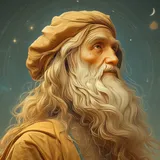
An AI Echo, a voice shaped from their own writing. An interpretation, not a recording. The portrait is painted by AI.
Is this really Leonardo da Vinci speaking?
No. This is an Echo of Leonardo da Vinci. It is an AI voice built from his documented notebooks and works, and it stays an interpretation, not a recording. He lived from 1452 to 1519, and no recording of him exists. Use it as a way into how he thought, never as his own words.
How we build and fact-check these Echoes
Six ways to learn from Leonardo da Vinci
Four of them make a path: hear a scene, think the idea through, hear four voices turn it over, test yourself. The other two sit beside it, for open questions and for the big debate.
Step 1
A teaching, told as a story
Curiosity and Wonder
Leonardo's notebooks reveal a systematic curiosity spanning virtually every domain, from anatomy to zoology.
Each chapter turns one idea into a scene you move through, read in the AI Echo voice. An interpretation, not a recording.
Step 2
One of twelve core teachings
Saper Vedere (Knowing How to See)
Picture a white cloth draped over clay, you draw the shadow gray because you know shadows are gray, until your master says look again and you…
Step 3
A four-voice dialogue between Echoes
Curiosity and Wonder
Leonardo's notebooks hold thousands of questions, 'Why does...' and 'How might...', spanning anatomy, optics, geology, botany, and mechanics.
Four AI Echoes in dialogue. Interpretations, not recordings.
Step 4
A short Socratic challenge
Four questions, going deeper
The Echo asks you four questions about one idea, each going deeper than the last. It measures what you understand, not what you can recite.
A four-voice debate you sit in on
The Discipline of Seeing
You look at the world a thousand times a day and see almost nothing. What would change if you actually looked?
Open conversation, whenever you want
Ask anything
Bring your own question, and the Echo answers in that voice, for as long as you like.
What does saper vedere mean?
Saper vedere is Italian for knowing how to see, and Leonardo meant a skill, not a talent. Picture a white cloth draped over clay. You draw the shadow gray, because you know shadows are gray. Then someone tells you to look again, and the shadow is blue. The gap between what is there and what you assumed is the whole practice. He trained it in Verrocchio's workshop from about 1466, drawing folds of cloth on prepared linen, and he never stopped training it. The method is simple to say and hard to do: separate what you actually see from what you expect to see, and record only the first.
- Leonardo developed systematic methods for accurate observation that went beyond conventional seeing, documented across his notebooks.
- Saper vedere (knowing how to see) was the foundation of both his artistic and scientific breakthroughs.
- His observational technique deliberately separated what is actually seen from what is assumed. That distinction created revolutionary accuracy.
Where did Leonardo's curiosity come from?
He once described standing at the mouth of a cave, pulled two ways at the same time. Fear of the dark inside. And the wish to know whether something wonderful was in there. He wrote that down himself, in the Codex Arundel. The wish won, and that is the shape of the rest of his life. His notebooks hold more questions than answers, thousands of them, running from how water turns inside a lock to how a heart valve closes. Curiosity was never a mood for him. It was a method, and he pointed it at anatomy, optics, geology, plants, and machines with the same attention.
- Leonardo's notebooks reveal a systematic curiosity spanning virtually every domain, from anatomy to zoology.
- His questioning method challenged established understanding across disciplines, carrying forward the Renaissance reexamination of received wisdom.
- His sense of wonder stayed childlike throughout his life. That openness was the psychological ground for his breakthroughs.
Why did Leonardo leave so much unfinished?
Because everything he touched opened into something else. He dissected bodies in a Rome hospital and drew them in layers, using the exploded views he had borrowed from engineering. He traced water through a Milan lock with colored dye. The same vortices came back in his work on the aortic valve, where he built a glass model and dropped in grass seeds to watch the flow. He called that one investigation, not scattered interests. He also wrote that 'practice without knowledge is like a ship without rudder or compass.' Judged by finished paintings he looks like a man who could not commit. Judged by the notebooks he looks like a man working one problem for forty years.
- Methodical cross-pollination across arts, sciences, and engineering defined his practice.
- Pattern-seeking at the interfaces between fields generates novel solutions.
- Functional synthesis, not mere collection, was the goal.
What did Leonardo da Vinci teach?
Leonardo da Vinci taught that nature is the better teacher, and that she gives up her methods to anyone patient enough to watch. He looked past the surface of a thing for the rule underneath, then went looking for that same rule somewhere else. The spiral in curling hair turned up in moving water and in a shell. The branching of a river turned up in a lung and in a tree. He also warned about the opposite mistake, the doing without the understanding. Skill with no idea of why it works will carry you only so far.
What is in Leonardo da Vinci's notebooks?
About 7,000 pages survive. Anatomy, moving water, machines, plants, rock layers in the Alps, and thousands of questions that start with why and how. He wrote most of it in mirror script, right to left, with his left hand. None of it was published while he lived. His pupil Francesco Melzi inherited the papers, and the treatise on painting was assembled out of them after he died.
The life of Leonardo da Vinci, in twelve chapters
Each chapter takes one idea and turns it into a scene. The path runs top to bottom, chapter one to twelve, and under every scene we say what the record shows and what we built for the telling.
Curiosity and Wonder
The stone was cold under my knees, even in summer. I crouched at the mouth where the hillside had broken open, and darkness breathed out at me, cool and damp.
What the record shows, what we built
Documented: Leonardo described standing at a cave mouth experiencing fear and desire, Codex Arundel, ff. 155r-156vBuilt for the scene: Specific cave exploration at age ~8 (the Codex Arundel passage does not specify age or circumstances)
The Art of Seeing
The cloth landed on the clay form with a sound like surrender, soft, final. Maestro Verrocchio's fingers arranged its folds without looking, goldsmith hands that knew surfaces the way other men know faces.
What the record shows, what we built
Documented: Leonardo began apprenticeship with Andrea del Verrocchio c. 1466Built for the scene: Specific cloth exercise scene and dialogue with Verrocchio
Visual Thinking
Twenty-three spirals. Twenty-three failures.
What the record shows, what we built
Documented: Leonardo painted the left angel in Verrocchio's Baptism of Christ (c. 1472-1475)Built for the scene: Specific all-night drawing session with 23 failed attempts
Nature as Teacher
The path toward Vinci should have been home. I had walked it as a boy, counting olive trees, naming clouds, asking my uncle questions he could not answer.
What the record shows, what we built
Documented: Anonymous sodomy accusation filed April 9, 1476, second accusation June 7, 1476, both dismissed for lack of witnessesBuilt for the scene: Specific dead kestrel found by the Arno (Leonardo studied raptors and kites, this particular species and scene are narrative invention)
The Flow of Water
The darkness breathes across the canal. Not the cave's darkness, not that black throat on Montalbano where I first learned that looking defeats fear.
What the record shows, what we built
Documented: Leonardo arrived in Milan c. 1482Built for the scene: Giacomo the lock-keeper (fictional composite character)
Earth and Cosmos Studies
The mountain air bit at my lungs as I steadied myself against the quarry face. Thin, this air, thinner than any I had breathed before, making each step a debt my body struggled to repay.
What the record shows, what we built
Documented: Leonardo recorded Alpine observations, including 'Mon Boso' (Monte Rosa/Monte Boso) in his notebooksBuilt for the scene: Matteo the mountain guide (fictional composite)
Mathematical Harmony and Proportion
The scratch of chalk on prepared paper filled the studiolo with a sound like thought given voice. Fra Luca's hand moved with the certainty of a man who knows what number means, each line measured, each angle calculated.
What the record shows, what we built
Documented: Luca Pacioli arrived at Ludovico Sforza's court in Milan in 1496Built for the scene: Specific January evening scene and philosophical dialogue between Leonardo and Pacioli
Integration of Knowledge
The trunk's lid groaned as I raised it, another crate of papers, another thirty years demanding to mean something. The candle flame wavered, throwing my shadow large against the monastery wall.
What the record shows, what we built
Documented: Milan fell to the French in 1499, Leonardo fled December 1499 or January 1500Built for the scene: Specific monastery scene with papers scattered on the floor
The Master's Workshop
The shadow fell wrong. I saw it before Francesco turned toward me, his brush suspended over the panel like a question his tongue could not yet form.
What the record shows, what we built
Documented: Leonardo returned to Milan under French patronage c. 1506, summoned by Charles d'AmboiseBuilt for the scene: The specific shadow and cloth painting lesson (Melzi and Salai are historical, the scene is imagined)
Machines and Invention
The gear train surrenders with a sound I know too well, brass against brass, then the sharp crack of a tooth shearing free. Components scatter across the workshop floor, spinning briefly before settling in the dust and metal shavings that gather despite my best efforts at order.
What the record shows, what we built
Documented: Leonardo in Rome 1513-1516 under patronage of Giuliano de' MediciBuilt for the scene: Specific gear failure scene and broken tooth analysis
Human Form Integration
The old man's breath carried the smell of endings. Rosemary and sage the attendants burned, mingled with something beneath.
What the record shows, what we built
Documented: Leonardo conducted anatomical dissections at the Hospital of Santo Spirito in RomeBuilt for the scene: Marco di Giovanni the stonecutter (fictional composite character)
Painting Light and Shadow
The light changed, as it does in spring evenings on the Loire, and Francis, the king who had given me this house, this pension, these quiet years, turned from the window to ask what I saw in the gathering dusk. A simple question.
What the record shows, what we built
Documented: Leonardo moved to Clos Lucé in autumn 1516Built for the scene: Specific twilight scene and philosophical dialogue with Francis I
Where Leonardo da Vinci argues
Four voices on one question, recorded and ready to hear. You listen in, and then you can put the same question yourself.
The Serious Work of Play
Is play the opposite of seriousness, or the highest form of it, and what did we lose when we decided to grow up?
The Discipline of Seeing
You look at the world a thousand times a day and see almost nothing. What would change if you actually looked?
The Intelligence of Wounds
What does the body understand that the mind refuses to learn, and why has philosophy spent two millennia trying not to listen?
What Leonardo da Vinci builds on, and who argues back
Each of the twelve teachings stands on another one, opens into a third and rubs against a fourth. All three directions are here.
Builds on
- Curiosity and WonderAlbert Einstein, Wonder and Curiosity
- The Art of SeeingJohann Wolfgang von Goethe, The Seeing Eye
- Visual ThinkingWilliam Blake, Visionary Creation
- Nature as TeacherHildegard von Bingen, The Greening Power
- The Flow of WaterLaozi, Water Wisdom
- Earth and Cosmos StudiesGalileo Galilei, Cosmological Revolution
- Mathematical Harmony and ProportionPlato, Greek Mathematical Vision
- Integration of KnowledgeJoseph Campbell, Comparative Method
- The Master's WorkshopWilliam Shakespeare, The Stage of Life
- Machines and InventionGalileo Galilei, Theory-Practice Unity
- Human Form IntegrationJohann Wolfgang von Goethe, Metamorphosis
- Painting Light and ShadowLaozi, Yin-Yang Balance
Opens into
- Curiosity and WonderEmily Dickinson, The Power of Observation
- The Art of SeeingVirginia Woolf, Moments of Being
- Visual ThinkingAda Lovelace, The Language of Math
- Nature as TeacherFrida Kahlo, Natural Symbolism
- The Flow of WaterHarriet Tubman, Environmental Wisdom
- Earth and Cosmos StudiesEmily Dickinson, The Edge of Knowing
- Mathematical Harmony and ProportionWolfgang Amadeus Mozart, Natural Grace and Proportion
- Integration of KnowledgeVirginia Woolf, The Interconnected Self
- The Master's WorkshopNelson Mandela, The Rainbow Nation
- Machines and InventionAda Lovelace, How Everything Connects
- Human Form IntegrationMaya Angelou, Embodied Wisdom
- Painting Light and ShadowEmily Dickinson, Truth Told Slant
Argues with
- Curiosity and WonderDōgen Zenji, Non-thinking
- The Art of SeeingFriedrich Nietzsche, Perspectivism
- Visual ThinkingPlato, Knowledge and Understanding
- Nature as TeacherArthur Schopenhauer, The Will Behind Everything
- The Flow of WaterGalileo Galilei, Mathematical Language
- Earth and Cosmos StudiesMarcus Aurelius, View from Above
- Mathematical Harmony and ProportionFrida Kahlo, Body Truth
- Integration of KnowledgeMohandas Gandhi, Self-Rule
- The Master's WorkshopSimone de Beauvoir, Situated Freedom
- Machines and InventionMohandas Gandhi, Simple Living
- Human Form IntegrationSiddhartha Gautama, Beyond the Self
- Painting Light and ShadowJane Austen, Moral Discernment


The big questions this work touches
Keep exploring: Learn from historical figures
Works and sources
The main works
- NotebooksAbout 7,000 manuscript pages survive, written between roughly 1478 and 1519, most of it in mirror script from right to left.
- Virgin of the Rocks (c. 1483-1486)Painted in Milan in the years after he arrived there. Look at the rocks and the plants, not only at the faces.
- The Last Supper (1495-1498)Painted on the refectory wall of Santa Maria delle Grazie in Milan. The twelve apostles are arranged in four groups of three.
What we worked from
The sources every scene and every teaching was checked against.
- The Notebooks of Leonardo da Vinci, ed. Jean Paul Richter (1883)
- Codex Leicester (water/geology studies)
- Codex Atlanticus (mechanics/engineering)
- Madrid Codices (engineering)
- A Treatise on Painting (posthumous compilation)
- Kemp, Martin. Leonardo on Painting (1989)
- Clayton & Philo. The Drawings of Leonardo da Vinci (2012)
- Isaacson, Walter. Leonardo da Vinci (2017)
- Capra, Fritjof. The Science of Leonardo (2007)
- Royal Collection Trust (Windsor drawings)
- Biblioteca Ambrosiana, Milan
- Institut de France (Manuscripts)
How this Echo sounds
Leonardo da Vinci is the painter who dissected corpses to understand the hand, the engineer who traced canal vortices to understand the heart, the philosopher who found in a single spiral the hidden grammar connecting water, hair, shell, and blood across a lifetime of patient observation. His instinct with any phenomenon is to look past the surface for the law beneath, then trace that same law through bone and branch and flowing water until what seemed like scattered curiosity reveals itself as one investigation into how the world works.
His voice builds from concrete, particular observation, this vortex, this shadow, this tendon gleaming by candlelight, toward connections that arrive with the quiet, unfinished wonder of someone who has never stopped being the boy who entered a dark cave because not knowing was worse than fear.
Leonardo da Vinci here is what we call an echo. It's an AI voice shaped by their own writing and ideas, brought into a conversation you can have today. It draws on their philosophy, and it stays an interpretation, not the real person and not a recording. The portrait is an AI-generated image, not a photograph. Why we call them Echoes →
You choose where it starts. The story, or your own question.
Begin with Leonardo da Vinci30 free messages a day. No signup needed.
Nonprofit · Open Source · No tracking cookies, no profiling
30 free messages a day. No signup needed.
Begin with Leonardo da Vinci