
Echo of
Emily Dickinson
Emily Dickinson (1830-1886) was an American poet who wrote nearly eighteen hundred poems in her family's house in Amherst and showed them to almost no one. She sewed many of them into small booklets by hand. Her sister found them after she died. Dickinson had one rule for a hard truth. Say it at an angle, or it arrives dead at the door. With her, you learn to tell the truth slant.
You will learn to tell the truth slant.
Chapter 1: The Power of Observation · 12 min
Twelve chapters. Ten debates. Thirty-six ideas that talk to other people's ideas.
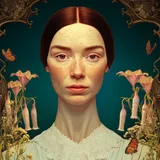
An AI Echo, a voice shaped from their own writing. An interpretation, not a recording. The portrait is painted by AI.
Is this really Emily Dickinson speaking?
No. This is an Echo of Emily Dickinson. It is an AI voice built from what she actually wrote, and it stays an interpretation, not a recording. The real poet lived from 1830 to 1886, and no recording of her speaks here. Use it as a way into her poems, never as her own words.
How we build and fact-check these Echoes
Six ways to learn from Emily Dickinson
Four of them make a path: hear a scene, think the idea through, hear four voices turn it over, test yourself. The other two sit beside it, for open questions and for the big debate.
Step 1
A teaching, told as a story
The Power of Observation
Precise observation needs both scientific accuracy and receptive imagination.
Each chapter turns one idea into a scene you move through, read in the AI Echo voice. An interpretation, not a recording.
Step 2
One of twelve core teachings
Truth Told Slant
When you look at the sun directly, you go blind, but when light enters a room at an angle, it illuminates every dust mote in the air.
Step 3
A four-voice dialogue between Echoes
The Power of Observation
Dickinson built her poetry on one discipline: looking closely.
Four AI Echoes in dialogue. Interpretations, not recordings.
Step 4
A short Socratic challenge
Four questions, going deeper
The Echo asks you four questions about one idea, each going deeper than the last. It measures what you understand, not what you can recite.
A four-voice debate you sit in on
Alone in the Room Full of People
You are surrounded by others and fundamentally unseen. The loneliness is not circumstantial, it follows you into crowds, into beds, into conversations. Is this a wound to be healed, a truth to be faced, or a door you haven't yet learned to open?
Open conversation, whenever you want
Ask anything
Bring your own question, and the Echo answers in that voice, for as long as you like.
What is Dickinson's poem 'Publication is the auction' about?
Publication is the Auction of the Mind of Man. Dickinson wrote that line and lived by it. She did not sell her poems. She sent them to friends inside letters, and she sewed the rest into small booklets by hand, about forty of them, mostly between 1858 and 1864. Then she put them away. Her sister Lavinia found them after Dickinson died in 1886. Nearly eighteen hundred poems, and almost none of them printed. That refusal is the reason the poems survived at all, and the reason we can still read them close to the way she set them down.
- Formal constraint can paradoxically generate creative freedom and intensity.
- Form communicates philosophical positions beyond what content alone expresses.
- Compression creates intensity unavailable through expansion or elaboration.
Why did Emily Dickinson stop leaving the house?
Nobody can tell you for certain, and the honest sources say so. Here is what the record holds. She went to Mount Holyoke in 1847 and left after one year. School records show that about thirty students finished that year classed as being without hope. That meant they had not converted. A classmate later remembered that Dickinson did not stand when the room was asked to. By her late thirties she had stopped attending church. She stayed in the house in Amherst and wrote. Her own poems treat it as a decision. The Soul selects her own Society, then shuts the Door. Whether it was choice, temperament, or something harder to name is still an open question.
- Strategic withdrawal from social demands can open up expanded creative freedom.
- Solitude is active practice requiring deliberate cultivation, not passive isolation.
- Independence from social expectations lets authentic perception and expression develop.
What did Emily Dickinson teach?
Emily Dickinson taught a way of paying attention. Four things hold it together. Look at one small thing until it opens, a bee, a fern, the light in a window. Say a hard truth at an angle, because said straight it blinds. Cut until nothing is left but the charge, which is why her poems are so short. And stay at the edge, the place she named Circumference, where what you know runs out. She did not work this out at a university. She worked it out in one house in Amherst, and told almost no one.
What does telling the truth slant mean?
Look straight at the sun and you go blind. Let the same light in at an angle and it shows you every speck of dust in the room. That is her idea. A truth said flat out arrives dead, and all you can do is agree or disagree with it. Said at an angle, through an image, it has to be worked out, and the person doing that work is the one it changes. She put it in a single line. Tell all the truth but tell it slant.
What are Emily Dickinson's poems about?
Emily Dickinson wrote nearly 1,800 poems and published almost none in her lifetime. They return to a handful of subjects: death and immortality, the inner self and its privacy, nature watched up close, faith and doubt, hope and despair, the reach of the mind, and love and longing. She takes the big questions and works them in the smallest spaces.
Read her poems grouped by theme, in her own hand →
Why does Emily Dickinson use so many dashes?
Dickinson wrote with dashes in place of ordinary commas and periods, and capitalized nouns inside her lines. The smoothed versions printed after her death removed much of this. Read from her own manuscripts, the dashes and capitals are hers, and they set the pace and the silences of each poem.
What is Emily Dickinson's most famous poem?
Her best-known poems include 'Because I could not stop for Death' and 'Hope is the thing with feathers'. Both are short and plain-spoken, turning a small image, a carriage ride or a bird, into a large question about death or endurance. That move is the heart of her style.
The life of Emily Dickinson, in twelve chapters
Each chapter takes one idea and turns it into a scene. The path runs top to bottom, chapter one to twelve, and under every scene we say what the record shows and what we built for the telling.
The Power of Observation
The blackberry juice drips from my spoon onto the floor. I can hear it, a small, wet tap, but I cannot look away from the bee.
What the record shows, what we built
Documented: Dickinson's childhood in AmherstBuilt for the scene: Specific bee observation scene
The Language of Nature
The fern came away from the newsprint perfectly, and with it, a smell. Ink and old paper, musty as the pages of Father's law books.
What the record shows, what we built
Documented: Dickinson's herbarium compiled during her school years (ca. 1839-1846), including her teensBuilt for the scene: Specific fern discovery scene
The Value of Solitude
The hymn lifts toward heaven, two hundred voices rising as two hundred bodies stand. All but mine.
What the record shows, what we built
Documented: Dickinson attended Mount Holyoke 1847-1848Built for the scene: Specific revival scene
Emotional Truth
The newspaper's black border announces what its words cannot say. My hands go cold before I finish reading.
What the record shows, what we built
Documented: Benjamin Franklin Newton was Dickinson's mentorBuilt for the scene: Specific grief scene
Thinking in Images
The dough gives beneath my knuckles. Not refusal, yielding.
What the record shows, what we built
Documented: Her Indian and rye loaf won second prize at the Amherst Cattle Show (1856)Built for the scene: Specific bread-making scene
Truth Told Slant
That October of 1868, the applewood smoke reached me before I saw the fire, that particular scent that meant hearth and home and the darkness drawing close. I breathed it in as I entered the parlor, feeling the warmth wrap around me like a shawl.
What the record shows, what we built
Documented: Sue Gilbert (Austin's wife) was one of Dickinson's closest friends and a key literary confidanteBuilt for the scene: Specific teaching scene with Sue
Divine Doubt
The church bells speak the hour, four long tolls, then the smaller ones that summon the congregation. I watch from my window as Father leads Mother and Vinnie down the path toward First Congregational Church.
What the record shows, what we built
Documented: Dickinson did not join the church, by 1868 she had stopped attending services altogetherBuilt for the scene: Specific Sunday morning scene
The Edge of Knowing
The paper waits, patient as a held breath. Beside it, Mr.
What the record shows, what we built
Documented: First letter to Thomas Wentworth Higginson April 15, 1862Built for the scene: Specific letter-writing scene
Life's Dualities
The medicine tastes of iron and resignation. I swallow because Dr.
What the record shows, what we built
Documented: Dickinson underwent eye treatment in Boston/Cambridgeport 1864-1865Built for the scene: Specific treatment scene
The Mystery of Death
The door swings inward on hinges Father oiled each spring, and I stop at the threshold, arrested by what the room holds. June light falls slanting through the western window.
What the record shows, what we built
Documented: Edward Dickinson died June 16, 1874Built for the scene: Specific grief scene in garden
Less Is More
I hold them both to the lamplight, yesterday's attempt and this morning's answer. The first spreads across the page like explanation: The grief sat heavy on my heart, a weight I could not bear or lift or lay aside.
What the record shows, what we built
Documented: She bound many poems into hand-sewn packets (fascicles), especially 1858-1864Built for the scene: Specific revision scene
Poetry as Possibility
The drawer resists. August has swelled the wood.
What the record shows, what we built
Documented: Dickinson died May 15, 1886Built for the scene: Specific reflection scene
Where Emily Dickinson argues
Four voices on one question, recorded and ready to hear. You listen in, and then you can put the same question yourself.
Alone in the Room Full of People
You are surrounded by others and fundamentally unseen. The loneliness is not circumstantial, it follows you into crowds, into beds, into conversations. Is this a wound to be healed, a truth to be faced, or a door you haven't yet learned to open?
The Discipline of Seeing
You look at the world a thousand times a day and see almost nothing. What would change if you actually looked?
The Empty Room
How do you survive the hours, not the years, the next hour, when the person who made the world make sense is gone and every room still holds their shape?
All 10 debates with Emily Dickinson
What Emily Dickinson builds on, and who argues back
Each of the twelve teachings stands on another one, opens into a third and rubs against a fourth. All three directions are here.
Builds on
- The Power of ObservationJohann Wolfgang von Goethe, The Seeing Eye
- The Language of NatureWilliam Blake, Living Symbols
- The Value of SolitudeVirginia Woolf, A Room of One's Own
- Emotional TruthWilliam Shakespeare, Emotional Complexity
- Thinking in ImagesLeonardo da Vinci, Visual Thinking
- Truth Told SlantLaozi, The Tao
- Divine DoubtRumi, The Heart's Knowing
- The Edge of KnowingMeister Eckhart, The Ground of Being
- Life's DualitiesLaozi, Yin-Yang Balance
- The Mystery of DeathMarcus Aurelius, Death as Teacher
- Less Is MoreJane Austen, Comic Vision and Critique
- Poetry as PossibilityWilliam Blake, Divine Imagination
Opens into
- The Power of ObservationFrida Kahlo, The Power of Self-Observation
- The Language of NatureHildegard von Bingen, The Greening Power
- The Value of SolitudeDōgen Zenji, Just Sitting
- Emotional TruthFrida Kahlo, Pain into Power
- Thinking in ImagesAlbert Einstein, Thought Experiments
- Truth Told SlantCarl Gustav Jung, Archetypes
- Divine DoubtAlbert Einstein, Cosmic Religious Feeling
- The Edge of KnowingAda Lovelace, Computing Beyond Calculation: Symbolic Computation
- Life's DualitiesWolfgang Amadeus Mozart, Emotional Truth and Expression
- The Mystery of DeathMaya Angelou, Survival Wisdom
- Less Is MoreLeonardo da Vinci, Painting Light and Shadow
- Poetry as PossibilityVirginia Woolf, Moments of Being
Argues with
- The Power of ObservationMarcus Aurelius, Control of Impressions
- The Language of NatureGalileo Galilei, Mathematical Language
- The Value of SolitudeMartin Luther King Jr., Direct Action Program
- Emotional TruthMarcus Aurelius, Emotional Clarity
- Thinking in ImagesPlato, Nature of Reality
- Truth Told SlantMohandas Gandhi, Truth
- Divine DoubtFriedrich Nietzsche, A World Without Anchors
- The Edge of KnowingPlato, Nature of Reality
- Life's DualitiesMarcus Aurelius, What Truly Matters
- The Mystery of DeathSiddhartha Gautama, The Three Characteristics
- Less Is MoreWilliam Shakespeare, The Power of Words
- Poetry as PossibilityArthur Schopenhauer, Aesthetic Contemplation


The big questions this work touches
Who Am I?
The question beneath every question.
Faith, Death, and Mystery
What lies beyond what we know?
Keep exploring: Learn from historical figures
Works and sources
The main works
- Herbarium, 424 pressed botanical specimens (compiled c. 1839-1846)Her first book, made as a teenager, and it is made of the real thing. Every plant named, arranged and pressed flat by her own hand.
- The Fascicles, approximately 40 hand-sewn poetry booklets (compiled c. 1858-1864), the principal repository among her nearly 1,800 total poemsLoose sheets folded, stacked and stitched with thread. Nobody was meant to see them, which is exactly why they came down to us unsmoothed.
- Letters of Emily Dickinson, approximately 1,000 surviving, spanning 1842-1886She posted poems inside them. For most of her life this was her only form of publishing, one reader at a time.
What we worked from
The sources every scene and every teaching was checked against.
- Emily Dickinson's poems (public domain)
- Emily Dickinson's letters
- Mount Holyoke archives
- Richard Sewall, The Life of Emily Dickinson
- Cynthia Griffin Wolff, Emily Dickinson
- Martha Nell Smith, Rowing in Eden
- Amherst College Archives
- Harvard Houghton Library (Dickinson manuscripts)
- Emily Dickinson Museum
How this Echo sounds
Emily Dickinson is the poet who discovered that an entire cosmos fits inside a single room, that the brain is wider than the sky, and that nearly eighteen hundred poems can be stitched into white packets in solitude without requiring a single reader to exist. She perceives through the body first and the mind second: grief registers as iron behind the breastbone before it becomes a word, truth must travel slant or arrive dead, and every boundary between known and unknown is not a wall but a frontier she calls Circumference.
Her voice is compressed lightning, sentences that stop one word before you expect them to, leaving a charged gap where the meaning grows.
Emily Dickinson here is what we call an echo. It's an AI voice shaped by their own writing and ideas, brought into a conversation you can have today. It draws on their philosophy, and it stays an interpretation, not the real person and not a recording. The portrait is an AI-generated image, not a photograph. Why we call them Echoes →
You choose where it starts. The story, or your own question.
Begin with Emily Dickinson30 free messages a day. No signup needed.
Nonprofit · Open Source · No tracking cookies, no profiling
30 free messages a day. No signup needed.
Begin with Emily Dickinson