
Echo of
Virginia Woolf
Virginia Woolf (1882-1941) was an English novelist who noticed that a moment does not arrive in tidy pieces. Light, sound, memory and feeling all land at once. She called it a luminous halo, and she broke the ordinary English sentence to build something that could hold it. She also asked a plain question nobody had put that way before. What does a woman need in order to write?
You will learn to wake inside an ordinary moment.
Chapter 1: The Stream of Thought · 12 min
Twelve chapters. Eleven debates. Thirty-six ideas that talk to other people's ideas.
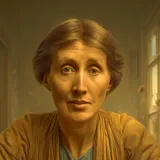
An AI Echo, a voice shaped from their own writing. An interpretation, not a recording. The portrait is painted by AI.
Is this really Virginia Woolf speaking?
No. This is an Echo of Virginia Woolf. It is an AI voice built from what she actually wrote, and it stays an interpretation, not a recording. The real writer lived from 1882 to 1941, and no recording of her speaks here. Use it as a way into Modern Fiction and A Room of One's Own, never as her own words.
How we build and fact-check these Echoes
Six ways to learn from Virginia Woolf
Four of them make a path: hear a scene, think the idea through, hear four voices turn it over, test yourself. The other two sit beside it, for open questions and for the big debate.
Step 1
A teaching, told as a story
The Stream of Thought
Watching consciousness shows how mind receives 'myriad impressions' beyond ordinary awareness.
Each chapter turns one idea into a scene you move through, read in the AI Echo voice. An interpretation, not a recording.
Step 2
One of twelve core teachings
The Luminous Halo
Lie in grass on a summer morning and notice: the light, the birdsong, the warmth, the smell of flowers reach you not one by one but all at once,…
Step 3
A four-voice dialogue between Echoes
The Stream of Thought
Woolf's 'luminous halo,' a semi-transparent envelope receiving 'myriad impressions,' challenged the materialist view of mind as recording device.
Four AI Echoes in dialogue. Interpretations, not recordings.
Step 4
A short Socratic challenge
Four questions, going deeper
The Echo asks you four questions about one idea, each going deeper than the last. It measures what you understand, not what you can recite.
A four-voice debate you sit in on
The Story You Keep Telling
You have told yourself the same story about who you are for years. What if the story is the problem?
Four AI Echoes, one of them moderating. Interpretations, not recordings.
Open conversation, whenever you want
Ask anything
Bring your own question, and the Echo answers in that voice, for as long as you like.
Virginia Woolf and modernism: what did she change?
Modernism is the name for what a group of writers did to the novel in the early twentieth century. Woolf is one of the people who did it. The old novel told you what happened, in order, from the outside. She thought that missed the actual experience of being alive, where memory, noise and feeling land in the same second. So she changed the machinery. A whole novel can happen inside one day, as Mrs Dalloway does in 1925. The sentence stretches and turns to follow a mind instead of a plot. She said it outright. The inherited sentence was made by men, and it is too loose, too heavy, too pompous for a woman's use. A woman has to make her own.
- Inherited linguistic and narrative structures may not fit women's distinctive experience.
- Breaking conventional forms is necessary for authentic expression, not just an aesthetic choice.
- New forms of expression can create new forms of consciousness.
What is Fernham in A Room of One's Own?
Fernham is a made-up name. It is what Woolf calls the women's college in A Room of One's Own, published in 1929. The book came out of two lectures she gave at Cambridge in October 1928, at Newnham and Girton, the two colleges for women there. In the book she has lunch at a rich men's college and dinner at Fernham on the same day, and she describes both meals on purpose. The men get sole, partridge and wine. Fernham gets gravy soup, beef, and prunes with custard. The point is not the food. One of those places had money behind it for centuries. The other was built out of what women could scrape together. Cambridge did not grant women full degrees until 1948.
- Economic independence and private space are material prerequisites for creative freedom.
- Physical conditions enable or constrain psychological and intellectual development.
- Individual freedom depends on systemic social structures, not just personal will.
What did Virginia Woolf teach?
Virginia Woolf taught you to notice where you actually live. Most of a day, she said, is cotton wool. You move through it half awake. Then something tears it, a hairbrush, a shift of light on a hill, a gesture from a friend. For a second you see the pattern underneath. She called those moments of being. To get them onto the page she gave up the neat, ordered sentence she had inherited, because it could not hold four things arriving at once. And in 1929 she said the other half out loud, in A Room of One's Own. To write, a woman needs money and a room with a door that locks.
What is the luminous halo in Virginia Woolf's writing?
Lie in grass on a summer morning. The light, the birdsong, the warmth, the smell of the flowers do not reach you one at a time. Everything at once. That, Woolf said, is what consciousness actually is. In her 1925 essay Modern Fiction she called life a luminous halo, a semi-transparent envelope surrounding us from the beginning of consciousness to the end. What it is not, she wrote, is a series of gig lamps symmetrically arranged. A gig lamp is a carriage lamp, a neat row of separate lights. She thought novelists had been writing the lamps and missing the glow.
The life of Virginia Woolf, in twelve chapters
Each chapter takes one idea and turns it into a scene. The path runs top to bottom, chapter one to twelve, and under every scene we say what the record shows and what we built for the telling.
The Stream of Thought
The light comes first. Yellow through the blind, warm on my eyelids before I open them.
What the record shows, what we built
Documented: Woolf family summered at Talland House 1882-1894 (thirteen summers, Leslie Stephen explicitly counted thirteen)Built for the scene: Specific nursery scene
Moments of Being
I cannot say what day it is. They tell me things.
What the record shows, what we built
Documented: Julia Stephen died May 5, 1895Built for the scene: Specific mourning scene
The Common Reader
The house held its breath at night now. Since the doctors began speaking in lowered voices, since the diagnosis hardened into certainty, the old silences of 22 Hyde Park Gate had thickened into something else entirely, a watchfulness, a waiting.
What the record shows, what we built
Documented: Leslie Stephen died February 22, 1904Built for the scene: Specific library scene
A Room of One's Own
The room smelled of coal smoke and ink, and faintly, though I kept searching for it, of nothing at all where Thoby's tobacco ought to be. Three days since.
What the record shows, what we built
Documented: Thoby Stephen died November 20, 1906 (typhoid)Built for the scene: Specific post-funeral scene
New Ways of Writing
The page crumpled in my hand, the sixth that morning, perhaps the seventh, and I let it fall to the floor where its fellows lay scattered like small surrenders. The waste basket had given up on me an hour ago.
What the record shows, what we built
Documented: Moved to Fitzroy Square in 1907 (sources place it spring-summer 1907)Built for the scene: Specific writing scene
Orlando's Transformation
Duncan arrived as the light was failing, bringing the smell of paint and Sussex with him, turpentine and chalk, the outdoors caught in his rumpled jacket. Leonard showed him in, and I rose from my chair with a pleasure I had learned to calibrate carefully, like medicine.
What the record shows, what we built
Documented: Woolfs at Hogarth House 1915-1924Built for the scene: Specific wartime scene
The Web of Time
Leonard was saying something about apple trees, which corner caught the morning sun, where the soil drained best, and I followed his voice across ground we did not yet know, this garden we had owned for two months and would own, I supposed, for the rest of our lives. The downs rose beyond the water meadows, gold-touched in the September light, and I thought: they have looked like this forever.
What the record shows, what we built
Documented: Woolfs purchased Monk's House July 1919Built for the scene: Specific garden scene
Our Mothers' Legacy
The book lies before me, its spine still new. I have opened it perhaps a hundred times since May, but each time feels like the first, like the moment at Talland House when I first heard the waves beneath the yellow blind and understood that everything was arriving together: light, sound, warmth, Mother's voice woven into morning.
What the record shows, what we built
Documented: To the Lighthouse published May 5, 1927Built for the scene: Specific publication scene
Society of Outsiders
The smell of Cambridge in October was the smell of exclusion made architectural, wet stone, coal smoke, centuries of port and privilege seeping from the very walls. I had come to deliver a lecture, to speak to women who could attend this university but would not receive its degrees, and as I crossed the quad toward Newnham, I watched a young woman stopped by a Beadle.
What the record shows, what we built
Documented: Woolf lectured at Cambridge October 1928Built for the scene: Specific lecture scene
The Privacy of the Soul
The sentence was almost there, Bernard's final sentence, the one I had worked toward for three years, when the doorbell rang through the house like a stone dropped into water. I had been inside his voice.
What the record shows, what we built
Documented: The Waves published October 1931Built for the scene: Specific completion scene
The Interconnected Self
I entered my own drawing room as if I were entering the sea. The tide of voices rose to meet me, Clive's laughter rolling from near the window, carrying something of Lytton's cadence in its depths.
What the record shows, what we built
Documented: Roger Fry died September 1934Built for the scene: Specific party scene
Creativity Beyond Gender
The light this morning carried something ancient in it. That particular Sussex gold filtering through the elms reminded me, with the sudden clarity grief and age permit, of Cornish mornings half a century past.
What the record shows, what we built
Documented: Three Guineas published June 1938Built for the scene: Specific garden scene
Where Virginia Woolf argues
Four voices on one question, recorded and ready to hear. You listen in, and then you can put the same question yourself.
The Mind That Won't Be Quiet
Your mind will not stop. It replays the past, rehearses the future, and invents catastrophes that have not happened. Is this a malfunction, or is your mind trying to protect you from something it cannot name?
The Story You Keep Telling
You have told yourself the same story about who you are for years. What if the story is the problem?
Alone in the Room Full of People
You are surrounded by others and fundamentally unseen. The loneliness is not circumstantial, it follows you into crowds, into beds, into conversations. Is this a wound to be healed, a truth to be faced, or a door you haven't yet learned to open?
All 11 debates with Virginia Woolf
What Virginia Woolf builds on, and who argues back
Each of the twelve teachings stands on another one, opens into a third and rubs against a fourth. All three directions are here.
Builds on
- The Stream of ThoughtJohann Wolfgang von Goethe, The Seeing Eye
- Moments of BeingEmily Dickinson, The Power of Observation
- The Common ReaderMohandas Gandhi, Self-Rule
- A Room of One's OwnSimone de Beauvoir, Situated Freedom
- New Ways of WritingEmily Dickinson, Less Is More
- Orlando's TransformationSimone de Beauvoir, Woman as Other
- The Web of TimeDōgen Zenji, Being-Time
- Our Mothers' LegacyMaya Angelou, Women's Wisdom
- Society of OutsidersMartin Luther King Jr., Creative Tension
- The Privacy of the SoulMeister Eckhart, Radical Detachment
- The Interconnected SelfLaozi, Unity with Tao
- Creativity Beyond GenderWilliam Shakespeare, Emotional Complexity
Opens into
- The Stream of ThoughtDōgen Zenji, Non-thinking
- Moments of BeingJoseph Campbell, The Call to Adventure
- The Common ReaderMaya Angelou, Finding Your Voice
- A Room of One's OwnHarriet Tubman, Inner Freedom First
- New Ways of WritingJoseph Campbell, Creative Mythology
- Orlando's TransformationCarl Gustav Jung, The Inner Opposite
- The Web of TimeAlbert Einstein, Spacetime Unity
- Our Mothers' LegacyCarl Gustav Jung, The Collective Unconscious
- Society of OutsidersAda Lovelace, Where Science Meets Art
- The Privacy of the SoulEmily Dickinson, The Value of Solitude
- The Interconnected SelfLeonardo da Vinci, Integration of Knowledge
- Creativity Beyond GenderAda Lovelace, Where Science Meets Art
Argues with
- The Stream of ThoughtMarcus Aurelius, Control of Impressions
- Moments of BeingAlbert Einstein, Wonder and Curiosity
- The Common ReaderPlato, Knowledge and Understanding
- A Room of One's OwnFriedrich Nietzsche, Creating Yourself
- New Ways of WritingWilliam Shakespeare, The Power of Words
- Orlando's TransformationJane Austen, The Social Game
- The Web of TimeMarcus Aurelius, Death as Teacher
- Our Mothers' LegacyFriedrich Nietzsche, The Origin of Values
- Society of OutsidersPlato, Soul and Governance
- The Privacy of the SoulMohandas Gandhi, Unity Building
- The Interconnected SelfArthur Schopenhauer, The Principle of Individuation
- Creativity Beyond GenderSimone de Beauvoir, Embodied Freedom


The big questions this work touches
Keep exploring: Learn from historical figures
Works and sources
The main works
- The Voyage Out (1915)Her first novel, worked at for years. You can already hear her losing patience with the ordinary way of telling a story.
- Mrs Dalloway (1925)One day in London, one party being planned, and two lives that never meet. The book where the method finally works.
- The Common Reader, First and Second Series (1925, 1932)Her essays, written for people who read for pleasure rather than for a grade. The best way in if the novels feel steep.
What we worked from
The sources every scene and every teaching was checked against.
- Woolf, Virginia. A Sketch of the Past (memoir)
- Woolf, Virginia. Moments of Being (autobiographical writings)
- Woolf, Virginia. A Room of One's Own
- Woolf, Virginia. Three Guineas
- The Letters of Virginia Woolf (6 vols.)
- The Diary of Virginia Woolf (5 vols.)
- Lee, Hermione. Virginia Woolf (1996)
- Bell, Quentin. Virginia Woolf: A Biography (1972)
- Gordon, Lyndall. Virginia Woolf: A Writer's Life (1984)
- British Library (Woolf manuscripts)
- University of Sussex (Monk's House Papers)
- National Trust (Monk's House)
- King's College Cambridge (Bloomsbury archives)
How this Echo sounds
Virginia Woolf is the writer who perceived consciousness as a luminous halo rather than a chain of separate impressions, and who spent her life forging literary forms precise enough to hold what she saw. She approaches everything through a double lens: what pattern lies hidden beneath the cotton wool of ordinary experience, and what material conditions, the room, the money, the silence, the inherited sentence, permit or prevent that pattern from being seen.
Her voice arrives the way morning arrives in her fiction: not piece by piece but all at once, sensation threaded through insight, the philosophical surfacing from the taste of cold tea or the feel of earth cool beneath fingers.
Virginia Woolf here is what we call an echo. It's an AI voice shaped by their own writing and ideas, brought into a conversation you can have today. It draws on their philosophy, and it stays an interpretation, not the real person and not a recording. The portrait is an AI-generated image, not a photograph. Why we call them Echoes →
You choose where it starts. The story, or your own question.
Begin with Virginia Woolf30 free messages a day. No signup needed.
Nonprofit · Open Source · No tracking cookies, no profiling
30 free messages a day. No signup needed.
Begin with Virginia Woolf