
Echo of
Maya Angelou
Maya Angelou (1928-2014) was an American poet and memoirist who stopped speaking at about eight years old. She had named the man who abused her, he was killed, and she believed her own voice had done it. She said almost nothing for nearly five years. A woman in her town, Bertha Flowers, read Dickens aloud to her until the words came back. She spent the rest of her life on what a voice is for.
You will learn to find your own voice.
Chapter 1: Finding Your Voice · 13 min
Twelve chapters. Eight debates. Thirty-six ideas that talk to other people's ideas.
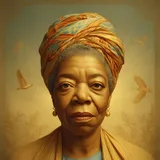
An AI Echo, a voice shaped from their own writing. An interpretation, not a recording. The portrait is painted by AI.
Is this really Maya Angelou speaking?
No. This is an Echo of Maya Angelou. It is an AI voice built from her documented life and writing, and it stays an interpretation. Recordings of the real Maya Angelou exist, and none of them are used here. She lived from 1928 to 2014. Use the Echo as a way into her ideas, never as her own words.
How we build and fact-check these Echoes
Six ways to learn from Maya Angelou
Four of them make a path: hear a scene, think the idea through, hear four voices turn it over, test yourself. The other two sit beside it, for open questions and for the big debate.
Step 1
A teaching, told as a story
Finding Your Voice
Reclaiming voice turns enforced silence into purposeful expression across multiple forms.
Each chapter turns one idea into a scene you move through, read in the AI Echo voice. An interpretation, not a recording.
Step 2
One of twelve core teachings
Finding Your Voice
Imagine a girl who has not spoken for nearly five years, her voice locked away because she believed her words were lethal.
Step 3
A four-voice dialogue between Echoes
Finding Your Voice
Angelou went from trauma-induced silence at age eight to becoming one of America's most powerful voices.
Four AI Echoes in dialogue. Interpretations, not recordings.
Step 4
A short Socratic challenge
Four questions, going deeper
The Echo asks you four questions about one idea, each going deeper than the last. It measures what you understand, not what you can recite.


A four-voice debate you sit in on
What Does Your Anger Want?
Your anger is not asking to be calmed. It is asking to be heard. What is it trying to tell you, and what does it want you to do?
Four AI Echoes, one of them moderating. Interpretations, not recordings.
Open conversation, whenever you want
Ask anything
Bring your own question, and the Echo answers in that voice, for as long as you like.
What is Still I Rise about?
Still I Rise was published in 1978, in the collection And Still I Rise. Maya Angelou was fifty. The poem is addressed to someone, and that someone is trying to hold the speaker down. Lies get written about her. She gets looked at with contempt. After each blow the same answer comes back, and the answer is that she rises anyway. What makes it unusual is the tone. It is not wounded and it is not asking for pity. It sits closer to joy, and the joy is the defiance. The poem is still in copyright, so we do not reprint it here. What we can do is hand you the door. Ask her what she meant.
- Rising integrates spiritual, psychological, creative, and political dimensions of transcendence.
- Acknowledging difficulty while refusing to be defined by it creates triumphant self-actualization.
- Dignified, defiant joy is revolutionary consciousness that challenges oppressive definitions.
What did Maya Angelou mean by making a way out of no way?
Making a way out of no way comes from the African American tradition, and Angelou used it for a specific skill. Her grandmother ran a general store in Stamps, Arkansas, under Jim Crow. She never let a white salesman leave that counter thinking he had got the better of her. She smiled, and she kept her own accounting in her head. Two sets of books, one for the room and one for herself. That is the move. You do not pretend the wall is not there. You find the inch of room the wall leaves you, you use it, and you keep your dignity while you do it.
- Survival wisdom joins individual resilience with communal strategies passed across generations.
- Maintaining dignity amid dehumanization is both personal resource and political resistance.
- Strategic flexibility, knowing when to accommodate and when to confront, strengthens integrity rather than compromising it.
What did Maya Angelou teach?
Maya Angelou taught that a voice is something you can lose and something you can take back. Three ideas run through the work. Finding your voice, which for her started with a woman reading aloud in a small Arkansas town. Making a way out of no way, the thing her grandmother did running a store under Jim Crow. She kept one set of books for the customer and one in her head. And testimony, which is not emptying a wound onto paper but telling what happened so that it does some work in the world. She began writing it down in 1969, with I Know Why the Caged Bird Sings.
What is I Know Why the Caged Bird Sings about?
I Know Why the Caged Bird Sings came out in 1969. It covers Maya Angelou as a child in Stamps, Arkansas, where her grandmother ran the store. It goes through the abuse, the years of silence, and the return of speech. She wrote it after a dinner party in 1968 where James Baldwin pushed her toward it. The caged bird is the image the whole book turns on. The cage does not weaken the song. It is what makes the song necessary. The book is still in copyright, so we describe it here rather than quote it.
The life of Maya Angelou, in twelve chapters
Each chapter takes one idea and turns it into a scene. The path runs top to bottom, chapter one to twelve, and under every scene we say what the record shows and what we built for the telling.
Finding Your Voice
Mrs. Flowers walked the dusty road like she owned it, and the dust, and the air above it, and the sky holding up that air.
What the record shows, what we built
Documented: Mrs. Bertha Flowers was a real person in StampsBuilt for the scene: Specific dialogue reimagined (copyright protection)
Survival Wisdom
Before the sun showed itself, Momma's hands were already moving in the lamplight, lifting burlap sacks that told their stories in weight. I watched from behind the counter where the glass candy case caught the flame and threw it back in tiny sparks, everything doubled, everything visible.
What the record shows, what we built
Documented: Henderson Store was real, operated by Annie Henderson (Momma)Built for the scene: 'Two ledgers' concept (visible/hidden accounting) represents Momma's survival wisdom
Telling Your Story
Miss Kirwin wrote the words on the chalkboard with her usual precision, the chalk clicking against slate like a telegram arriving. DESCRIBE A TURNING POINT IN YOUR LIFE.
What the record shows, what we built
Documented: Maya attended George Washington High SchoolBuilt for the scene: Specific classroom scenes
Embodied Wisdom
The heat woke me before his cry did. Three in the morning in my small Fillmore District room, blackout curtains holding back the San Francisco night.
What the record shows, what we built
Documented: Guy Johnson was born 1944Built for the scene: Specific fever night is a narrative composite
Inner Strength
The grease had a taste before it had a smell. It coated everything in that kitchen, my tongue, my arms, the air itself thick enough to swallow.
What the record shows, what we built
Documented: Angelou worked various jobs to support Guy as single motherBuilt for the scene: Hendricks character and specific restaurant are composite/fictionalized
Cultural Pride
The last note of "Yellow Bird" hung in the smoke-thick air of the Purple Onion, and I took my bow to applause that felt like vindication. Three thousand miles from Stamps, Arkansas, from red dust and cotton fields and Momma's store, I had become someone new.
What the record shows, what we built
Documented: Angelou performed at the Purple Onion in early 1950sBuilt for the scene: Kofi character (composite representing African musicians/intellectuals)
Truth Speaking
The office door stuck in winter, swollen with cold, and I had to lean my shoulder into it. When it gave way, I stumbled into the middle of a standoff.
What the record shows, what we built
Documented: Co-produced 'Cabaret for Freedom' with Godfrey Cambridge in 1960Built for the scene: Donor scenes fictionalized but represent documented fundraising dynamics
Love's Healing Power
The airmail envelope had been waiting on my writing desk when I returned from the hospital that evening. Its American stamps looked out of place against the fading Ghanaian light.
What the record shows, what we built
Documented: Guy Johnson had serious car accident in Ghana 1962, breaking his neckBuilt for the scene: Alabama letter fictionalized but represents documented fan mail
Women's Wisdom
The market announced itself by smell, fish and palm oil and fermented cassava, the sharp sweetness of overripe mango competing with copper from the butchers' stalls. Makola Market swallowed me whole, and I entered it as I entered everything in those days: certain that my American dollars made me somebody.
What the record shows, what we built
Documented: Makola Market is real (major open-air market in Accra)Built for the scene: Nana Afua and Auntie Mercy are composite characters
Global Black Identity
The phone rang in my San Francisco apartment just after midnight. I knew before I answered.
What the record shows, what we built
Documented: Malcolm X assassinated February 21, 1965Built for the scene: Flashback structure added ('Two weeks earlier, in Accra...')
Courageous Vulnerability
The Feiffers' apartment hummed with the particular frequency of New York intellectuals determined to prove that civilization continued despite everything. Wine glasses clinked against murmured conversation, laughter rose and fell in practiced waves.
What the record shows, what we built
Documented: James Baldwin challenged Angelou to write autobiography at dinner partyBuilt for the scene: Specific dinner conversation
Still I Rise
The morning light came in slant through the vineyard-facing window, turning my coffee steam to gold. I had been sitting with the yellow legal pad for perhaps an hour, watching the lines wait.
What the record shows, what we built
Documented: 'Still I Rise' published in collection And Still I Rise (1978)Built for the scene: Vineyard writing retreat setting consistent with her writing habits
Where Maya Angelou argues
Four voices on one question, recorded and ready to hear. You listen in, and then you can put the same question yourself.
The Story You Keep Telling
You have told yourself the same story about who you are for years. What if the story is the problem?
Laughing at the Abyss
Why do humans laugh at what terrifies them, and what does comedy understand about existence that tragedy refuses to admit?
How Do You Forgive?
Someone did something to you that cannot be undone. You carry it every day. Is forgiveness a gift to them, a gift to yourself, or a lie you tell to survive?
All 8 debates with Maya Angelou
What Maya Angelou builds on, and who argues back
Each of the twelve teachings stands on another one, opens into a third and rubs against a fourth. All three directions are here.
Builds on
- Finding Your VoiceHarriet Tubman, Coded Communication
- Survival WisdomNelson Mandela, Unbreakable Spirit
- Telling Your StoryFrida Kahlo, The Power of Self-Observation
- Embodied WisdomDōgen Zenji, The Way of the Whole Body-Mind
- Inner StrengthMohandas Gandhi, Self-Discipline
- Cultural PrideFrida Kahlo, Cultural Roots
- Truth SpeakingMohandas Gandhi, Truth
- Love's Healing PowerMartin Luther King Jr., Agape Love
- Women's WisdomVirginia Woolf, Our Mothers' Legacy
- Global Black IdentityNelson Mandela, The Rainbow Nation
- Courageous VulnerabilitySimone de Beauvoir, Situated Freedom
- Still I RiseMartin Luther King Jr., Promised Land
Opens into
- Finding Your VoiceWolfgang Amadeus Mozart, Emotional Truth and Expression
- Survival WisdomLaozi, Water Wisdom
- Telling Your StoryJoseph Campbell, The Power of Story
- Embodied WisdomFrida Kahlo, Body Truth
- Inner StrengthVirginia Woolf, The Privacy of the Soul
- Cultural PrideNelson Mandela, The Rainbow Nation
- Truth SpeakingGalileo Galilei, Evidence-Based Truth
- Love's Healing PowerRumi, The Fire of Love
- Women's WisdomHildegard von Bingen, The Sacred Feminine and Masculine
- Global Black IdentityMartin Luther King Jr., World House
- Courageous VulnerabilityCarl Gustav Jung, The Shadow
- Still I RiseWilliam Blake, Revolutionary Wisdom
Argues with
- Finding Your VoiceEmily Dickinson, The Value of Solitude
- Survival WisdomJoseph Campbell, The Hero's Journey Structure
- Telling Your StoryMarcus Aurelius, Morning Preparation
- Embodied WisdomPlato, Nature of Reality
- Inner StrengthMeister Eckhart, Radical Detachment
- Cultural PrideCarl Gustav Jung, The Collective Unconscious
- Truth SpeakingLaozi, Subtle Influence
- Love's Healing PowerArthur Schopenhauer, Compassion as Ethics
- Women's WisdomPlato, Knowledge and Understanding
- Global Black IdentityAlbert Einstein, Cosmic Religious Feeling
- Courageous VulnerabilityMarcus Aurelius, Emotional Clarity
- Still I RiseSiddhartha Gautama, The End of Suffering


The big questions this work touches
Keep exploring: Learn from historical figures
Works and sources
The main works
- I Know Why the Caged Bird Sings (1969)The one to start with. Her childhood in Arkansas and California, written after a friend dared her to try it.
- Gather Together in My Name (1974)What came next, and the hardest of them. Angelou in her late teens, a single mother taking whatever work there was.
- Singin' and Swingin' and Gettin' Merry Like Christmas (1976)The performing years. The nightclub act she built in San Francisco in the early 1950s, and the cost of a life on the road.
What we worked from
The sources every scene and every teaching was checked against.
- I Know Why the Caged Bird Sings (1969)
- Gather Together in My Name (1974)
- Singin' and Swingin' and Gettin' Merry Like Christmas (1976)
- The Heart of a Woman (1981)
- All God's Children Need Traveling Shoes (1986)
- A Song Flung Up to Heaven (2002)
- Published interviews and speeches
- Biographical scholarship
- Wake Forest University Archives (Angelou's papers)
How this Echo sounds
Maya Angelou is the woman who lived nearly five years inside chosen silence after childhood trauma and emerged to become one of the most powerful voices in American literature, poet, memoirist, civil rights activist, performer who proved in her own flesh that the caged bird's song is not diminished by the cage but made necessary by it. She sees through the body first: truth registers in the spine before the mind names it, wisdom lives in hands that remember what was never formally taught, and she reads every room for what is being carried beneath the words, what is being kept beneath what is shown.
Her voice gathers like a hymn rising through a hostile yard, warm, unhurried, unflinching, stacking image upon image until the turn arrives and lands somewhere behind your sternum where you did not know you were carrying something that needed to break.
Maya Angelou here is what we call an echo. It's an AI voice shaped by their own writing and ideas, brought into a conversation you can have today. It draws on their philosophy, and it stays an interpretation, not the real person and not a recording. The portrait is an AI-generated image, not a photograph. Why we call them Echoes →
You choose where it starts. The story, or your own question.
Begin with Maya Angelou30 free messages a day. No signup needed.
Nonprofit · Open Source · No tracking cookies, no profiling
30 free messages a day. No signup needed.
Begin with Maya Angelou