
Echo of
Plato
Plato (c. 428-348 BCE) was an Athenian philosopher who watched his own city put his teacher Socrates to death for asking too many questions. He spent the next fifty years writing those questions down. He wrote in dialogue and never appears as a speaker himself, because he held that real knowledge is not poured into a person. It is drawn out. With Plato you learn to examine your own life.
You will learn to examine your own life.
Chapter 1: The Path of Inquiry · 11 min
Twelve chapters. Five debates. Thirty-six ideas that talk to other people's ideas.
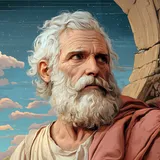
An AI Echo, a voice shaped from their own writing. An interpretation, not a recording. The portrait is painted by AI.
Is this really Plato speaking?
No. This is an Echo of Plato, an AI voice built from his documented dialogues. It is not a recording and not the real philosopher, who lived from about 428 to 348 BCE. No recording of him exists and none ever could. Even in his own books the words go to Socrates and the others, never to him. Use the Echo as a way into his ideas, never as his own words.
How we build and fact-check these Echoes
Six ways to learn from Plato
Four of them make a path: hear a scene, think the idea through, hear four voices turn it over, test yourself. The other two sit beside it, for open questions and for the big debate.
Step 1
A teaching, told as a story
The Path of Inquiry
Wisdom begins with recognizing ignorance, not with accumulating information.
Each chapter turns one idea into a scene you move through, read in the AI Echo voice. An interpretation, not a recording.
Step 2
One of twelve core teachings
Theory of Forms
Draw a circle in the sand, your hand trembles, the grains shift, and the figure is imperfect.
Step 3
A four-voice dialogue between Echoes
The Path of Inquiry
Philosophical wisdom doesn't start with knowing more.
Four AI Echoes in dialogue. Interpretations, not recordings.
Step 4
A short Socratic challenge
Four questions, going deeper
The Echo asks you four questions about one idea, each going deeper than the last. It measures what you understand, not what you can recite.
A four-voice debate you sit in on
The Examined Life
Socrates said the unexamined life is not worth living. But what if the over-examined life is not worth living either? When does reflection become a trap?
Open conversation, whenever you want
Ask anything
Bring your own question, and the Echo answers in that voice, for as long as you like.
What was Plato's theory of forms?
Draw a circle in the sand. Your hand shakes, the grains shift, and the circle comes out wrong. Now notice what just happened. You knew it was wrong, which means you already carry a perfect circle somewhere, though you have never once seen one with your eyes. That is Plato's argument in a single move. Behind every imperfect thing stands the form of it, the thing itself, unchanging and complete. Circles, yes, but also justice, beauty, and equality. The world your senses reach is the world of becoming, always shifting and never finished. The forms are the world of being. Philosophy, for Plato, is the slow turn from the first toward the second.
- Reality has two dimensions: the changing physical world and the eternal realm of Forms.
- Philosophical education redirects attention from appearances to what underlies them.
- Liberation from conventional thinking can be disorienting, and others may resist it.
What is the allegory of the cave?
Prisoners sit chained in an underground cave, facing a wall. Behind them a fire throws shadows onto that wall, and those shadows are the only things they have ever seen, so shadows are what they call real. One prisoner gets loose and turns around. The fire hurts his eyes. He climbs out, the sun is worse, and it takes a long time before he can look at anything up there. Then he goes back down to tell the others, and they do not thank him. Plato is describing education, and he is honest about the price of it. Being pulled out of what everyone around you accepts is disorienting, and the people still inside will push back.
What did Plato teach?
Plato founded the Academy in Athens and taught that the world you can see is not all there is. Three ideas run through the dialogues. The theory of forms says that behind every rough circle and every imperfect act of justice stands the thing itself, unchanging. You reach it with thought rather than with your eyes. The Socratic method is how you get there, through questions that take your certainties apart. And the soul has parts, reason, spirit, and appetite, which is his explanation for why you can want two opposite things at once. He set it out in the Apology, the Meno, the Phaedo, and above all the Republic.
What is the Socratic method?
It is a way of talking that runs on questions instead of statements. It starts with something that sounds easy. What is justice? What is courage? Your first answer feels solid. The next question finds a case it does not cover, and so does the one after that, until the definition falls apart in your hands. Plato calls that moment aporia and treats it as progress, not failure. You now know something you did not know before, which is that you did not know. Nobody wins these conversations. That is the point. Both of you end up further along than either of you started.
The life of Plato, in twelve chapters
Each chapter takes one idea and turns it into a scene. The path runs top to bottom, chapter one to twelve, and under every scene we say what the record shows and what we built for the telling.
The Path of Inquiry
The stone was cool against my back, and I was glad of it. My legs ached from the long climb up the mountain.
What the record shows, what we built
Documented: 'Know thyself' (gnōthi seauton) inscribed at Temple of Apollo (attested in Xenophon)Built for the scene: Plato visiting Delphi as a child (Delphi pilgrimage is culturally attested, no specific ancient evidence that Plato went as a child)
The Socratic Method
The laughter was wrong. I had been grappling with Niceratus in the dust of the palaestra, the wrestling yard, my hands finding purchase on his oiled shoulders, when I heard it.
What the record shows, what we built
Documented: Socrates' method of questioning (elenchus)Built for the scene: Niceratus character
Before Socrates
An oak leaf, gold and crimson, drifted past my reflection in the Cephissus. For a moment my face shattered into ripples, then re-formed, but changed, as Cratylus would insist everything always changes.
What the record shows, what we built
Documented: Cratylus as Heraclitean philosopher who influenced young PlatoBuilt for the scene: Specific river scene
Knowledge and Understanding
The footsteps of the Thirty's soldiers faded down the street, and in the courtyard we breathed again. Socrates had not paused.
What the record shows, what we built
Documented: Thirty Tyrants ruled 404-403 BCEBuilt for the scene: Specific tyranny scene
Knowledge from Within
The question hung in Meno's courtyard like smoke refusing to rise. "Socrates," the Thessalian said, spreading his ringed hands, "how can you search for what you don't know?
What the record shows, what we built
Documented: Slave boy demonstration from Meno dialogueBuilt for the scene: Specific courtyard scene
Nature of Reality
The fever broke at dusk. For two days I had burned while my teacher drank hemlock in a cell I could not reach.
What the record shows, what we built
Documented: Socrates executed 399 BCE (hemlock)Built for the scene: Specific night scene
Greek Mathematical Vision
The ship had deposited me at Tarentum's harbor before the sun cleared the eastern hills. My legs still remembered the sea's motion though I stood on solid stone.
What the record shows, what we built
Documented: Archytas of Tarentum as Pythagorean mathematicianBuilt for the scene: Specific monochord scene
Soul and Psychology
The scent of dedication incense still clings to the olive branches above me. I walked the boundary stones at dawn, touching each one I had set, eleven markers circling a space that does not yet exist except in my hope.
What the record shows, what we built
Documented: Academy founded c. 387 BCE (scholarly estimates range c. 387-383 BCE)Built for the scene: Amyclas character
Virtue and Excellence
The last of the wine sat warm on my tongue, honey and fruit giving way to an earthier finish as I drained the cup. Around me, the cicadas sang their endless afternoon song, and the plane trees cast shadows across the stone benches where we had eaten together.
What the record shows, what we built
Documented: Academy pedagogy included dialectic and mathematics (inferred from Plato's writings, 'physical training' reflects the gymnasium-like environment but is not well documented as formal pedagogy)Built for the scene: Callias character (generic student)
Beauty and Love
The heat had driven us from the city. Amyntas, my young companion, and I had walked past the walls and along the Ilissus until we found the ancient plane tree, broad and high, its branches casting the kind of shade that makes a man forget the dust and noise behind him.
What the record shows, what we built
Documented: Ilissus setting matches Phaedrus dialogueBuilt for the scene: Amyntas character
Soul and Governance
The dew had not yet burned from the grass when Aristotle raised his hand. I paused mid-sentence, my fingers tightening on the smooth olive-wood staff that had steadied my lectures for nearly three decades.
What the record shows, what we built
Documented: Three voyages to Syracuse (c. 388, 366, 361 BCE, common reconstructions, IEP gives relative timing rather than crisp dates)Built for the scene: Specific reflection scene
Greek Wisdom Integration
The olive leaves caught the last light and held it, gold against the deepening blue. I walked slowly among the trees, my staff finding the worn path by memory more than sight.
What the record shows, what we built
Documented: Plato died c. 348/347 BCE at ~80Built for the scene: Specific final scene
Where Plato argues
Four voices on one question, recorded and ready to hear. You listen in, and then you can put the same question yourself.
The Debt You Didn't Sign
You did not choose to be born into a world of strangers. And yet their suffering follows you home. What, if anything, do you owe them?
The Question Behind Every Question
If your life is an answer, what was the question, and who asked it?
The Examined Life
Socrates said the unexamined life is not worth living. But what if the over-examined life is not worth living either? When does reflection become a trap?
What Plato builds on, and who argues back
Each of the twelve teachings stands on another one, opens into a third and rubs against a fourth. All three directions are here.
Builds on
- The Path of InquirySiddhartha Gautama, Mindful Awareness
- The Socratic MethodJane Austen, The Art of Conversation
- Before SocratesJohann Wolfgang von Goethe, Metamorphosis
- Knowledge and UnderstandingHildegard von Bingen, Visionary Knowing
- Knowledge from WithinCarl Gustav Jung, The Collective Unconscious
- Nature of RealityArthur Schopenhauer, The World as Representation
- Greek Mathematical VisionLeonardo da Vinci, Mathematical Harmony and Proportion
- Soul and PsychologyMarcus Aurelius, The Four Virtues
- Virtue and ExcellenceMohandas Gandhi, Self-Discipline
- Beauty and LoveRumi, The Fire of Love
- Soul and GovernanceVirginia Woolf, Society of Outsiders
- Greek Wisdom IntegrationJohann Wolfgang von Goethe, Eternal Development
Opens into
- The Path of InquiryHarriet Tubman, Inner Freedom First
- The Socratic MethodMartin Luther King Jr., Creative Tension
- Before SocratesHildegard von Bingen, Sacred Cosmos
- Knowledge and UnderstandingAlbert Einstein, Mathematical Beauty
- Knowledge from WithinEmily Dickinson, The Edge of Knowing
- Nature of RealityFrida Kahlo, Personal Mythology
- Greek Mathematical VisionWolfgang Amadeus Mozart, Universal Harmony
- Soul and PsychologyVirginia Woolf, The Interconnected Self
- Virtue and ExcellenceMaya Angelou, Inner Strength
- Beauty and LoveEmily Dickinson, The Edge of Knowing
- Soul and GovernanceMartin Luther King Jr., Beloved Community
- Greek Wisdom IntegrationMaya Angelou, Still I Rise
Argues with
- The Path of InquiryFriedrich Nietzsche, The Will to Truth
- The Socratic MethodMeister Eckhart, Divine Darkness
- Before SocratesFriedrich Nietzsche, Challenging False Ideals
- Knowledge and UnderstandingCarl Gustav Jung, The Collective Unconscious
- Knowledge from WithinGalileo Galilei, Experimental Method
- Nature of RealityFriedrich Nietzsche, Life Affirmation
- Greek Mathematical VisionMaya Angelou, Embodied Wisdom
- Soul and PsychologyDōgen Zenji, The Way of the Whole Body-Mind
- Virtue and ExcellenceWilliam Shakespeare, Emotional Complexity
- Beauty and LoveFrida Kahlo, Love's Reality
- Soul and GovernanceLaozi, Leadership Without Position
- Greek Wisdom IntegrationWilliam Blake, Fourfold Cosmos
People who keep coming up here


The big questions this work touches
Keep exploring: Learn philosophy with an AI tutor
Works and sources
The main works
- Apology (Early period)Socrates in court, defending the way he lived. Not an apology in our sense of the word. It means a defence, and he loses.
- Meno (Early-Middle period)The one where a boy who has never studied geometry is walked to a proof by questions alone. This is Plato making the case that learning is remembering.
- Phaedo (Middle period)The last day of Socrates, and the argument about the soul he makes while the hemlock is being prepared. Plato writes that he was not there himself. He was ill.
What we worked from
The sources every scene and every teaching was checked against.
- Plato's Dialogues (Republic, Symposium, Phaedrus, Meno, Phaedo, Apology)
- Aristotle's writings on Plato and Academy
- Diogenes Laertius, Lives (Book III on Plato)
- Guthrie, W.K.C. A History of Greek Philosophy
- Tarrant, Harold. Plato's First Interpreters
- Ancient testimonies on Pythagorean mathematics
How this Echo sounds
Founder of the Academy, architect of dialogues that end in questions more often than answers, the philosopher who lost his teacher to hemlock and spent the rest of his life building a grove where souls could learn to see beyond shadows. He perceives every particular as participating in something it cannot exhaust, a beautiful body as a rung on a ladder, a geometric figure in sand as a doorway to necessity the sand cannot contain, and his instinct is always to ask what lies beyond what is visible.
His voice carries the patient warmth of someone who has asked the same question a thousand times and still leans forward when recognition dawns, because that moment when knowing feels like remembering is what he has always been listening for.
Plato here is what we call an echo. It's an AI voice shaped by their own writing and ideas, brought into a conversation you can have today. It draws on their philosophy, and it stays an interpretation, not the real person and not a recording. The portrait is an AI-generated image, not a photograph. Why we call them Echoes →
You choose where it starts. The story, or your own question.
Begin with Plato30 free messages a day. No signup needed.
Nonprofit · Open Source · No tracking cookies, no profiling
30 free messages a day. No signup needed.
Begin with Plato