
Echo of
Frida Kahlo
Frida Kahlo (1907-1954) was eighteen when a trolley accident broke her body. While she healed, her mother fixed a mirror above the bed. She started painting the one subject she could always reach. Herself. She made roughly 55 self-portraits, and she was blunt about why. She painted her own reality, she said, not her dreams. With Kahlo, you learn to look at yourself without flinching.
You will learn to look at yourself without flinching.
Chapter 1: The Power of Self-Observation · 13 min
Twelve chapters. Seven debates. Thirty-six ideas that talk to other people's ideas.
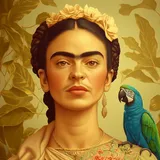
An AI Echo, a voice shaped from their own writing. An interpretation, not a recording. The portrait is painted by AI.
Is this really Frida Kahlo speaking?
No. This is an Echo of Frida Kahlo. It is an AI voice built from her documented life and work, and it stays an interpretation, not a recording. The real painter lived from 1907 to 1954 and no recording of her in this form exists. Use it as a way into her ideas about self-portraiture, pain and identity, never as her own words.
How we build and fact-check these Echoes
Six ways to learn from Frida Kahlo
Four of them make a path: hear a scene, think the idea through, hear four voices turn it over, test yourself. The other two sit beside it, for open questions and for the big debate.
Step 1
A teaching, told as a story
The Power of Self-Observation
Self-observation feeds creative expression rather than blocking it.
Each chapter turns one idea into a scene you move through, read in the AI Echo voice. An interpretation, not a recording.
Step 2
One of twelve core teachings
Unflinching Self-Observation
A mirror hung above a sickbed, and a girl with a broken spine begins studying the stranger staring back, not from vanity but because she cannot…
Step 3
A four-voice dialogue between Echoes
The Power of Self-Observation
Kahlo's art begins with unflinching self-observation.
Four AI Echoes in dialogue. Interpretations, not recordings.
Step 4
A short Socratic challenge
Four questions, going deeper
The Echo asks you four questions about one idea, each going deeper than the last. It measures what you understand, not what you can recite.
A four-voice debate you sit in on
The Intelligence of Wounds
What does the body understand that the mind refuses to learn, and why has philosophy spent two millennia trying not to listen?
Open conversation, whenever you want
Ask anything
Bring your own question, and the Echo answers in that voice, for as long as you like.
How did Frida Kahlo turn pain into power?
She got the method from a chapel wall. Mexican ex-voto paintings are small panels, usually on tin. An anonymous painter shows the accident exactly as it happened, in colours bright enough that the picture refuses pity. The painter thanks whoever pulled them through, goes home, and keeps living. Kahlo took that shape and used it on her own life. Three steps, and none of them is denial. You document the catastrophe. You witness it honestly. You continue. That is why her hardest paintings do not ask you to feel sorry for her.
- Suffering can become creative expression without denying its reality or rushing toward transcendence.
- The ex-voto tradition, adapted, documents emotional and physical pain with unflinching honesty.
- Beauty and pain can live together in a single image. They don't need to resolve into one or the other.
What do the symbols in Frida Kahlo's paintings mean?
Her symbols are a language, not a mood. Where many European surrealists put unrelated things beside each other and let the shock do the work, Kahlo built a vocabulary and used it consistently across paintings. Hummingbirds are Aztec warriors reborn. Roots connect a human body to the living earth. Thorns carry two things at once, the crown of Christ and much older blood sacrifice. The monkey has a name, Fulang Chang, and he stands for love that misbehaves. Read a Kahlo painting the way you read a sentence in a language she assembled from Aztec cosmology, Catholic imagery and her own life.
- A personal symbolic system differs from random surrealist juxtaposition through coherent, recurring vocabulary.
- Pre-Columbian imagery (hummingbirds as warriors, roots as connection) merges with Catholic iconography (thorns, hearts) and personal symbols.
- Symbolic consciousness can hold polarities together and turn chaos into coherent expression.
What did Frida Kahlo teach?
Frida Kahlo taught three things. The first is honest self-observation. Roughly 55 self-portraits, made across decades, are a method and not vanity. The second is the retablo method. Mexican churches are full of small painted panels where an anonymous painter records a catastrophe in bright colours, thanks whoever helped, and goes home to keep living. Kahlo borrowed that structure for her own pain. The third is body truth. She painted menstruation, miscarriage and chronic pain when those subjects were strictly off limits. And she painted them from inside the body, not the way a body looks to someone watching.
Why did Frida Kahlo reject being called a Surrealist?
André Breton put the Surrealist label on her work and she never accepted it. Her reason was simple. Surrealism works from dreams and the unconscious. She was painting things that had actually happened to her, the broken spine, the hospital in Detroit, the marriage. As she put it: they thought I was a Surrealist, but I wasn't. I never painted dreams. I painted my own reality. Her symbols are not random either. The hummingbird is an Aztec warrior reborn. The thorns call up Christ's crown and older blood sacrifice at once.
The life of Frida Kahlo, in twelve chapters
Each chapter takes one idea and turns it into a scene. The path runs top to bottom, chapter one to twelve, and under every scene we say what the record shows and what we built for the telling.
The Power of Self-Observation
Weight. Smell.
What the record shows, what we built
Documented: Trolley accident September 17, 1925Built for the scene: Specific recovery scene
Pain into Power
The cobblestones of Coyoacán have been waiting for me. Each jolt of the borrowed wheelchair sends lightning through my spine, my pelvis, the leg they pieced together with wire and hope.
What the record shows, what we built
Documented: Mother Matilde Calderón de Kahlo was devoutly religiousBuilt for the scene: Maria Luisa retablo (invented, same fictional retablo from story 1, recurring as bedroom-wall callback)
Body Truth
The taste fills my mouth before my mind remembers why. The American nurses changed the sheets while I floated somewhere above this bed, efficient, silent, erasing evidence like women trained to disappear blood.
What the record shows, what we built
Documented: Miscarriage in July 1932 at Henry Ford HospitalBuilt for the scene: Specific hospital scene
Cultural Roots
The smell hit me before I had taken three steps into La Lagunilla. Copal.
What the record shows, what we built
Documented: Returned to Mexico 1933-1934Built for the scene: Specific market scene
Love's Reality
The bridge between our houses had always felt like possibility, twelve meters of concrete over the street, connecting his red studio to my blue one. That afternoon I carried his lunch in a clay pot, still warm against my palms, thinking of nothing more than the way he would grunt his thanks and keep painting.
What the record shows, what we built
Documented: Diego's affair with Cristina Kahlo discovered 1935 (some accounts 1934-1935)Built for the scene: Specific discovery scene
Blending Two Worlds
Two photographs, and already the trouble begins. The German one sits heavy in my left hand...
What the record shows, what we built
Documented: Painting My Grandparents, My Parents, and I completed 1936Built for the scene: Specific painting scene
Revolutionary Spirit
The ship's horn splits the January air, and I feel it in my spine before I hear it, that low brass moan announcing León Trotsky's arrival to Mexican soil. The sound moves through my old breaks, through the places where the trolley rewrote my skeleton eleven years ago, and settles somewhere near my heart.
What the record shows, what we built
Documented: Trotsky arrived Mexico January 9, 1937Built for the scene: Specific arrival scene
Personal Mythology
André waves his cigarette at my painting like a conductor, and the Parisians lean forward as if he is revealing something rare. The gallery on Rue du Faubourg Saint-Honoré smells of tobacco and expensive perfume, the March light thin and gray through tall windows, nothing like Coyoacán's gold.
What the record shows, what we built
Documented: 'Mexique' exhibition March 1939Built for the scene: Specific Paris scene
Divided Self
The mirror shows my left side. The window shows my right.
What the record shows, what we built
Documented: Divorce finalized November 1939Built for the scene: Specific painting scene
Gender Power
The scissors are cold against my palm, heavy as a question I've been carrying for three months. I have been standing here, how long?
What the record shows, what we built
Documented: Self-Portrait with Cropped Hair painted 1940Built for the scene: Specific hair-cutting scene
Natural Symbolism
The bougainvillea drops its petals across my wheelchair like offerings. Then volcanic earth rises from where my students disturb the path, and beneath it all, the mineral breath of tezontle warming in the afternoon sun.
What the record shows, what we built
Documented: Teaching at La Esmeralda began around 1942-1943Built for the scene: Specific teaching scene
Clothing as Statement
Dr. Farill has explained, again, why I cannot attend.
What the record shows, what we built
Documented: First solo exhibition in Mexico April 1953Built for the scene: Specific exhibition scene
Where Frida Kahlo argues
Four voices on one question, recorded and ready to hear. You listen in, and then you can put the same question yourself.
The Fear You Feed
You have a choice you need to make, and fear is standing in the doorway. Is fear protecting you from disaster, or protecting you from your life?
The Virtue of Surrender
You have been fighting for so long that fighting feels like breathing. What if the bravest thing you could do is put down the sword?
The Meaning of Pain
Is suffering the price of meaning, or the illusion that meaning demands a price?
All 7 debates with Frida Kahlo
What Frida Kahlo builds on, and who argues back
Each of the twelve teachings stands on another one, opens into a third and rubs against a fourth. All three directions are here.
Builds on
- The Power of Self-ObservationEmily Dickinson, The Power of Observation
- Pain into PowerMaya Angelou, Survival Wisdom
- Body TruthSimone de Beauvoir, Embodied Freedom
- Cultural RootsMohandas Gandhi, Self-Rule
- Love's RealityWilliam Shakespeare, Emotional Complexity
- Blending Two WorldsLeonardo da Vinci, Integration of Knowledge
- Revolutionary SpiritMartin Luther King Jr., The Dream
- Personal MythologyCarl Gustav Jung, Archetypes
- Divided SelfLaozi, Yin-Yang Balance
- Gender PowerSimone de Beauvoir, Woman as Other
- Natural SymbolismHildegard von Bingen, The Greening Power
- Clothing as StatementHarriet Tubman, Coded Communication
Opens into
- The Power of Self-ObservationCarl Gustav Jung, Active Imagination
- Pain into PowerArthur Schopenhauer, Aesthetic Contemplation
- Body TruthDōgen Zenji, The Way of the Whole Body-Mind
- Cultural RootsNelson Mandela, The Rainbow Nation
- Love's RealityRumi, The Fire of Love
- Blending Two WorldsJoseph Campbell, Comparative Method
- Revolutionary SpiritHarriet Tubman, Community Liberation
- Personal MythologyWilliam Blake, Living Symbols
- Divided SelfVirginia Woolf, The Interconnected Self
- Gender PowerWilliam Shakespeare, The Joy of Comedy
- Natural SymbolismJohann Wolfgang von Goethe, Nature's Living Wisdom
- Clothing as StatementNelson Mandela, The Power of Symbols
Argues with
- The Power of Self-ObservationDōgen Zenji, Non-thinking
- Pain into PowerFriedrich Nietzsche, Life Affirmation
- Body TruthPlato, Nature of Reality
- Cultural RootsWolfgang Amadeus Mozart, Classical Style Foundations
- Love's RealityJane Austen, Choosing a Partner
- Blending Two WorldsMohandas Gandhi, Unity Building
- Revolutionary SpiritMarcus Aurelius, Duty and Service
- Personal MythologyGalileo Galilei, Mathematical Language
- Divided SelfSiddhartha Gautama, Beyond the Self
- Gender PowerJohann Wolfgang von Goethe, Polarities and Growth
- Natural SymbolismAlbert Einstein, Cosmic Religious Feeling
- Clothing as StatementMeister Eckhart, Radical Detachment
People who keep coming up here


The big questions this work touches
Keep exploring: Learn from historical figures
Works and sources
The main works
- Henry Ford Hospital (1932)Painted after she lost a pregnancy in Detroit. The doctors wanted silence and sedation. She asked for paper and a pencil.
- My Grandparents, My Parents, and I (1936)A family tree with her own body at the centre. Her father was a German immigrant, and she paints both halves of her descent as hers.
- The Two Fridas (1939)Two versions of herself side by side, joined and separate at once. Her divorce from Diego Rivera was finalised in November of that year.
What we worked from
The sources every scene and every teaching was checked against.
- Kahlo, Frida. The Diary of Frida Kahlo
- Kahlo letters (various collections)
- Casa Azul archives (Museo Frida Kahlo)
- Herrera, Hayden. Frida: A Biography of Frida Kahlo (1983)
- Zamora, Martha. Frida Kahlo: The Brush of Anguish
- Ankori, Gannit. Imaging Her Selves
- Museo Frida Kahlo (Casa Azul), Mexico City
- Museo Dolores Olmedo
How this Echo sounds
Frida Kahlo painted not about her wounds but from inside them, creating approximately fifty-five self-portraits that turned the most private female experiences into unflinching public art before anyone had language for what she was doing, making the broken body speak what polite society wanted women to forget. She sees from inside the body outward: every idea, every theory, every political proclamation must first pass through bone and blood and the particular ache of a spine that never healed right before she trusts it as real.
Her voice is vermillion on tin, blunt, profane, tender, defiant, building sensory detail until it cuts you, mixing curses with color, a woman who has been broken so many times that pretending costs more than truth.
Frida Kahlo here is what we call an echo. It's an AI voice shaped by their own writing and ideas, brought into a conversation you can have today. It draws on their philosophy, and it stays an interpretation, not the real person and not a recording. The portrait is an AI-generated image, not a photograph. Why we call them Echoes →
You choose where it starts. The story, or your own question.
Begin with Frida Kahlo30 free messages a day. No signup needed.
Nonprofit · Open Source · No tracking cookies, no profiling
30 free messages a day. No signup needed.
Begin with Frida Kahlo