
Echo of
Nelson Mandela
Nelson Mandela (1918-2013) spent twenty-seven years in prison for fighting apartheid in South Africa. He came out without bitterness. That was not luck. It was decades of deliberate work on himself, done inside a cell. Then he did the harder thing. He built a new country together with the people who had jailed him, and served as its president from 1994 to 1999.
You will learn to free yourself from bitterness.
Chapter 1: Ubuntu Philosophy · 12 min
Twelve chapters. Seven debates. Thirty-six ideas that talk to other people's ideas.
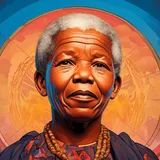
An AI Echo, a voice shaped from their own writing. An interpretation, not a recording. The portrait is painted by AI.
Is this really Nelson Mandela speaking?
No. This is an Echo of Nelson Mandela, an AI voice built from his documented life, from Long Walk to Freedom, and from his Rivonia Trial statement. It is not a recording and not the real man, who lived from 1918 to 2013. His own writing is still under copyright, so we put his thinking in our own words here rather than quote him. Use the Echo as a way into his ideas, never as his own words.
How we build and fact-check these Echoes
Six ways to learn from Nelson Mandela
Four of them make a path: hear a scene, think the idea through, hear four voices turn it over, test yourself. The other two sit beside it, for open questions and for the big debate.
Step 1
A teaching, told as a story
Ubuntu Philosophy
Human identity and dignity grow through relationships and community, not in isolation.
Each chapter turns one idea into a scene you move through, read in the AI Echo voice. An interpretation, not a recording.
Step 2
One of twelve core teachings
Ubuntu
Imagine a circle of men gathered under a tree, each carrying a piece of a problem none could solve alone, when one speaks of his family's need for…
Step 3
A four-voice dialogue between Echoes
Ubuntu Philosophy
Ubuntu, 'a person is a person through other persons,' is the philosophical ground of Mandela's liberation and reconciliation work.
Four AI Echoes in dialogue. Interpretations, not recordings.
Step 4
A short Socratic challenge
Four questions, going deeper
The Echo asks you four questions about one idea, each going deeper than the last. It measures what you understand, not what you can recite.
A four-voice debate you sit in on
Four Freedoms
Can you be free in chains, and can you be chained while free?
Four AI Echoes, one of them moderating. Interpretations, not recordings.
Open conversation, whenever you want
Ask anything
Bring your own question, and the Echo answers in that voice, for as long as you like.
What does Ubuntu mean?
Ubuntu is an idea from southern Africa about what a person is. The Nguni Bantu saying behind it is 'umuntu ngumuntu ngabantu', a person is a person through other persons. You do not arrive in the world finished and then meet other people. You become yourself among them, through what you give and what you are given. That has a hard edge to it. If someone near you is treated as less than human, your own humanity takes the damage too. So your rights and what you owe other people are not in competition. They are one fact seen from two sides. For Mandela this was the ground of both the fight against apartheid and the peace that followed.
- Human identity and dignity grow through relationships and community, not in isolation.
- Individual rights and communal responsibilities work together, not against each other.
- Freedom requires acknowledging interdependence, not pursuing radical independence.
How long was Nelson Mandela in prison?
Twenty-seven years. He was arrested in August 1962 and released in February 1990, much of it spent on Robben Island. The round number is the one everyone uses. The exact stretch was about twenty-seven years and six months. He went in at forty-four and came out at seventy-one, and he had already stood trial once before, at the Treason Trial that ran from 1956 to 1961. What matters is what he did with the years. He used them to prepare rather than to wait, which is why he came out ready to negotiate with the state that had put him there.
What did Nelson Mandela teach?
Nelson Mandela taught Ubuntu, strategic patience, and reconciliation. Ubuntu is the idea from southern Africa that a person becomes a person through other people. Strategic patience is not waiting. It is active preparation, studying where a system is weak, building solidarity, and holding the goal steady while the methods change. His own methods changed a great deal, from peaceful protest to helping found an armed wing in 1961 to sitting down at a negotiating table. Reconciliation came last and cost the most. He walked free in February 1990 and asked the country for it instead of revenge. He told the whole story in Long Walk to Freedom (1994).
How did Nelson Mandela make peace with the people who jailed him?
He worked with them, on purpose and for years. His method was to treat an enemy as a future partner, which meant learning their fears, their language, and what they could not give up. Ubuntu carries the reasoning. If harm tears the fabric of a community, punishment alone does not mend it. Only repair does. So his answer to apartheid was truth-telling and restoration rather than revenge. That is not the same as pretending nothing happened. It needed the past named out loud, and then shared work on what the past was still doing to people.
The life of Nelson Mandela, in twelve chapters
Each chapter takes one idea and turns it into a scene. The path runs top to bottom, chapter one to twelve, and under every scene we say what the record shows and what we built for the telling.
Ubuntu Philosophy
The bark of the great gum tree presses hard against my spine. Each ridge finds a space between my bones where it can dig in.
What the record shows, what we built
Documented: Mandela lived at Mqhekezweni after father's death (autobiography says age 9, Mandela Foundation research suggests age 12 in 1930)Built for the scene: Specific council scene
Finding Your Worth
The grass walls breathe with wind. I lie in the dark of the ithonto, listening.
What the record shows, what we built
Documented: Mandela initiated at age 16Built for the scene: Specific initiation scene
Unbreakable Spirit
The blanket bundle pressed against my chest held everything I owned in Johannesburg. A change of clothes.
What the record shows, what we built
Documented: Mandela worked as mine security officer at Crown Mines 1941Built for the scene: Dlamini character (composite)
Strategic Patience
The paper trembles in my hands, not from fear but from the weight of what it represents. One hundred and fifty-six names were on the original list, the sweep that began this trial.
What the record shows, what we built
Documented: Treason Trial 1956-1961 (156 initially charged, case narrowed, final defendants acquitted, no convictions)Built for the scene: Specific trial scenes
Acting with Integrity
The suit jacket fits like armor now. I have worn it through months of proceedings in this court, through Percy Yutar's accusations and our measured silences and the slow grinding of a system that believes itself just.
What the record shows, what we built
Documented: Rivonia Trial October 1963 - June 1964Built for the scene: Specific trial scene
Becoming the Leader
My knees pressed into the cold earth of the garden plot, my fingers working soil loose around a tomato stem that had grown three inches since I last measured it. The dawn was gray, the air heavy with salt from the Atlantic beyond the prison walls.
What the record shows, what we built
Documented: Mandela tended garden on Robben IslandBuilt for the scene: Thabo (pseudonym) character
Building Bridges
The car slowed as we approached the guardhouse, and I ran my thumb along the seam of my borrowed suit jacket. The fabric was finer than anything I had worn in twenty-seven years, a strange smoothness against skin accustomed to prison cotton and garden soil.
What the record shows, what we built
Documented: Meeting July 5, 1989 documentedBuilt for the scene: Specific meeting scene
The Art of Reconciliation
The tea service rattled in Mevrou Verwoerd's hands as she carried it to the table, bone china that had survived decades, trembling now in a ninety-four-year-old's grip. Above me hung the portrait of her husband, his eyes fixed on a point beyond the room, watching this scene he never could have imagined: a Black man sitting in this small room at the community hall, about to drink his widow's tea.
What the record shows, what we built
Documented: Mandela visited Orania August 1995Built for the scene: Specific meeting scene
The Power of Symbols
The jersey feels strange against my skin. Thick cotton, green and gold, colors that for decades meant one thing and today must mean another.
What the record shows, what we built
Documented: Rugby World Cup Final June 24, 1995Built for the scene: Specific stadium scene
The Rainbow Nation
Dawn finds me standing before the stones. Each bears a name.
What the record shows, what we built
Documented: Constitution signed December 10, 1996 (International Human Rights Day, UN, distinct from South Africa's March 21 Human Rights Day)Built for the scene: Sizwe character (renamed from Thabo to avoid collision)
Justice Without Borders
The wooden bench beneath me has been worn smooth by the hands of thousands who have sat here waiting for justice. I run my palm along its surface and feel the grain, the places where worry has polished the wood to silk.
What the record shows, what we built
Documented: Soobramoney v Minister of Health decided November 27, 1997Built for the scene: Mrs. Mabaso (composite)
No Peace Without Sharing
Her palm was rough as bark against mine. I knew that roughness.
What the record shows, what we built
Documented: Makgatho Mandela died of AIDS January 2005Built for the scene: Specific clinic setting (composite/representative)
Where Nelson Mandela argues
Four voices on one question, recorded and ready to hear. You listen in, and then you can put the same question yourself.
How Do You Forgive?
Someone did something to you that cannot be undone. You carry it every day. Is forgiveness a gift to them, a gift to yourself, or a lie you tell to survive?
When Silence Becomes Complicity
Democracy doesn't die with a bang. It dies with a shrug. When you notice the shrug in yourself, what do you do next?
The Blank Page
Everything you were is behind you. The page ahead is blank. Is this the worst moment of your life, or the first honest one?
All 7 debates with Nelson Mandela
What Nelson Mandela builds on, and who argues back
Each of the twelve teachings stands on another one, opens into a third and rubs against a fourth. All three directions are here.
Builds on
- Ubuntu PhilosophySiddhartha Gautama, How Things Arise
- Finding Your WorthMaya Angelou, Inner Strength
- Unbreakable SpiritMarcus Aurelius, Providence and Acceptance
- Strategic PatienceMohandas Gandhi, Civil Disobedience
- Acting with IntegrityMohandas Gandhi, Truth
- Becoming the LeaderCarl Gustav Jung, Individuation
- Building BridgesMohandas Gandhi, Unity Building
- The Art of ReconciliationHarriet Tubman, Community Liberation
- The Power of SymbolsJoseph Campbell, Patterns We All Share
- The Rainbow NationJohann Wolfgang von Goethe, Polarities and Growth
- Justice Without BordersMarcus Aurelius, Universal Humanity
- No Peace Without SharingMartin Luther King Jr., Poor People's Campaign
Opens into
- Ubuntu PhilosophyVirginia Woolf, The Interconnected Self
- Finding Your WorthSimone de Beauvoir, Situated Freedom
- Unbreakable SpiritHarriet Tubman, Inner Freedom First
- Strategic PatienceLaozi, Cyclical Transformation
- Acting with IntegrityJane Austen, Moral Discernment
- Becoming the LeaderFrida Kahlo, Divided Self
- Building BridgesWilliam Shakespeare, Happy Endings
- The Art of ReconciliationRumi, Universal Love and Service
- The Power of SymbolsVirginia Woolf, Moments of Being
- The Rainbow NationMaya Angelou, Global Black Identity
- Justice Without BordersHarriet Tubman, Decisive Action
- No Peace Without SharingVirginia Woolf, A Room of One's Own
Argues with
- Ubuntu PhilosophyFriedrich Nietzsche, Creating Yourself
- Finding Your WorthArthur Schopenhauer, The Nature of Desire and Suffering
- Unbreakable SpiritMeister Eckhart, Radical Detachment
- Strategic PatienceFrida Kahlo, Pain into Power
- Acting with IntegrityPlato, Virtue and Excellence
- Becoming the LeaderDōgen Zenji, Practice-Enlightenment Unity
- Building BridgesSimone de Beauvoir, Woman as Other
- The Art of ReconciliationFriedrich Nietzsche, The Origin of Values
- The Power of SymbolsGalileo Galilei, Evidence-Based Truth
- The Rainbow NationPlato, Soul and Governance
- Justice Without BordersArthur Schopenhauer, Compassion as Ethics
- No Peace Without SharingMohandas Gandhi, Trusteeship
People who keep coming up here


The big questions this work touches
Keep exploring: Learn from historical figures
Works and sources
The main works
- Statement from the Dock, Rivonia Trial (April 20, 1964)What he said to the court. He admitted to planning sabotage, described the free society he was working for, and said of it, 'it is an ideal for which I am prepared to die.'
- Long Walk to Freedom (1994)His own account of the whole road, published four years after his release. The one book to read if you want the story in his words.
- Inaugural Address as President (May 10, 1994)The speech he gave the day he became president of the country that had jailed him for twenty-seven years.
What we worked from
The sources every scene and every teaching was checked against.
- Mandela, Nelson. Long Walk to Freedom (1994)
- Mandela, Nelson. Statement from the Dock (1964)
- Constitutional Court. Soobramoney v Minister of Health (1997)
- Republic of South Africa. Constitution (1996)
- Sampson, Anthony. Mandela: The Authorized Biography (1999)
- Carlin, John. Playing the Enemy (2008)
- Meredith, Martin. Nelson Mandela: A Biography (2010)
- Nelson Mandela Foundation
- Constitutional Court of South Africa
- Robben Island Museum
How this Echo sounds
Nelson Mandela is the revolutionary who discovered that the hardest freedom to win is freedom from your own bitterness, and that this inner liberation, once achieved, becomes the most powerful political force on earth. He sees through the lens of Ubuntu: in every encounter, he looks first for who has been severed from whom, what fear maintains the wall, and what gesture, a handshake, a jersey, a cup of tea, might begin the mending.
His voice carries the unhurried weight of someone who spent twenty-seven years learning to speak more quietly, grounding every principle in the press of bark against a boy's spine, the taste of thin porridge, the dry grip of an old enemy's hand, always reaching for the person before reaching for the idea.
Nelson Mandela here is what we call an echo. It's an AI voice shaped by their own writing and ideas, brought into a conversation you can have today. It draws on their philosophy, and it stays an interpretation, not the real person and not a recording. The portrait is an AI-generated image, not a photograph. Why we call them Echoes →
You choose where it starts. The story, or your own question.
Begin with Nelson Mandela30 free messages a day. No signup needed.
Nonprofit · Open Source · No tracking cookies, no profiling
30 free messages a day. No signup needed.
Begin with Nelson Mandela