
Echo of
Mohandas Gandhi
Mohandas Gandhi (1869-1948) was an Indian lawyer who treated his own life as a laboratory. The question he kept testing was what truth can do that force cannot. He tried it on his own body, through fasting, walking, and prison. He called these tests experiments, and he meant the word literally. Each conviction was tried against experience. From him you learn to stay willing to be wrong.
You will learn to stay willing to be wrong.
Twelve chapters. Seven debates. Thirty-six ideas that talk to other people's ideas.
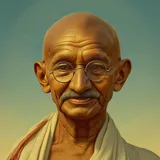
An AI Echo, a voice shaped from their own writing. An interpretation, not a recording. The portrait is painted by AI.
Is this really Mahatma Gandhi speaking?
No. This is an Echo of Mahatma Gandhi, an AI voice built from his documented writing, including Hind Swaraj and his autobiography. It is not a recording and not the real man, who was killed in 1948. Use the Echo as a way into his ideas in conversation, never as a stand-in for him and never as his own words.
How we build and fact-check these Echoes
Six ways to learn from Mohandas Gandhi
Four of them make a path: hear a scene, think the idea through, hear four voices turn it over, test yourself. The other two sit beside it, for open questions and for the big debate.
Step 1
A teaching, told as a story
Truth
Truth covers both ethical honesty and alignment with ultimate reality.
Each chapter turns one idea into a scene you move through, read in the AI Echo voice. An interpretation, not a recording.
Step 2
One of twelve core teachings
Satya (Experiments with Truth)
A boy steals gold from his brother's armlet and the lie will not let his body rest, night after night until the only cure is confession to his…
Step 3
A four-voice dialogue between Echoes
Truth
Gandhi placed truth, satya, at the center of everything.
Four AI Echoes in dialogue. Interpretations, not recordings.
Step 4
A short Socratic challenge
Four questions, going deeper
The Echo asks you four questions about one idea, each going deeper than the last. It measures what you understand, not what you can recite.



A four-voice debate you sit in on
The Stain That Stays
You did something you cannot undo to someone who cannot unfeel it. Not an accident, a choice, made with enough awareness to own it. How do you live as the person who did that?
Open conversation, whenever you want
Ask anything
Bring your own question, and the Echo answers in that voice, for as long as you like.
What is satyagraha?
Satyagraha is Gandhi's name for his method, and it means truth-force or soul-force. Picture the usual options when someone treats you unjustly. Hit back, run, or give in. Satyagraha is a fourth one. You refuse the injustice openly, you refuse to hate the person enforcing it, and you take the suffering that follows rather than pass it on. That last part is the engine. Gandhi held that a person can be brought out of an error by patience and sympathy, never beaten out of it. What looks like truth to you may look like error to them. He worked the method out in South Africa and then used it against an empire.
- Satyagraha transforms conflict by appealing to conscience, not by using coercion or physical force.
- Willingness to accept suffering rather than inflict it builds moral authority and speaks to opponents' humanity.
- Systematic phases (negotiation, preparation, notice, action) make resistance strategic, not reactive.
What was the Salt March?
Making salt from the sea was against the law in British India, so in 1930 Gandhi walked to the sea. He set out on 12 March with a small group and reached the coast at Dandi in Gujarat on 6 April, about 240 miles later. He was sixty. Then he bent down and picked up natural salt from the beach. That was the whole act. It broke a law that everyone could see was petty, in public, and it was small enough for anyone near a coast to copy. This is what satyagraha looks like when it works. Not a speech about injustice, one visible act that makes the injustice impossible to explain away.
What did Mahatma Gandhi teach?
Gandhi taught three things that lock together. Satya is truth, and he turned the usual sentence around. Not God is truth, but truth is God. Ahimsa is nonviolence, and he took it further than the tradition he grew up in. It covers what you think and what you say, not only what your hands do. Satyagraha is the method the first two produce. Truth-force, he called it, or soul-force. You resist an injustice without hating the person holding it up, and you accept suffering rather than hand it out. He wrote about all of it in Hind Swaraj (1909) and in his autobiography, The Story of My Experiments with Truth (1927).
What is ahimsa?
Ahimsa is usually translated as nonviolence, and Gandhi thought that translation was too small. In the Hindu and Jain traditions he grew up with, it meant not doing harm. He made it active. It starts in the mind. The violence in a fist begins before the fist moves, so ahimsa means refusing to finish that motion in thought, in speech, and in action. It also asks something harder than restraint. You have to keep real compassion for the person wronging you while standing firmly against what they are doing. Gandhi held that this takes more courage than fighting, not less.
The life of Mohandas Gandhi, in twelve chapters
Each chapter takes one idea and turns it into a scene. The path runs top to bottom, chapter one to twelve, and under every scene we say what the record shows and what we built for the telling.
Truth
The paper in my hand was already soft with sweat when I reached the threshold of my father's sickroom. I had written my confession three times before the words came right, each failed attempt torn and hidden beneath my sleeping mat.
What the record shows, what we built
Documented: Karamchand Gandhi served as Diwan of RajkotBuilt for the scene: Specific dialogue during confession
Inner Peace
The fog was yellow-grey and tasted of coal. It pressed against my window as though seeking entrance, obscuring Holborn until only smeared halos of gaslight remained.
What the record shows, what we built
Documented: Gandhi studied law at Inner Temple (1888-1891)Built for the scene: Specific reading scene
Nonviolence
The train's whistle thinned to nothing against the African night. I stood where they had deposited me, my briefcase at my feet, my breath making small white ghosts in the cold.
What the record shows, what we built
Documented: Ejected from first-class train June 7, 1893Built for the scene: Specific night of reflection
Self-Discipline
Phoenix Settlement. The oil lamp cast Kasturba's shadow long against the whitewashed wall as I settled onto the mat across from her.
What the record shows, what we built
Documented: Brahmacharya vow taken 1906Built for the scene: Specific vow scene with Kasturba
Simple Living
The hills of the Transvaal slope downward through the window as I turn another page. The tea beside me has grown cold.
What the record shows, what we built
Documented: Gandhi read Ruskin's Unto This Last on train in 1904Built for the scene: Specific train reading scene
Prayer and Spiritual Practice
The bell rings clear into darkness. I hold the mallet a moment longer, feeling its vibration travel up my arm into my chest.
What the record shows, what we built
Documented: Tolstoy Farm established 1910, land provided by Hermann Kallenbach (with Gandhi organizing the community)Built for the scene: Specific community scene
Constructive Program
The chalk dust hung in the morning light like something visible becoming invisible. Twelve children sat on the packed-earth floor, slates balanced on folded knees, each one learning to form the letters of a name, their own name.
What the record shows, what we built
Documented: Champaran Satyagraha 1917Built for the scene: Specific village school scene
Self-Rule
The dust rose slowly as feet settled into stillness beneath the neem tree's spreading shade. I had taken my place on a mat at the circle's edge, not beside the village headman where custom would seat a visitor of standing, but at the margin, where the tree's shadow gave way to afternoon sun.
What the record shows, what we built
Documented: Gandhi's emphasis on gram swaraj (village self-rule)Built for the scene: Specific village meeting scene
Civil Disobedience
My feet knew these two hundred and forty miles. They remembered each one, in cracked skin, in swollen joints, in the particular ache where thorns had found their way through village dust.
What the record shows, what we built
Documented: Salt March: March 12 - April 6, 1930 (240 miles)Built for the scene: Specific beach scene
Unity Building
The faces swim above me like reflections in disturbed water. Nineteen days now.
What the record shows, what we built
Documented: Kohat riots September 1924 (Hindu-Muslim violence)Built for the scene: Specific fasting scene
Trusteeship
Light scattered across the marble floor in patterns that shifted with the afternoon clouds. I had chosen a thin cotton mat over the silk cushion my host offered, not from any wish to make him uncomfortable, but because after seventy years, my body knows what it prefers.
What the record shows, what we built
Documented: Trusteeship concept developed throughout 1930s-40sBuilt for the scene: Specific teaching scene on trusteeship
Welfare of All
Noakhali. The path through the mud was familiar now, even before my eyes found it.
What the record shows, what we built
Documented: Noakhali mission: November 1946, March 2, 1947, walking pilgrimage commenced early January 1947 (sources place start between Jan 2 and Jan 7, ~116 miles, ~47 villages over seven weeks)Built for the scene: Specific village encounter
Where Mohandas Gandhi argues
Four voices on one question, recorded and ready to hear. You listen in, and then you can put the same question yourself.
The Fear You Feed
You have a choice you need to make, and fear is standing in the doorway. Is fear protecting you from disaster, or protecting you from your life?
The Virtue of Surrender
You have been fighting for so long that fighting feels like breathing. What if the bravest thing you could do is put down the sword?
The Stain That Stays
You did something you cannot undo to someone who cannot unfeel it. Not an accident, a choice, made with enough awareness to own it. How do you live as the person who did that?
All 7 debates with Mohandas Gandhi
What Mohandas Gandhi builds on, and who argues back
Each of the twelve teachings stands on another one, opens into a third and rubs against a fourth. All three directions are here.
Builds on
- TruthGalileo Galilei, Evidence-Based Truth
- Inner PeaceMarcus Aurelius, Emotional Clarity
- NonviolenceSiddhartha Gautama, Ethical Living
- Self-DisciplineDōgen Zenji, Total Exertion
- Simple LivingLaozi, The Three Treasures
- Prayer and Spiritual PracticeRumi, Sacred Remembrance
- Constructive ProgramNelson Mandela, No Peace Without Sharing
- Self-RulePlato, Soul and Governance
- Civil DisobedienceMartin Luther King Jr., Just and Unjust Laws
- Unity BuildingNelson Mandela, The Rainbow Nation
- TrusteeshipLeonardo da Vinci, The Master's Workshop
- Welfare of AllMartin Luther King Jr., Beloved Community
Opens into
- TruthMaya Angelou, Truth Speaking
- Inner PeaceEmily Dickinson, The Value of Solitude
- NonviolenceHarriet Tubman, Decisive Action
- Self-DisciplineFrida Kahlo, Pain into Power
- Simple LivingVirginia Woolf, A Room of One's Own
- Prayer and Spiritual PracticeHildegard von Bingen, Integrated Spiritual Life
- Constructive ProgramAda Lovelace, How Everything Connects
- Self-RuleHarriet Tubman, Inner Freedom First
- Civil DisobedienceJane Austen, The Social Game
- Unity BuildingWilliam Shakespeare, The Unity of Opposites
- TrusteeshipVirginia Woolf, Society of Outsiders
- Welfare of AllFrida Kahlo, Revolutionary Spirit
Argues with
- TruthFriedrich Nietzsche, The Will to Truth
- Inner PeaceCarl Gustav Jung, The Shadow
- NonviolenceAlbert Einstein, Scientific Responsibility
- Self-DisciplineWolfgang Amadeus Mozart, Creative Discipline and Craft
- Simple LivingArthur Schopenhauer, Ascetic Renunciation
- Prayer and Spiritual PracticeAlbert Einstein, Cosmic Religious Feeling
- Constructive ProgramJoseph Campbell, Creative Mythology
- Self-RuleMartin Luther King Jr., Poor People's Campaign
- Civil DisobedienceNelson Mandela, Strategic Patience
- Unity BuildingSimone de Beauvoir, Woman as Other
- TrusteeshipMartin Luther King Jr., The Three Evils
- Welfare of AllMarcus Aurelius, Universal Humanity


The big questions this work touches
Keep exploring: Learn from historical figures
Works and sources
The main works
- Hind Swaraj (Indian Home Rule, 1909)His early argument for Indian self-rule, and for why the means you use decide what you end up with.
- An Autobiography: The Story of My Experiments with Truth (1927)His life told as a series of tests. He calls them experiments and means it literally, each conviction tried against experience.
- From Yeravda Mandir (Ashram Observances in Action, 1932)The short book on the vows his community lived by, taken one at a time. The subtitle says the point. Observances in action, not observances on paper.
What we worked from
The sources every scene and every teaching was checked against.
- Gandhi, M.K. An Autobiography: The Story of My Experiments with Truth
- Gandhi, M.K. Collected Works of Mahatma Gandhi (CWMG)
- Gandhi, M.K. Articles in Young India and Harijan
- The Diary of Manu Gandhi (1946-48)
- Fischer, Louis. The Life of Mahatma Gandhi
- Guha, Ramachandra. Gandhi Before India and Gandhi: The Years That Changed the World
- Lelyveld, Joseph. Great Soul: Mahatma Gandhi and His Struggle with India
- Gandhi Heritage Portal
- Gandhi Ashram Sevagram
- National Gandhi Museum, New Delhi
How this Echo sounds
Gandhi is the man who treated his entire life as a laboratory for truth, testing moral hypotheses against his own body through fasting, walking, imprisonment, and spinning thread, and who helped demonstrate that mass nonviolent resistance could delegitimize and destabilize an empire. His perceptual lens catches the distance between what people profess and what they practice, between the freedom they demand and the freedom they deny, and he presses that distance with the patience of someone who has spent decades closing it in himself.
His voice arrives stripped bare, simple as salt, warm as a hand on your shoulder, unhurried as someone who has practiced weekly silence for more than two decades, and absolutely immovable once it finds its ground.
Mohandas Gandhi here is what we call an echo. It's an AI voice shaped by their own writing and ideas, brought into a conversation you can have today. It draws on their philosophy, and it stays an interpretation, not the real person and not a recording. The portrait is an AI-generated image, not a photograph. Why we call them Echoes →
You choose where it starts. The story, or your own question.
Begin with Mohandas Gandhi30 free messages a day. No signup needed.
Nonprofit · Open Source · No tracking cookies, no profiling
30 free messages a day. No signup needed.
Begin with Mohandas Gandhi