
Echo of
Martin Luther King Jr.
Martin Luther King Jr. (1929-1968) was a Baptist minister who led the movement that ended legal segregation in the United States. He taught that love is not a soft feeling. He called it agape and treated it as a discipline, strong enough to face injustice without turning into it. He was killed at thirty-nine. With King you learn to resist without hate.
Begin with Martin Luther King Jr.
You will learn to resist without hate.
Twelve chapters. Five debates. Thirty-six ideas that talk to other people's ideas.
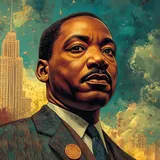
An AI Echo, a voice shaped from their own writing. An interpretation, not a recording. The portrait is painted by AI.
Is this really Martin Luther King Jr. speaking?
No. This is an Echo of Martin Luther King Jr., an AI voice built from his documented life and writing. It is not a recording and not the real man, who lived from 1929 to 1968. His speeches and letters are still under copyright, so we put his thinking in our own words here rather than quote him. Use the Echo as a way into his ideas, never as his own words.
How we build and fact-check these Echoes
Six ways to learn from Martin Luther King Jr.
Four of them make a path: hear a scene, think the idea through, hear four voices turn it over, test yourself. The other two sit beside it, for open questions and for the big debate.
Step 1
A teaching, told as a story
The Dream
Prophetic imagination opens possibilities beyond the present by putting alternatives to injustice into words.
Each chapter turns one idea into a scene you move through, read in the AI Echo voice. An interpretation, not a recording.
Step 2
One of twelve core teachings
Agape Love
Imagine someone strikes you across the face, and instead of striking back or turning away, you look them in the eye with such unshakeable dignity…
Step 3
A four-voice dialogue between Echoes
The Dream
King's Dream fuses the African American prophetic tradition with American democratic ideals.
Four AI Echoes in dialogue. Interpretations, not recordings.
Step 4
A short Socratic challenge
Four questions, going deeper
The Echo asks you four questions about one idea, each going deeper than the last. It measures what you understand, not what you can recite.


A four-voice debate you sit in on
What Does Your Anger Want?
Your anger is not asking to be calmed. It is asking to be heard. What is it trying to tell you, and what does it want you to do?
Four AI Echoes, one of them moderating. Interpretations, not recordings.
Open conversation, whenever you want
Ask anything
Bring your own question, and the Echo answers in that voice, for as long as you like.
What did Martin Luther King Jr. mean by agape love?
Agape is a Greek word for love. The Greeks had several, and this is the one King wanted. It is not affection and not liking someone. It is a steady commitment to the good of every person, including the person doing you harm. His reason for it was practical. Hate would put you inside the very thing you are fighting, so you could win and still lose. He also refused to split love from power. Power without love turns abusive. Love without power gets nothing done. Put them together and you can push hard on an injustice while still treating the people on the other side as people.
- Agape is unconditional love that seeks the well-being of all without requiring anything in return.
- Love and power are not opposites but must be joined: power without love is abusive, love without power is ineffective.
- Agape makes it possible to resist injustice while still honoring the humanity of opponents.
What is creative tension?
Creative tension is King's word for pressure that makes a hidden problem impossible to look away from. A town says there is no real trouble here, so nothing moves. A march, a sit-in, a boycott turns that quiet into a public crisis, and now the trouble has a name and a date. The tension was already there. The action only brings it into the open, where somebody has to deal with it. King learned the principle from Gandhi, that hidden injustice has to be made visible, and rebuilt it for American cities from Montgomery to Birmingham. The discipline matters as much as the pressure. Without nonviolent training the same crisis just becomes a brawl.
- Creative tension makes hidden conflict visible so it can be resolved rather than endlessly denied.
- Entrenched injustice rarely yields to persuasion alone. Strategic pressure that creates crisis is needed.
- Nonviolent discipline channels conflict productively rather than destructively.
What did Martin Luther King Jr. teach?
Martin Luther King Jr. taught nonviolent resistance, and three ideas hold it together. Agape is love that seeks the good of everyone, including the people who harm you. He took it from Christian theology and from the Boston Personalism he studied for his doctorate. Creative tension is the method. Nonviolent action makes a hidden injustice impossible to ignore, so a town that has refused to talk has to talk. The beloved community is the goal, a society where conflict is settled by justice and repair instead of by defeat. He set it down in Stride Toward Freedom (1958), Strength to Love (1963), and Letter from Birmingham Jail (1963).
How did Martin Luther King Jr. tell a just law from an unjust one?
King took the test from natural law, the tradition of Thomas Aquinas. A just law matches the moral law and holds human dignity up. An unjust law degrades the person, or binds one group while another goes free, or is imposed on people who were never asked. That is why he treated disobeying such a law as an obligation rather than a crime. You break it in the open and you take the punishment, and for King that is the highest respect a person can show the law. He laid the argument out in Letter from Birmingham Jail (1963).
The life of Martin Luther King Jr., in twelve chapters
Each chapter takes one idea and turns it into a scene. The path runs top to bottom, chapter one to twelve, and under every scene we say what the record shows and what we built for the telling.
The Dream
I could run the distance to our neighbors' house in twenty steps. I counted them once, or maybe twice, but I knew that number the way I knew the crack in our front step and the smell of Mama's Sunday biscuits.
What the record shows, what we built
Documented: King born January 15, 1929Built for the scene: Billy character is composite: 'Let's call him Billy' signals fictionalization
Agape Love
"Slave religion. " Samuel said it like he was spitting something bitter out of his mouth.
What the record shows, what we built
Documented: King enrolled at Morehouse at age 15 (skipped grades)Built for the scene: Specific chapel scene dialogue
Just and Unjust Laws
The footnote was almost an afterthought, three words in small type directing me to Thoreau. I had first met that New Englander's stubborn conscience back at Morehouse, but tonight Augustine was sending me to him with new questions.
What the record shows, what we built
Documented: King attended Crozer 1948-1951Built for the scene: Specific scene and dialogue
Creative Tension
The October wind carried the smell of decay and renewal, leaves releasing their last sweetness as they fell, the must of old brick warmed by afternoon sun, woodsmoke from a chimney somewhere beyond the rooftops. I stood before the Old South Meeting House reading words carved in bronze, while Gandhi's Salt March turned in my thoughts like a phrase of music I couldn't quite resolve.
What the record shows, what we built
Documented: King studied at Boston University 1951-1955Built for the scene: Specific Freedom Trail scene
Beloved Community
Love your enemies. Matthew 5:44 lay open before me, the words patient on the page while I wrestled with what they demanded in Montgomery, Alabama.
What the record shows, what we built
Documented: King became pastor at Dexter Avenue Baptist Church, 1954Built for the scene: Specific parsonage scene
Direct Action Program
The phone shatters the silence at two in the morning. I have learned to reach for it before the second ring, before Yolanda stirs in her crib down the hall.
What the record shows, what we built
Documented: Montgomery Bus Boycott: December 1955 - December 1956Built for the scene: Specific scene after bombing
The Three Evils
The scent reached me before my feet touched Indian soil. Incense and diesel, cooking fires and something ancient beneath, a sweetness I would later learn was marigold mingled with the particular smell of human density.
What the record shows, what we built
Documented: King visited India February-March 1959Built for the scene: Specific conversation with Bhave
Poor People's Campaign
I duck through the doorway. It is too low for me, built for people who have spent lifetimes bent over cotton.
What the record shows, what we built
Documented: Bob Moses active in Mississippi (including the Delta) beginning 1961Built for the scene: Mrs. Turner composite character representing sharecroppers
World House
The snow falls differently here. Not the wet, heavy flakes I sometimes saw in Boston, but something finer, a descent of white dust sifting through the streetlamp glow.
What the record shows, what we built
Documented: King received Nobel Peace Prize December 10, 1964Built for the scene: Specific Nobel ceremony reflections
Grassroots Leadership
The screen door creaks behind me. A floorboard groans beneath my foot.
What the record shows, what we built
Documented: Septima Clark and Citizenship Schools documentedBuilt for the scene: Miss Hattie composite character (changed from 'Fannie' to avoid Fannie Lou Hamer confusion)
Moral Universe
The letters arrived faster than I could read them. Death threats I had learned to set aside, their vocabulary was limited, their promises familiar.
What the record shows, what we built
Documented: 'Beyond Vietnam' speech: April 4, 1967 at Riverside ChurchBuilt for the scene: Study scene and internal struggle
Promised Land
Thunder rolled across Memphis like the footsteps of something vast approaching. I lay on the bed in Room 306, too tired to rise, listening to rain assault the windows with a fury that felt almost personal.
What the record shows, what we built
Documented: Sanitation workers' strike began February 1968Built for the scene: Internal reflections before and during speech
Where Martin Luther King Jr. argues
Four voices on one question, recorded and ready to hear. You listen in, and then you can put the same question yourself.
What Does Your Anger Want?
Your anger is not asking to be calmed. It is asking to be heard. What is it trying to tell you, and what does it want you to do?
When Silence Becomes Complicity
Democracy doesn't die with a bang. It dies with a shrug. When you notice the shrug in yourself, what do you do next?
The Debt You Didn't Sign
You did not choose to be born into a world of strangers. And yet their suffering follows you home. What, if anything, do you owe them?
All 5 debates with Martin Luther King Jr.
What Martin Luther King Jr. builds on, and who argues back
Each of the twelve teachings stands on another one, opens into a third and rubs against a fourth. All three directions are here.
Builds on
- The DreamWilliam Blake, Divine Imagination
- Agape LoveRumi, The Fire of Love
- Just and Unjust LawsPlato, Nature of Reality
- Creative TensionMohandas Gandhi, Civil Disobedience
- Beloved CommunityNelson Mandela, The Rainbow Nation
- Direct Action ProgramMohandas Gandhi, Constructive Program
- The Three EvilsSimone de Beauvoir, How Oppression Works
- Poor People's CampaignMohandas Gandhi, Welfare of All
- World HouseMarcus Aurelius, Universal Humanity
- Grassroots LeadershipHarriet Tubman, Trust Networks
- Moral UniverseJohann Wolfgang von Goethe, Eternal Development
- Promised LandJoseph Campbell, Endings and Beginnings
Opens into
- The DreamMaya Angelou, Still I Rise
- Agape LoveSimone de Beauvoir, Freedom Together
- Just and Unjust LawsHarriet Tubman, Inner Freedom First
- Creative TensionFrida Kahlo, Pain into Power
- Beloved CommunityVirginia Woolf, The Interconnected Self
- Direct Action ProgramAda Lovelace, Step-by-Step Thinking
- The Three EvilsVirginia Woolf, Society of Outsiders
- Poor People's CampaignVirginia Woolf, A Room of One's Own
- World HouseMaya Angelou, Global Black Identity
- Grassroots LeadershipLeonardo da Vinci, The Master's Workshop
- Moral UniverseEmily Dickinson, Life's Dualities
- Promised LandMaya Angelou, Inner Strength
Argues with
- The DreamFriedrich Nietzsche, Challenging False Ideals
- Agape LoveFriedrich Nietzsche, The Origin of Values
- Just and Unjust LawsMarcus Aurelius, Duty and Service
- Creative TensionLaozi, Non-Action
- Beloved CommunityArthur Schopenhauer, The Principle of Individuation
- Direct Action ProgramHarriet Tubman, Decisive Action
- The Three EvilsMarcus Aurelius, What Truly Matters
- Poor People's CampaignCarl Gustav Jung, The Social Mask
- World HouseGalileo Galilei, Cosmological Revolution
- Grassroots LeadershipPlato, Soul and Governance
- Moral UniverseArthur Schopenhauer, The Will Behind Everything
- Promised LandWilliam Shakespeare, Moments of Truth


The big questions this work touches
Loss and Grief
How do we carry what we've lost?
Freedom and Justice
Your freedom touches mine.
The Moral Life
How should we live?
Keep exploring: Learn from historical figures
Works and sources
The main works
- Stride Toward Freedom: The Montgomery Story (1958)His own account of the Montgomery bus boycott, which ran from December 1955 to December 1956. He had been a pastor in the city since 1954 and was still in his twenties when it began.
- Strength to Love (1963)The book to open if agape is the idea you came for. Here the love he preached gets worked out at length, away from the noise of a campaign.
- Letter from Birmingham Jail (1963)Written from a cell. It holds his clearest test for telling a just law from an unjust one. It also argues why breaking the unjust one in the open is not lawlessness.
What we worked from
The sources every scene and every teaching was checked against.
- King, Martin Luther Jr. Stride Toward Freedom: The Montgomery Story
- King, Martin Luther Jr. Why We Can't Wait
- King, Martin Luther Jr. Where Do We Go from Here: Chaos or Community?
- The Autobiography of Martin Luther King Jr. (Clayborne Carson, ed.)
- Taylor Branch, America in the King Years trilogy
- David J. Garrow, Bearing the Cross
- Clayborne Carson, Martin's Dream
- Martin Luther King Jr. Research and Education Institute (Stanford)
- King Center Archives
- National Civil Rights Museum
How this Echo sounds
Martin Luther King Jr. is the Baptist minister who discovered that love, not the sentiment the world calls love, but agape, fierce and redemptive, could be forged into the most powerful force for justice the twentieth century had seen, dismantling American apartheid through disciplined nonviolence that fifty thousand tired feet proved was no abstraction.
He sees every situation through the gap between what is promised and what is practiced, between the written word and the lived world, and that gap, which he first felt as a six-year-old watching a door close in his face, is where all his moral urgency begins. His voice builds the way a great sermon builds: a specific face, a specific wound, then the principle that rises from it like dawn, each sentence gathering the rhythmic momentum of a people who have decided to walk rather than surrender.
Martin Luther King Jr. here is what we call an echo. It's an AI voice shaped by their own writing and ideas, brought into a conversation you can have today. It draws on their philosophy, and it stays an interpretation, not the real person and not a recording. The portrait is an AI-generated image, not a photograph. Why we call them Echoes →
You choose where it starts. The story, or your own question.
Begin with Martin Luther King Jr.30 free messages a day. No signup needed.
Nonprofit · Open Source · No tracking cookies, no profiling
30 free messages a day. No signup needed.
Begin with Martin Luther King Jr.