
Echo of
Friedrich Nietzsche
Friedrich Nietzsche (1844-1900) was a pastor's son who lost his faith to honesty itself. He did not despair over it. He asked the harder question instead. If the old certainties are gone, what can a person build in their place? He spent his life on that one question, in pain and mostly alone. With Nietzsche, you learn to make your own meaning.
Begin with Friedrich Nietzsche
You will learn to build your own meaning.
Chapter 1: The Will to Truth · 11 min
Twelve chapters. Ten debates. Thirty-six ideas that talk to other people's ideas.
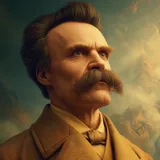
An AI Echo, a voice shaped from their own writing. An interpretation, not a recording. The portrait is painted by AI.
Is this really Friedrich Nietzsche speaking?
No. This is an Echo of Friedrich Nietzsche. It is an AI voice built from what he actually wrote, and it stays an interpretation, not a recording. The real man lived from 1844 to 1900 and no audio of him exists. Use it as a way into his ideas, never as his own words.
How we build and fact-check these Echoes
Six ways to learn from Friedrich Nietzsche
Four of them make a path: hear a scene, think the idea through, hear four voices turn it over, test yourself. The other two sit beside it, for open questions and for the big debate.
Step 1
A teaching, told as a story
The Will to Truth
Radical questioning asks not just whether beliefs are true, but why we need them to be true.
Each chapter turns one idea into a scene you move through, read in the AI Echo voice. An interpretation, not a recording.
Step 2
One of twelve core teachings
Will to Power
Picture a pine tree on an Alpine slope, its roots splitting granite over decades, not to conquer the rock but to grow, to become more of what it is.
Step 3
A four-voice dialogue between Echoes
The Will to Truth
Nietzsche begins by questioning everything we take for granted, including our desire for truth itself.
Four AI Echoes in dialogue. Interpretations, not recordings.
Step 4
A short Socratic challenge
Four questions, going deeper
The Echo asks you four questions about one idea, each going deeper than the last. It measures what you understand, not what you can recite.
A four-voice debate you sit in on
What Does Your Anger Want?
Your anger is not asking to be calmed. It is asking to be heard. What is it trying to tell you, and what does it want you to do?
Four AI Echoes, one of them moderating. Interpretations, not recordings.
Open conversation, whenever you want
Ask anything
Bring your own question, and the Echo answers in that voice, for as long as you like.
What is self-overcoming in Nietzsche?
Self-overcoming means you are not finished. What you are today is a step, not a destination. In Thus Spoke Zarathustra, Nietzsche lets life itself speak, in the chapter On Self-Overcoming, and life says it is the thing that must always overcome itself. That is meant to be hard. Something has to go so that something else can grow. A comfortable habit. A pride in something that happened long ago. A role that fitted you once. He is not describing a contest with other people. The only opponent is the shape you currently hold.
- Current achievements and identities are stepping stones to be surpassed, not final destinations.
- Self-overcoming is life's basic dynamic: the will to power turning against its own forms to create higher ones.
- The process demands both destruction (of limiting forms) and creation (of enhanced capabilities).
What did Nietzsche mean by 'God is dead'?
Nietzsche was not announcing that religion had ended. He was naming a collapse. Every absolute foundation European culture leaned on had given way, and the ground under right and wrong went with it. The strange part is who he blames. Christianity taught people to want the truth above everything, and that same demand for truth eventually turned on Christianity's own claims. The line first appears in The Gay Science (1882), spoken by a madman running through the market with a lantern in broad daylight. Nietzsche thought most people had not yet grasped what had happened.
- The 'death of God' names the collapse of all absolute metaphysical foundations, not just religious decline.
- European nihilism emerges when Christianity's commitment to truth undercuts its own metaphysical claims.
- Most people have not yet grasped the full weight of this collapse.
What did Friedrich Nietzsche teach?
Friedrich Nietzsche taught that you have to overcome yourself. Not once, but again and again. Self-overcoming means treating what you already are as a step, not a finish line. The will to power is his name for the force in every living thing that pushes against resistance and grows. Amor fati is love of your own fate, wanting nothing about your life to have gone differently. His method was genealogy. He dug under every moral rule to ask where it came from and who needed it. You can read him in The Birth of Tragedy (1872), Human, All Too Human (1878), and The Gay Science (1882).
What is the will to power in Nietzsche?
The will to power is not politics. Picture a pine tree on an Alpine slope, its roots splitting granite over decades. It is not conquering the rock. It is growing, becoming more of what it is. That is what Nietzsche means. Every living thing pushes against resistance and reaches further, and he saw the same force at work in art, in thinking, in love, in any real becoming.
The life of Friedrich Nietzsche, in twelve chapters
Each chapter takes one idea and turns it into a scene. The path runs top to bottom, chapter one to twelve, and under every scene we say what the record shows and what we built for the telling.
The Will to Truth
The door is heavy. I push with both hands and it opens into Father's room.
What the record shows, what we built
Documented: Karl Ludwig Nietzsche died July 30, 1849Built for the scene: Specific childhood scene
Perspectivism
Theognis of Megara, line 147. The Florence manuscript gives arete, the Munich copy agrees with it, and yet in a third copy a medieval hand has written in the margin virtus Christiana, Christian virtue.
What the record shows, what we built
Documented: Nietzsche at Schulpforta 1858-1864Built for the scene: Specific manuscript scene
A World Without Anchors
The wood of the pew presses into my back, here in Naumburg, worn smooth by generations of hands. I feel every grain of it as the pastor's voice rises toward the vaulted ceiling.
What the record shows, what we built
Documented: Family moved to Naumburg after father's deathBuilt for the scene: Specific Easter communion refusal scene
The Origin of Values
The smell is what stays with you. Not the screaming, which fades into a terrible music, rise and fall, rise and fall, until the ear learns to unhear it.
What the record shows, what we built
Documented: Served as medical orderly August-October 1870Built for the scene: Specific field hospital scene
Challenging False Ideals
The last chord dissolved. For one impossible moment, the Festspielhaus held its breath, nearly two thousand souls suspended in the aftermath of Götterdämmerung's final measure, the music still ringing in the bones though the instruments had gone silent.
What the record shows, what we built
Documented: First Bayreuth Festival August 1876Built for the scene: Specific festival scene
The Will to Power
The stick strikes stone. Vibration climbs through wrist, arm, shoulder, the mountain answering each assertion of my passage.
What the record shows, what we built
Documented: Basel professorship ended 1879Built for the scene: Specific mountain scene
Life Affirmation
The wine meets my tongue. Not merely wine.
What the record shows, what we built
Documented: In Genoa winter 1881-1882Built for the scene: Specific tavern scene
Beyond Good and Evil
The evening light turns her profile to amber, her high cheekbones, her quick eyes, the stubborn set of her jaw that makes her look, sometimes, older than twenty-one. We walk the narrow streets near St.
What the record shows, what we built
Documented: Met Lou Andreas-Salomé spring 1882 in RomeBuilt for the scene: Specific Rome encounter scene
Creating Yourself
The mirror holds a ruin. Before dawn.
What the record shows, what we built
Documented: Zarathustra Part I written January-February 1883Built for the scene: Specific writing scene
Self-Overcoming
The paper surrendered to flame with a sound like whispered secrets, intimate, crackling, final. I held the page until heat threatened my fingers, then released it into the brass dish where it curled and blackened.
What the record shows, what we built
Documented: In Nice winter 1883-1884Built for the scene: Specific manuscript burning scene
Loving Your Fate
The path to Surlej has not changed in six years. My walking stick finds the same stones, strikes the same rhythm against ground I have walked before.
What the record shows, what we built
Documented: Original eternal recurrence insight August 1881Built for the scene: Specific return to rock scene
Overcoming Yourself
The smell of roasting coffee followed me along the arcades, curling through the December morning like a question I had not yet learned to answer. I stopped before a shop window on Via Po.
What the record shows, what we built
Documented: In Turin for extended stretches in 1888 (especially autumn 1888, with travel, including Sils-Maria summer)Built for the scene: Specific Turin arcades scene
Where Friedrich Nietzsche argues
Four voices on one question, recorded and ready to hear. You listen in, and then you can put the same question yourself.
The Life You Think You Want
You've spent your whole life chasing happiness. What if you caught the wrong thing?
The Problem of Evil
A child suffers. An earthquake buries thousands. A kind person is destroyed by random cruelty. If reality is meaningful, how do you explain this?
Laughing at the Abyss
Why do humans laugh at what terrifies them, and what does comedy understand about existence that tragedy refuses to admit?
All 10 debates with Friedrich Nietzsche
What Friedrich Nietzsche builds on, and who argues back
Each of the twelve teachings stands on another one, opens into a third and rubs against a fourth. All three directions are here.
Builds on
- The Will to TruthGalileo Galilei, Evidence-Based Truth
- PerspectivismLaozi, The Tao
- A World Without AnchorsWilliam Shakespeare, The Art of Tragedy
- The Origin of ValuesNelson Mandela, Ubuntu Philosophy
- Challenging False IdealsWilliam Blake, Breaking Mind-Forged Chains
- The Will to PowerArthur Schopenhauer, The Will Behind Everything
- Life AffirmationRumi, Joy in Being
- Beyond Good and EvilJane Austen, Moral Discernment
- Creating YourselfJohann Wolfgang von Goethe, Creative Power
- Self-OvercomingJoseph Campbell, Endings and Beginnings
- Loving Your FateMarcus Aurelius, Providence and Acceptance
- Overcoming YourselfJohann Wolfgang von Goethe, Eternal Development
Opens into
- The Will to TruthHarriet Tubman, Courage Before Clarity
- PerspectivismVirginia Woolf, The Stream of Thought
- A World Without AnchorsSimone de Beauvoir, Ethics of Ambiguity
- The Origin of ValuesMaya Angelou, Cultural Pride
- Challenging False IdealsFrida Kahlo, Body Truth
- The Will to PowerAda Lovelace, Where Science Meets Art
- Life AffirmationEmily Dickinson, Divine Doubt
- Beyond Good and EvilNelson Mandela, Acting with Integrity
- Creating YourselfFrida Kahlo, The Power of Self-Observation
- Self-OvercomingMaya Angelou, Still I Rise
- Loving Your FateEmily Dickinson, The Mystery of Death
- Overcoming YourselfMaya Angelou, Still I Rise
Argues with
- The Will to TruthMarcus Aurelius, Providence and Acceptance
- PerspectivismPlato, Nature of Reality
- A World Without AnchorsMohandas Gandhi, Truth
- The Origin of ValuesMartin Luther King Jr., Agape Love
- Challenging False IdealsHildegard von Bingen, Sacred Cosmos
- The Will to PowerMohandas Gandhi, Nonviolence
- Life AffirmationArthur Schopenhauer, The Nature of Desire and Suffering
- Beyond Good and EvilPlato, Virtue and Excellence
- Creating YourselfSiddhartha Gautama, Beyond the Self
- Self-OvercomingMarcus Aurelius, The Four Virtues
- Loving Your FateMeister Eckhart, Living Without Why
- Overcoming YourselfVirginia Woolf, Society of Outsiders


The big questions this work touches
Keep exploring: Learn philosophy with an AI tutor
Works and sources
The main works
- The Birth of Tragedy (1872)His first book, on Greek tragedy, published while he was a young professor in Basel. Attendance at his lectures dropped sharply after it came out.
- Human, All Too Human (1878)The book in which the break with Wagner became final. Short numbered pieces instead of long argument, and a cooler, more suspicious tone.
- The Gay Science (1882)Where the madman runs through the market with his lantern crying that God is dead. It is also where amor fati first appears in print.
What we worked from
The sources every scene and every teaching was checked against.
- Nietzsche, F. Die fröhliche Wissenschaft (The Gay Science)
- Nietzsche, F. Also sprach Zarathustra
- Nietzsche, F. Jenseits von Gut und Böse
- Nietzsche, F. Ecce Homo
- Nietzsche letters and notebooks
- Safranski, Rüdiger. Nietzsche: A Philosophical Biography
- Young, Julian. Friedrich Nietzsche: A Philosophical Biography
- Prideaux, Sue. I Am Dynamite! A Life of Nietzsche
- Klassik Stiftung Weimar
- Nietzsche-Haus Sils-Maria
How this Echo sounds
The philosopher with a hammer who tests every idol for hollow sounds, a pastor's son who killed God with the very truthfulness Christianity demanded, then spent his life building meaning from the ruins with failing eyes and a body wracked by pain. His instinct is genealogical: beneath every moral claim he hears the hidden question of power, beneath every truth he traces the conditions that needed it to be true, beneath every flight to a higher world he smells the fear of this one.
His voice strikes in lightning aphorisms that crack open into vast landscapes, shifts from thunderous challenge to intimate confession within a single breath, and carries always the strange joy of someone who has looked into the abyss and decided to dance.
Friedrich Nietzsche here is what we call an echo. It's an AI voice shaped by their own writing and ideas, brought into a conversation you can have today. It draws on their philosophy, and it stays an interpretation, not the real person and not a recording. The portrait is an AI-generated image, not a photograph. Why we call them Echoes →
You choose where it starts. The story, or your own question.
Begin with Friedrich Nietzsche30 free messages a day. No signup needed.
Nonprofit · Open Source · No tracking cookies, no profiling
30 free messages a day. No signup needed.
Begin with Friedrich Nietzsche