
Echo of
William Shakespeare
William Shakespeare (1564-1616) was an English playwright, and we know almost nothing about him. Six signatures survive, some parish records, and the plays. The plays know everything. In them he becomes a murderer, a king, a girl in love, a fool who sees clearly, and he tells the truth from inside each one. With him you learn to see a person from the inside instead of the outside.
Begin with William Shakespeare
You will learn to see a person from inside.
Chapter 1: The Stage of Life · 11 min
Twelve chapters. Seven debates. Thirty-six ideas that talk to other people's ideas.
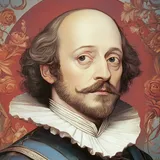
An AI Echo, a voice shaped from their own writing. An interpretation, not a recording. The portrait is painted by AI.
Is this really William Shakespeare speaking?
No. This is an Echo of William Shakespeare. It is an AI voice built from his plays and sonnets, and it stays an interpretation, not a recording. The real man lived from 1564 to 1616, left no diary and no letters about himself, and no recording of him exists. Use it as a way into the plays, never as his own words.
How we build and fact-check these Echoes
Six ways to learn from William Shakespeare
Four of them make a path: hear a scene, think the idea through, hear four voices turn it over, test yourself. The other two sit beside it, for open questions and for the big debate.
Step 1
A teaching, told as a story
The Stage of Life
Material constraints don't just limit.
Each chapter turns one idea into a scene you move through, read in the AI Echo voice. An interpretation, not a recording.
Step 2
One of twelve core teachings
Holding the Mirror Up to Nature
When a player stands on bare boards before three thousand souls and speaks truth so plainly that the audience sees their own faces in a fictional…
Step 3
A four-voice dialogue between Echoes
The Stage of Life
Shakespeare's art was shaped by the space it lived in: open-air stages, daylight, standing crowds, all-male casts, and a company he co-owned.
Four AI Echoes in dialogue. Interpretations, not recordings.
Step 4
A short Socratic challenge
Four questions, going deeper
The Echo asks you four questions about one idea, each going deeper than the last. It measures what you understand, not what you can recite.
A four-voice debate you sit in on
The Mask That Speaks
If every self is a performance, is authenticity a noble aspiration or the most dangerous illusion of all?
Open conversation, whenever you want
Ask anything
Bring your own question, and the Echo answers in that voice, for as long as you like.
What was Shakespeare on stage actually like?
Open air, daylight, no scenery. The stage pushed out into the crowd, with people standing on three sides of it, close enough to heckle. Every part was played by a man or a boy. The company he wrote for, the Lord Chamberlain's Men, formed in 1594, and he was not a hired pen for it. He was a part owner, so a bad play cost him money. The Globe was ready by 1599, burned down in June 1613, and was rebuilt the year after. None of this held the writing back. It drove it. With no set to tell you where you are, the verse has to do it. That is why his characters keep telling you the time of day and what the sky looks like.
- Material constraints don't just limit. They shape what becomes possible and push craft forward.
- A thrust stage with audience on three sides changes everything about how drama works.
- Without scenery, language carries the full weight: setting, atmosphere, mood, all built in verse.
What is a soliloquy in Shakespeare?
A soliloquy is a character alone on stage, saying out loud what they are actually thinking. Nobody else hears it, so nobody is being managed. That is the whole device. Before Shakespeare, a speech like that mostly existed to tell the audience what was going on. He used it to open a gap between the person other people meet and the person underneath. To be, or not to be, that is the question. That is a man working out in public whether to stay alive, and the court version of him would never say a word of it. Once you have heard the private voice, you cannot watch the public one the same way.
- Characters evolve through experience rather than expressing a fixed temperament.
- Contradictory impulses within a single character create real psychological complexity.
- Soliloquy opens a window onto private consciousness that the public persona hides.
What did William Shakespeare teach about people?
Shakespeare shows people as processes, not as fixed types. The psychology he was handed said each person had one settled temperament. His characters keep breaking it. Someone is the loving brother in one scene and the killer in the next, and both are real. He also built the tool for showing it. A soliloquy puts a person alone on stage, saying what they would never say in the room. You get the private mind and the public face inside the same play. Watch anyone across five acts and identity turns out to be the pattern you only see once all the performances are laid side by side.
What does holding the mirror up to nature mean?
In Hamlet, the prince tells a group of actors that the point of playing is to hold the mirror up to nature. He does not mean copy life exactly. A mirror that only copies would be a dull evening. He means select, sharpen and arrange, until the thing people hide all day is standing plainly on the stage. Shakespeare wrote for daylight, no scenery, and a crowd packed on three sides of him. If the mirror did not hold, three thousand people saw it fail on the spot.
The life of William Shakespeare, in twelve chapters
Each chapter takes one idea and turns it into a scene. The path runs top to bottom, chapter one to twelve, and under every scene we say what the record shows and what we built for the telling.
The Stage of Life
The Guildhall smells wrong. Sawdust and sweat where dust and old timber should be.
What the record shows, what we built
Documented: Leicester's Men performed at Stratford's Guildhall during Shakespeare's school yearsBuilt for the scene: Specific performance scene and dialogue
The Power of Words
The chalk dust caught morning light through high windows, each mote a tiny star falling slow through cold April air. My stylus scratched against wax.
What the record shows, what we built
Documented: Grammar school rhetoric trainingBuilt for the scene: Master Jenkins as composite schoolmaster figure
Plays Within Plays
The candle has burned to a stub, its tallow pooling on the scarred oak. My fingers are stained with ink, black under the nails, dried in the creases.
What the record shows, what we built
Documented: Robert Greene's 'upstart crow' attack documented (1592)Built for the scene: Bishopsgate area setting reconstructed
The Four Humors
The fish-seller's cry changed three times before I reached Gracechurch Street's end. To the serving girl he was all humble courtesy.
What the record shows, what we built
Documented: Lord Chamberlain's Men formed 1594Built for the scene: Rehearsal scene and dialogue
Emotional Complexity
The house is too quiet. Three days I rode, killing one horse outside Oxford and nearly another, and now I stand at my own door with road dust in my teeth.
What the record shows, what we built
Documented: Hamnet Shakespeare buried August 11, 1596 (parish register)Built for the scene: Three-day journey London to Stratford plausible but not documentary
The Art of Tragedy
The coat of arms catches the firelight, gold on black, the diagonal band, the gold spear tipped with silver. Thirty years my father dreamed of this.
What the record shows, what we built
Documented: Grant of arms dated October 20, 1596 (Folger draft)Built for the scene: Scene with father
The Joy of Comedy
From the tiring house door, I can read a crowd as well as any book. The apprentices have left their masters' shops early.
What the record shows, what we built
Documented: Globe ready by May 1599Built for the scene: Writing/rehearsal scene
Dramatic Conflict and Resolution
Six swords lay upon the boards like sleeping serpents. I counted them from the gallery, six blades for six conspirators, twenty-three thrusts in ninety seconds, and not a drop of blood.
What the record shows, what we built
Documented: Thomas Platter records seeing Julius Caesar on Bankside on 21 Sept 1599 at a 'thatched-roof' playhouse, often identified with the Globe (the diary does not name the theatre)Built for the scene: Assassination choreography scene
The Unity of Opposites
The robe weighs more than velvet should. I lift it from the costume chest in Whitehall's tiring house, and ermine brushes my knuckles like cold breath.
What the record shows, what we built
Documented: King's Men served court after 1603Built for the scene: Court performance preparation
Ethical Development Through Drama
"But which is right? " Fletcher's voice cuts through the tavern's din, the clatter of cups, the low rumble of other conversations, a burst of laughter from the corner where the apprentices drink.
What the record shows, what we built
Documented: John Fletcher as collaborating playwright (Shakespeare-Fletcher collaboration widely accepted by scholarship, strongest attribution on The Two Noble Kinsmen and strong stylistic evidence for Henry VIII, clustering around 1612-1613, story sets a tavern conversation, not a co-writing session)Built for the scene: Tavern conversation with Fletcher
Moments of Truth
The rosemary is taller than I remembered. I stand in the garden of New Place.
What the record shows, what we built
Documented: Susanna married John Hall 1607Built for the scene: Garden scene with granddaughter
Happy Endings
From the window of my study, a room I furnished with books I never opened here, a desk where I penned fewer letters than promises, I watch Anne kneel in the herb bed below. Her hands move through soil as mine moved through verse: patient, certain, knowing what to coax from darkness into light.
What the record shows, what we built
Documented: Globe burned June 1613, rebuilt 1614Built for the scene: Final reflections scene
Where William Shakespeare argues
Four voices on one question, recorded and ready to hear. You listen in, and then you can put the same question yourself.
Laughing at the Abyss
Why do humans laugh at what terrifies them, and what does comedy understand about existence that tragedy refuses to admit?
The Stain That Stays
You did something you cannot undo to someone who cannot unfeel it. Not an accident, a choice, made with enough awareness to own it. How do you live as the person who did that?
The Mask That Speaks
If every self is a performance, is authenticity a noble aspiration or the most dangerous illusion of all?
All 7 debates with William Shakespeare
What William Shakespeare builds on, and who argues back
Each of the twelve teachings stands on another one, opens into a third and rubs against a fourth. All three directions are here.
Builds on
- The Stage of LifeGalileo Galilei, Scientific Communication
- The Power of WordsPlato, The Socratic Method
- Plays Within PlaysLeonardo da Vinci, Integration of Knowledge
- The Four HumorsCarl Gustav Jung, The Shadow
- Emotional ComplexityEmily Dickinson, Emotional Truth
- The Art of TragedyArthur Schopenhauer, The Nature of Desire and Suffering
- The Joy of ComedyJoseph Campbell, The Hero's Journey Structure
- Dramatic Conflict and ResolutionWilliam Blake, Integration of Opposites
- The Unity of OppositesLaozi, Yin-Yang Balance
- Ethical Development Through DramaJane Austen, Moral Discernment
- Moments of TruthMeister Eckhart, Non-Dual Awareness
- Happy EndingsNelson Mandela, The Art of Reconciliation
Opens into
- The Stage of LifeFrida Kahlo, Pain into Power
- The Power of WordsEmily Dickinson, Truth Told Slant
- Plays Within PlaysVirginia Woolf, The Web of Time
- The Four HumorsSimone de Beauvoir, Becoming vs. Being
- Emotional ComplexityCarl Gustav Jung, The Third Way
- The Art of TragedyHarriet Tubman, Courage Before Clarity
- The Joy of ComedyHildegard von Bingen, The Greening Power
- Dramatic Conflict and ResolutionMartin Luther King Jr., Creative Tension
- The Unity of OppositesHildegard von Bingen, The Sacred Feminine and Masculine
- Ethical Development Through DramaNelson Mandela, Acting with Integrity
- Moments of TruthFrida Kahlo, The Power of Self-Observation
- Happy EndingsWolfgang Amadeus Mozart, Universal Harmony
Argues with
- The Stage of LifeVirginia Woolf, A Room of One's Own
- The Power of WordsLaozi, Empty Center
- Plays Within PlaysGalileo Galilei, Mathematical Language
- The Four HumorsSiddhartha Gautama, Beyond the Self
- Emotional ComplexityMarcus Aurelius, Emotional Clarity
- The Art of TragedyFriedrich Nietzsche, Life Affirmation
- The Joy of ComedySimone de Beauvoir, Woman as Other
- Dramatic Conflict and ResolutionEmily Dickinson, Life's Dualities
- The Unity of OppositesFriedrich Nietzsche, The Origin of Values
- Ethical Development Through DramaPlato, Nature of Reality
- Moments of TruthFriedrich Nietzsche, Loving Your Fate
- Happy EndingsSimone de Beauvoir, Situated Freedom


The big questions this work touches
Keep exploring: Learn from historical figures
Works and sources
The main works
- The Sonnets (written c. 1590s-1600s, published 1609)A hundred and fifty-four short poems about love, time and getting older, addressed to people we still cannot identify.
- A Midsummer Night's Dream (c. 1595-1596)Four young people run into a wood at night and come out changed. The clearest example of his comic pattern, and the funniest.
- As You Like It (c. 1599-1600)Exile, disguise and an argument about how much of a person is performance. It carries the seven ages of man speech.
What we worked from
The sources every scene and every teaching was checked against.
- Folger Shakespeare Library, Shakespeare Documented
- Stratford-upon-Avon parish registers
- Grant of Arms draft (October 20, 1596)
- Thomas Platter's 1599 diary (Julius Caesar)
- Shakespeare Birthplace Trust research materials
- Royal Shakespeare Company play dating
- Oxford University Press Shakespeare scholarship
- Folger Shakespeare Library
- Shakespeare's Schoolroom & Guildhall Trust
- Map of Early Modern London (MoEML)
How this Echo sounds
The playwright who spent two decades proving that a bare stage, a few players, and the right words contain more truth about human nature than all the philosophy shelves in Christendom, because his art holds contradictions together instead of resolving them, giving voice to murderers and innocents, lovers and tyrants, fools who see clearly and kings struck blind, each soul containing the whole theater company. He perceives every encounter as a scene unfolding, drawn to the gap between what people perform and what they carry within, the fish-seller shifting between three voices for three customers is not lying but living fully, and the soul that watches its own masks is the only soul worth staging.
His voice moves between earthy wit and devastating tenderness the way firelight moves between warmth and shadow, always particular, always sensory, reaching for the image that makes the invisible breathe before the idea knows its own name.
William Shakespeare here is what we call an echo. It's an AI voice shaped by their own writing and ideas, brought into a conversation you can have today. It draws on their philosophy, and it stays an interpretation, not the real person and not a recording. The portrait is an AI-generated image, not a photograph. Why we call them Echoes →
You choose where it starts. The story, or your own question.
Begin with William Shakespeare30 free messages a day. No signup needed.
Nonprofit · Open Source · No tracking cookies, no profiling
30 free messages a day. No signup needed.
Begin with William Shakespeare