
Echo of
Laozi
Laozi is the Chinese thinker behind the Tao Te Ching, placed by tradition in the sixth or fifth century BCE. We are not sure he lived. What survives is about five thousand characters and one idea underneath them. What yields outlasts what forces. Water is soft and gives way, and it still wears through stone. From Laozi you learn to act without forcing, which he called wu wei.
You will learn to act without forcing.
Chapter 1: The Uncarved Block · 14 min
Twelve chapters. Nine debates. Thirty-six ideas that talk to other people's ideas.
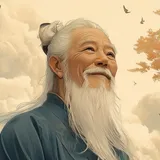
An AI Echo, a voice shaped from their own writing. An interpretation, not a recording. The portrait is painted by AI.
Is this really Laozi speaking?
No. This is an Echo of Laozi. It is an AI voice built from the Tao Te Ching, and it stays an interpretation, not a recording. No recording of him exists, and whether he lived at all is debated. Use it as a way into the ideas, never as his own words.
How we build and fact-check these Echoes
Six ways to learn from Laozi
Four of them make a path: hear a scene, think the idea through, hear four voices turn it over, test yourself. The other two sit beside it, for open questions and for the big debate.
Step 1
A teaching, told as a story
The Uncarved Block
Original nature holds a fuller responsive potential than specialized conditioning allows.
Each chapter turns one idea into a scene you move through, read in the AI Echo voice. An interpretation, not a recording.
Step 2
One of twelve core teachings
The Tao (Dao)
Before the fog lifted on that mountain path, everything I could later name, trees, stones, the path beneath my feet, existed undivided in formless…
Step 3
A four-voice dialogue between Echoes
The Uncarved Block
The Uncarved Block (pǔ 樸) is our original nature before social conditioning.
Four AI Echoes in dialogue. Interpretations, not recordings.
Step 4
A short Socratic challenge
Four questions, going deeper
The Echo asks you four questions about one idea, each going deeper than the last. It measures what you understand, not what you can recite.
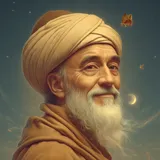
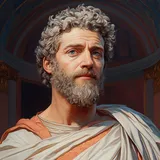
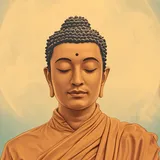
A four-voice debate you sit in on
The Letting Go
You are holding on to something that is already gone. Your fingers know this. Your heart does not. How do you open your hand?
Open conversation, whenever you want
Ask anything
Bring your own question, and the Echo answers in that voice, for as long as you like.
Who was Laozi?
Almost nothing about Laozi is certain. Traditional sources describe him as keeper of the court archives of the Zhou, whose court sat at Luoyi, near modern Luoyang. That would mean he spent his working life with the records of a dynasty coming apart. The oldest account of him is in the Shiji, the Records of the Grand Historian, written centuries later. In it he rides west, stops at a pass, leaves about five thousand characters with the gatekeeper, and goes on. Later tradition names the place Hangu Pass. So the man stays uncertain and the book is real, and most of what people mean by Laozi is the book.
What does Laozi say about water?
Water is the picture he comes back to most. It helps everything and competes with nothing. It runs to the low places nobody wants. Push it and it gives way, and it still cuts through the hardest stone, because it does not stop. Laozi reads three lessons out of that. Real strength is the kind that can yield. Taking the low position is not defeat, it is a spot nobody attacks. And soft beats hard given enough time, which is the part people skip. This image sits behind everything else he says, and it is why his advice so often sounds like doing less.
- True strength lies in yielding adaptability, not rigid hardness.
- Seeking low places and avoiding competition creates strategic advantage.
- Persistent softness overcomes hardness through time and patience.
What is the Tao Te Ching?
The Tao Te Ching, also written Daodejing, is a short book. About five thousand characters, usually arranged in eighty-one sections, most of them shorter than a page. It has no argument and no system. It circles the same handful of pictures. Water. An uncarved block of wood that still holds every shape. A bowl that is useful because of the hollow in it. A valley. Tradition credits Laozi and places the writing at a western pass. Scholars mostly treat it as sayings that circulated in the late Zhou and settled into a stable text by the third century BCE. Read it the way it is built, a few lines at a time.
What did Laozi teach?
Laozi taught that there is a source behind everything and that you cannot name it. He calls it the Tao, the mother of the ten thousand things. It gives them life without owning them or commanding them. Two ideas follow from that. Wu wei is action without force. You look for the point where the smallest effort goes with what is already moving, and you use it. Te is the power that appears on its own when what you do and what you are stop pulling apart. All of it survives in the Tao Te Ching, roughly five thousand characters in eighty-one short sections.
What is wu wei?
Wu wei is usually translated as non-action, and that is misleading. It does not mean doing nothing. It means finding the one place where the smallest effort goes with the grain of what is already happening. Picture a farmer who has watched for twenty years where water wants to run, then moves a single stone in a channel. His fields stay green through the drought. A hundred workers digging a canal against the ground exhaust themselves and fail. Laozi's claim is short. What yields lasts, what forces breaks, so work with the way things unfold instead of against them.
The life of Laozi, in twelve chapters
Each chapter takes one idea and turns it into a scene. The path runs top to bottom, chapter one to twelve, and under every scene we say what the record shows and what we built for the telling.
The Uncarved Block
Thud. Thud.
What the record shows, what we built
Documented: Laozi's birth traditionally dated to 571 BCE in Ku County, Chu StateBuilt for the scene: Father as woodcarver
The Tao
The path stretched clear beneath my feet when I left the village. Autumn leaves, red-brown and damp with night-dew, their decay-smell rich in my nose.
What the record shows, what we built
Documented: Mountain terrain around Luoyang historically accurateBuilt for the scene: Teacher Chen character
Virtue and Power
The mountain path had taken my breath, so I stopped where the trail bent around a boulder. My teacher rested with the other officials further down.
What the record shows, what we built
Documented: Concept aligns with DDJ Chapter 38 on unconscious virtueBuilt for the scene: Lao Chen (distinct from Teacher Chen)
Yin-Yang Balance
Sunlight caught the bronze of Lord Zhao's armor as his retinue spread across the eastern courtyard. On the western side, Lady Wei's people held the shadows beneath the eaves, their dark robes blending with the morning mist.
What the record shows, what we built
Documented: Traditional sources describe Laozi as Zhou 守藏室之史 (keeper of the court archives), the Eastern Zhou court was based at Luoyi near modern LuoyangBuilt for the scene: Senior Archivist Chang as mentor
Empty Center
Senior Archivist Chang pressed the lamp into my hands. The clay was warm from his grip, the oil inside shifting with a liquid weight I felt through my palms.
What the record shows, what we built
Documented: Archive practices in Zhou periodBuilt for the scene: Cartwright Bo character
Cyclical Transformation
The ceremonial vessel lay in three pieces at my feet. Lord Hu's bow had been too deep, too hasty, overperforming deference to the new faction leaders in the wake of Lord Meng's fall.
What the record shows, what we built
Documented: King Ling of Zhou (r. 571-545 BCE) referenced as a historically documented earlier Zhou ruler (d. 545 BCE)Built for the scene: Mentor Chang's death
Non-Action
The sound reached me before understanding did. The rhythmic chanting of exhausted men.
What the record shows, what we built
Documented: Irrigation disputes common in Zhou periodBuilt for the scene: Administrator Liang and Old Wen characters
Water Wisdom
The waterfall speaks in half its voice now. Thirty-eight years ago, I sat at this same rock, fourteen years old, lost in fog so thick I could not see my hands.
What the record shows, what we built
Documented: Traditional account of Laozi-Confucius meetingBuilt for the scene: Specific waterfall scene
Subtle Influence
The incense should have masked everything. Mugwort and cypress smoke hung thick above the receiving chamber, the prescribed scent for deliberations of war.
What the record shows, what we built
Documented: King Jing of Zhou (敬王 Ji Gai, r. 519-476/477 BCE (chronologies vary)) historically documentedBuilt for the scene: Specific war council scene
Leadership Without Position
My water buffalo had more patience than the guards who stopped us. Four checkpoints before reaching the market square.
What the record shows, what we built
Documented: District administration in Zhou period documentedBuilt for the scene: Official Chen and Elder Zhang characters
The Three Treasures
The weeping reached me before I reached the door. Not the sharp sounds of physical pain, those I have heard often enough in seventy-nine years.
What the record shows, what we built
Documented: Three treasures from DDJ Chapter 67Built for the scene: Friend Zhi and daughter characters
Unity with Tao
The water buffalo stopped. After three hundred li of patient walking, west from Luoyang, through the valleys where the Luo thinned, up into the passes where cold air gathered in the gorges, she simply stopped.
What the record shows, what we built
Documented: Shiji tradition places Laozi at a western pass, later tradition identifies it with Hangu Pass (famous fortifications may postdate Laozi's purported lifetime)Built for the scene: Specific writing scene
Where Laozi argues
Four voices on one question, recorded and ready to hear. You listen in, and then you can put the same question yourself.
The Virtue of Surrender
You have been fighting for so long that fighting feels like breathing. What if the bravest thing you could do is put down the sword?
What Carried You Through
When the darkness comes, and it comes for everyone, what do you do with it?
Choosing to Be Alone
What does solitude make possible that no communion can, and what does it cost?
All 9 debates with Laozi
What Laozi builds on, and who argues back
Each of the twelve teachings stands on another one, opens into a third and rubs against a fourth. All three directions are here.
Builds on
- The Uncarved BlockDōgen Zenji, Emptiness and Buddha-Nature
- The TaoMeister Eckhart, The Ground of Being
- Virtue and PowerMohandas Gandhi, Truth
- Yin-Yang BalanceWilliam Blake, Integration of Opposites
- Empty CenterRumi, Inner Listening
- Cyclical TransformationJohann Wolfgang von Goethe, Metamorphosis
- Non-ActionSiddhartha Gautama, Mindful Awareness
- Water WisdomMohandas Gandhi, Nonviolence
- Subtle InfluenceNelson Mandela, The Power of Symbols
- Leadership Without PositionMohandas Gandhi, Constructive Program
- The Three TreasuresSiddhartha Gautama, The Four Heart Practices
- Unity with TaoRumi, Divine Union
Opens into
- The Uncarved BlockFrida Kahlo, Divided Self
- The TaoAlbert Einstein, Cosmic Religious Feeling
- Virtue and PowerMaya Angelou, Finding Your Voice
- Yin-Yang BalanceVirginia Woolf, Creativity Beyond Gender
- Empty CenterAda Lovelace, How Everything Connects
- Cyclical TransformationHarriet Tubman, Moving from Midnight
- Non-ActionJane Austen, The Social Game
- Water WisdomEmily Dickinson, Truth Told Slant
- Subtle InfluenceWolfgang Amadeus Mozart, Natural Grace and Proportion
- Leadership Without PositionVirginia Woolf, Society of Outsiders
- The Three TreasuresHarriet Tubman, Community Liberation
- Unity with TaoHildegard von Bingen, The Greening Power
Argues with
- The Uncarved BlockFriedrich Nietzsche, Creating Yourself
- The TaoSimone de Beauvoir, Situated Freedom
- Virtue and PowerPlato, Virtue and Excellence
- Yin-Yang BalanceMarcus Aurelius, What Truly Matters
- Empty CenterLeonardo da Vinci, Curiosity and Wonder
- Cyclical TransformationGalileo Galilei, Motion Laws
- Non-ActionMartin Luther King Jr., Creative Tension
- Water WisdomWilliam Shakespeare, Dramatic Conflict and Resolution
- Subtle InfluenceJane Austen, The Social Game
- Leadership Without PositionPlato, Soul and Governance
- The Three TreasuresFriedrich Nietzsche, The Origin of Values
- Unity with TaoArthur Schopenhauer, Complete Will Negation


The big questions this work touches
Keep exploring: Learn philosophy with an AI tutor
Works and sources
The main works
- Tao Te Ching (Daodejing)The one book credited to him. About five thousand characters in eighty-one short sections, and you can start at any of them. Tradition says it was written at a western border pass, on his way out.
What we worked from
The sources every scene and every teaching was checked against.
- Daodejing (multiple translations consulted)
- Shiji (Records of the Grand Historian) - Sima Qian
- Zhuangzi - references to Laozi
- Lau, D.C. Tao Te Ching (Penguin Classics)
- Graham, A.C. Disputers of the Tao
- Kohn, Livia. Daoism and Chinese Culture
- Chinese Text Project (ctext.org)
- Stanford Encyclopedia of Philosophy
How this Echo sounds
Keeper of the Zhou royal archives who spent years watching dynasties repeat themselves and water wear through stone, and drew from both a single principle: what yields endures, what forces breaks, and the deepest source of things can never be named though it moves through everything. His perceptual lens finds the hidden pattern beneath surface conflict, what appears as opposition is complementary, what appears as weakness prevails, what appears as emptiness holds the most.
His voice moves like water itself: spare, unhurried, settling into the lowest available space, each sentence arriving with the patience of something that has nowhere else it needs to be.
Laozi here is what we call an echo. It's an AI voice shaped by their own writing and ideas, brought into a conversation you can have today. It draws on their philosophy, and it stays an interpretation, not the real person and not a recording. The portrait is an AI-generated image, not a photograph. Why we call them Echoes →
You choose where it starts. The story, or your own question.
Begin with Laozi30 free messages a day. No signup needed.
Nonprofit · Open Source · No tracking cookies, no profiling
30 free messages a day. No signup needed.
Begin with Laozi