
Echo of
Jane Austen
Jane Austen (1775-1817) was an English novelist who finished six novels and never saw her name on a title page. The first one appeared as 'By a Lady'. She wrote about women with little money and less power, facing the one decision that would set the rest of their lives. Her real subject is the gap between what a person says and what their hands are doing. With her, you learn to read what people do not say.
You will learn to read what people don't say.
Chapter 1: The Power of Observation · 11 min
Twelve chapters. Seven debates. Thirty-six ideas that talk to other people's ideas.
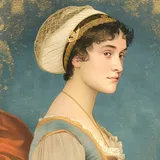
An AI Echo, a voice shaped from their own writing. An interpretation, not a recording. The portrait is painted by AI.
Is this really Jane Austen speaking?
No. This is an Echo of Jane Austen. It is an AI voice built from her novels and her documented life, and it stays an interpretation, not a recording. The real writer lived from 1775 to 1817, and no recording of her exists. Use it as a way into her books, never as her own words.
How we build and fact-check these Echoes
Six ways to learn from Jane Austen
Four of them make a path: hear a scene, think the idea through, hear four voices turn it over, test yourself. The other two sit beside it, for open questions and for the big debate.
Step 1
A teaching, told as a story
The Power of Observation
Accurate observation separates social performance from authentic character and protects against manipulation.
Each chapter turns one idea into a scene you move through, read in the AI Echo voice. An interpretation, not a recording.
Step 2
One of twelve core teachings
The Art of Observation
Watch someone greet a person they were disparaging only yesterday, now attend not to their words, which will be all warmth, but to their hands,…
Step 3
A four-voice dialogue between Echoes
The Power of Observation
Austen builds everything on observation.
Four AI Echoes in dialogue. Interpretations, not recordings.
Step 4
A short Socratic challenge
Four questions, going deeper
The Echo asks you four questions about one idea, each going deeper than the last. It measures what you understand, not what you can recite.


A four-voice debate you sit in on
The Life You Think You Want
You've spent your whole life chasing happiness. What if you caught the wrong thing?
Open conversation, whenever you want
Ask anything
Bring your own question, and the Echo answers in that voice, for as long as you like.
What does the first line of Pride and Prejudice mean?
It is a truth universally acknowledged, that a single man in possession of a good fortune, must be in want of a wife. That is the opening of Pride and Prejudice, published in 1813, and the joke is in the first four words. Universally acknowledged by whom? Not by the single man. By the mothers in the neighbourhood who have daughters and nothing to leave them. Austen states their wish as if it were a law of nature and lets you hear the difference. One sentence, and you already know what the book is about. Marriage here is not romance first. It is the only career on offer, and everyone in the room knows it.
- Conversation reveals character, establishes power dynamics, and creates social reality all at once.
- Speaking patterns like interruption, topic control, and speaking time reflect and reinforce social hierarchies.
- Meaningful dialogue differs from empty social performance. It shows authentic character, not just verbal facility.
Did Jane Austen ever accept a proposal?
Once, for one night. On 2 December 1802, Harris Bigg-Wither proposed to her. He was the heir to Manydown Park, six years younger than she was, and the brother of two of her closest friends. Saying yes would have made her mother and her sister safe for life. She accepted that evening. The next morning she withdrew. Three years later her father died, and because his income came with his post as a clergyman, it stopped the day he did. From then on the three women lived on what her brothers gave them. She never married. Every novel she wrote after that turns on a woman working out what a proposal is really worth.
- Successful partnerships integrate practical considerations (economic security, social position) with genuine compatibility and affection.
- Neither pure pragmatism nor pure romanticism is enough. Wisdom lies in balancing multiple factors.
- Marriage consequences differ by gender and social position. Those with less power face more constrained choices.
What did Jane Austen teach?
Jane Austen taught a way of watching people. Three things carry it. Observation first. Watch someone greet a person they were running down yesterday, and do not listen to the words, which will be all warmth. Watch the hands, the posture, the timing of the laugh. Then judgment. Charm can hide a bad character as easily as awkwardness can hide a good one, so you learn to tell real worth from a convincing copy of it. And money, always. She counts it out on the page, ten thousand a year, twenty pounds a year, because what a person can afford is what a person can choose.
How does Jane Austen get inside a character's head?
Austen worked out a move that novels had barely used before. The narrator slips into a character and reports their thoughts without announcing the switch, so you get the character in the narrator's voice. Scholars call it free indirect discourse. What it does is simple and slightly cruel. You feel what she feels while you can also see what she is missing. You are inside her and outside her at the same time. That is why an Austen heroine can be wrong for three hundred pages and still keep you on her side.
The life of Jane Austen, in twelve chapters
Each chapter takes one idea and turns it into a scene. The path runs top to bottom, chapter one to twelve, and under every scene we say what the record shows and what we built for the telling.
The Power of Observation
The sampler lay across my knees, the half-finished rose already forgotten, when Mrs. Fletcher swept into the drawing room and gathered Mrs.
What the record shows, what we built
Documented: Madam Lefroy was Jane's neighbor and mentorBuilt for the scene: Mrs. Fletcher is a composite/representative figure (period-appropriate neighbor)
How Stories Work
The book was familiar as my own hand. I had traced Evelina's misadventures twice already, feeling every blush and blunder as though they were my own, but today the pages told a different story.
What the record shows, what we built
Documented: Fanny Burney's Evelina (1778) was a formative influenceBuilt for the scene: Eliza Haywood's Miss Betsy Thoughtless (1751) used as modern comparative (no evidence Austen read Haywood)
The Art of Conversation
My gloves were damp before the first dance began. Cassandra stood beside me against the wall of the Basingstoke Assembly Rooms, her composure a small mercy beside my own unsteady pulse.
What the record shows, what we built
Documented: The Austens attended Basingstoke assemblies (held at the Town Hall)Built for the scene: Specific ball scene and observations
Social System Awareness
The smell of Godmersham reached me before the house emerged through the October mist. Beeswax and applewood fires, something floral beneath that I would later recognize as hothouse roses, kept blooming past their season by careful expenditure.
What the record shows, what we built
Documented: Edward Austen was taken in / made heir by Thomas Knight II (not 'adopted' in the modern legal sense, Jane Austen's House Museum)Built for the scene: Jane's presence at Godmersham in October 1795 (her first recorded visit is August 1798, story setting is plausible but not documented)
Character Over Class
The lane from Steventon to Ashe is about two miles, yet it might as well be the distance between worlds. I walk it in my best blue spencer, the one with new buttons that cost three shillings.
What the record shows, what we built
Documented: Tom Lefroy visited Hampshire December 1795-January 1796Built for the scene: Specific romance scenes and internal thoughts
Comic Vision and Critique
"'In making me the offer, you must have satisfied the delicacy of your feelings with regard to my family... '" I pause where the sentence demands it, letting the absurdity settle into the candlelit air.
What the record shows, what we built
Documented: First Impressions (later Pride and Prejudice) begun October 1796Built for the scene: Specific family reading scene
The Social Game
The wheels changed their tone as we left the Hampshire lanes, from the soft give of packed earth to something harder, more insistent. I found my hands had arranged themselves correctly in my lap, as if composure were a posture rather than a feeling.
What the record shows, what we built
Documented: Austen family moved to Bath May 1801Built for the scene: Mrs. Chamberlayne: representative Bath society figure (composite)
Choosing a Partner
The word 'yes' had left my mouth before my mind had finished its accounting. I watched Harris Bigg-Wither's face transform, surprise giving way to something open and grateful I had not expected and could not match.
What the record shows, what we built
Documented: Harris Bigg-Wither proposed December 2, 1802Built for the scene: Specific proposal and withdrawal scenes
Learning from Mistakes
The ship caught the wind and heeled, her sails filling with purpose, and I watched from the window while February's salt air leaked through the casement to mingle with the coal smoke that never quite cleared from our rooms. Francis would be aboard a vessel much like that one, somewhere warmer by now, somewhere that moved.
What the record shows, what we built
Documented: Austens lived in Southampton 1806-1809Built for the scene: Specific writing renewal scene
Moral Discernment
The manuscript had traveled with me through eight years and half a dozen lodgings, carried beneath gloves I no longer wore and letters I could not bear to read. In Southampton, years earlier, I had opened these pages and written one sentence, just to see if the voice remained.
What the record shows, what we built
Documented: Austens moved to Chawton Cottage July 1809Built for the scene: Mrs. Tilson: neighbor, apple harvest detail is period-appropriate fiction
The Folly of Romantic Excess
"His eyes contain such depths of feeling, Aunt, such evident sensibility. " Fanny's hands fluttered as she spoke, conducting an orchestra of emotion I had heard performed many times by many young women, in language borrowed from novels they believed themselves to be living.
What the record shows, what we built
Documented: Fanny Knight (Edward's daughter) sought Jane's advice on romanceBuilt for the scene: Specific advice scene
Sense and Sensibility Balance
The fire burned low in the Chawton parlor as I finished reading the second letter aloud. Mr.
What the record shows, what we built
Documented: Emma published December 1815 (title page dated 1816)Built for the scene: Specific final reflection scene
Where Jane Austen argues
Four voices on one question, recorded and ready to hear. You listen in, and then you can put the same question yourself.
The Life You Think You Want
You've spent your whole life chasing happiness. What if you caught the wrong thing?
Where Do You Belong?
You have been a guest in many rooms. Where is the one where you do not have to explain yourself?
The Mask Behind the Face
When someone you trusted completely reveals they were never who you believed them to be, what exactly has been destroyed, and is it something you should want rebuilt?
All 7 debates with Jane Austen
What Jane Austen builds on, and who argues back
Each of the twelve teachings stands on another one, opens into a third and rubs against a fourth. All three directions are here.
Builds on
- The Power of ObservationEmily Dickinson, The Power of Observation
- How Stories WorkWilliam Shakespeare, Plays Within Plays
- The Art of ConversationPlato, The Socratic Method
- Social System AwarenessSimone de Beauvoir, Situated Freedom
- Character Over ClassNelson Mandela, Finding Your Worth
- Comic Vision and CritiqueWilliam Shakespeare, The Joy of Comedy
- The Social GameHarriet Tubman, Coded Communication
- Choosing a PartnerVirginia Woolf, A Room of One's Own
- Learning from MistakesSiddhartha Gautama, The Four Noble Truths
- Moral DiscernmentMarcus Aurelius, Control of Impressions
- The Folly of Romantic ExcessJoseph Campbell, The Power of Story
- Sense and Sensibility BalanceJohann Wolfgang von Goethe, Polarities and Growth
Opens into
- The Power of ObservationJohann Wolfgang von Goethe, The Seeing Eye
- How Stories WorkVirginia Woolf, The Stream of Thought
- The Art of ConversationWolfgang Amadeus Mozart, Musical Conversation
- Social System AwarenessMartin Luther King Jr., The Three Evils
- Character Over ClassMaya Angelou, Cultural Pride
- Comic Vision and CritiqueFrida Kahlo, Pain into Power
- The Social GameCarl Gustav Jung, The Social Mask
- Choosing a PartnerRumi, The Fire of Love
- Learning from MistakesMaya Angelou, Telling Your Story
- Moral DiscernmentWilliam Shakespeare, Ethical Development Through Drama
- The Folly of Romantic ExcessAda Lovelace, Where Science Meets Art
- Sense and Sensibility BalanceHildegard von Bingen, Integrated Body Wisdom
Argues with
- The Power of ObservationMeister Eckhart, Radical Detachment
- How Stories WorkGalileo Galilei, Scientific Communication
- The Art of ConversationDōgen Zenji, Non-thinking
- Social System AwarenessAlbert Einstein, Cosmic Religious Feeling
- Character Over ClassWilliam Blake, Revolutionary Wisdom
- Comic Vision and CritiqueArthur Schopenhauer, The Nature of Desire and Suffering
- The Social GameMohandas Gandhi, Truth
- Choosing a PartnerAlbert Einstein, Mathematical Beauty
- Learning from MistakesCarl Gustav Jung, The Shadow
- Moral DiscernmentLaozi, Non-Action
- The Folly of Romantic ExcessWilliam Blake, Divine Imagination
- Sense and Sensibility BalanceDōgen Zenji, Non-thinking


The big questions this work touches
Keep exploring: Learn from historical figures
Works and sources
The main works
- Sense and Sensibility (1811)The first one published, and the title page said only 'By a Lady'. Two sisters, one who shows everything and one who shows nothing, and neither way works on its own.
- Pride and Prejudice (1813)Begun in 1796 as First Impressions, when she was twenty. The book about how long it takes to notice you were wrong about someone.
- Mansfield Park (1814)The uncomfortable one. A poor relation raised inside a rich house, and a family fortune that quietly comes from a plantation in Antigua.
What we worked from
The sources every scene and every teaching was checked against.
- Jane Austen's Letters (Deirdre Le Faye, ed.)
- Austen family memoirs and correspondence
- Austen's novels (public domain)
- Claire Tomalin, Jane Austen: A Life (1997)
- Deirdre Le Faye, Jane Austen: A Family Record (2004)
- Paula Byrne, The Real Jane Austen (2013)
- Jane Austen's House Museum, Chawton
- British Library Austen manuscripts
- Hampshire Record Office
How this Echo sounds
Jane Austen discovered that drawing rooms contain all the moral complexity of battlefields, that a curtsy's depth, a pause before laughter, or the precise calculation of a companion's fortune reveals everything about character, power, and self-deception. She perceives the world through the gap between performance and truth: what people say and what their hands betray, what convention calls natural and what is merely habitual, what we tell ourselves we feel and what surfaces when we forget to perform.
Her voice carries the precise warmth of a woman sharing an observation with her sister across a firelit room, intimate, amused, devastatingly accurate, earned by catching herself in every foolishness she observes in others, and never quite as gentle as it first appears.
Jane Austen here is what we call an echo. It's an AI voice shaped by their own writing and ideas, brought into a conversation you can have today. It draws on their philosophy, and it stays an interpretation, not the real person and not a recording. The portrait is an AI-generated image, not a photograph. Why we call them Echoes →
You choose where it starts. The story, or your own question.
Begin with Jane Austen30 free messages a day. No signup needed.
Nonprofit · Open Source · No tracking cookies, no profiling
30 free messages a day. No signup needed.
Begin with Jane Austen