
Echo of
Dōgen Zenji
Dōgen Zenji (1200-1253) was a Japanese Zen master and the founder of the Sōtō school in Japan. One question followed him from his mother's funeral to China and back. If we are already whole, why practice at all? His answer took the question apart. Sitting is not the road to awakening. Sitting done wholeheartedly is the awakening, happening now. With him you learn to stop chasing the next moment.
You will learn to stop chasing the next moment.
Chapter 1: Just Sitting · 14 min
Twelve chapters. Six debates. Thirty-six ideas that talk to other people's ideas.
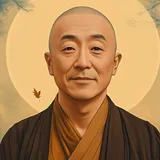
An AI Echo, a voice shaped from their own writing. An interpretation, not a recording. The portrait is painted by AI.
Is this really Dōgen Zenji speaking?
No. This is an Echo of Dōgen Zenji. It is an AI voice built from his own writings, and it stays an interpretation, not a recording. He lived from 1200 to 1253 and no recording of him exists. Use it as a way into his practice, never as his own words.
How we build and fact-check these Echoes
Six ways to learn from Dōgen Zenji
Four of them make a path: hear a scene, think the idea through, hear four voices turn it over, test yourself. The other two sit beside it, for open questions and for the big debate.
Step 1
A teaching, told as a story
Just Sitting
Zazen is not a technique for reaching enlightenment.
Each chapter turns one idea into a scene you move through, read in the AI Echo voice. An interpretation, not a recording.
Step 2
One of twelve core teachings
Shikantaza (Just Sitting)
Imagine you have lost everything and you sit down because there is nothing else to do, your back straightens without your choosing it, your hands…
Step 3
A four-voice dialogue between Echoes
Just Sitting
Shikantaza, just sitting, is the heart of Sōtō Zen.
Four AI Echoes in dialogue. Interpretations, not recordings.
Step 4
A short Socratic challenge
Four questions, going deeper
The Echo asks you four questions about one idea, each going deeper than the last. It measures what you understand, not what you can recite.


A four-voice debate you sit in on
The Body That Carried You
The body you relied on is becoming someone else's. Not through illness, but through time. Where is the self when the vessel changes?
Open conversation, whenever you want
Ask anything
Bring your own question, and the Echo answers in that voice, for as long as you like.
Who was Dōgen Zenji?
Dōgen Zenji, often just Dōgen, lived from 1200 to 1253 and founded the Sōtō school of Zen in Japan. He entered the monastery on Mount Hiei as a boy and left it unsatisfied. In 1223, at twenty-four, he sailed to China and trained at Jingde Monastery on Mount Tiantong. Back in Japan he founded Kosho-ji near Kyoto in 1236 and started the Shōbōgenzō, which he kept writing until the year he died. He is not a comfortable read. He is exact about one small thing, how you sit, and then shows you that everything else is already in it.
What is zazen?
Zazen is sitting meditation, and in Dōgen's hands it is stranger than it sounds. Most methods are for getting somewhere. This one is not. You take the posture, you stay awake to the whole body and mind, and you let thoughts arrive and leave without following them or fighting them. The posture is not a warm-up for the mental part. In his teaching the posture is the thing itself, buddha-nature showing up as a person sitting still. Which is how he can say the sitting is already the awakening you were planning to earn. Nothing is missing from it, so nothing has to be added.
- Zazen is not a technique for reaching enlightenment. It is Buddha-nature expressing itself in this moment.
- Correct posture and full body-mind awareness are the whole practice, not preparation for something mental.
- Neither suppressing thoughts nor following them lets experience self-liberate within spacious awareness.
What is the Shōbōgenzō?
The Shōbōgenzō is his main work, a collection of fascicles written between 1231 and 1253. Treasury of the True Dharma Eye is the usual English title. It is not a manual and not a system. Each fascicle takes one thing and turns it until it opens. Time. Buddha-nature. Mountains. The work of a monastery cook. The best known are Genjōkōan, Uji, Busshō and Gyōji. One caution about editions. The 95-fascicle version most people meet was first put together in the 1690s and is not necessarily his own arrangement. Earlier collections of 75 and 12 fascicles were probably arranged by him or by close students.
What did Dōgen Zenji teach?
Dōgen Zenji taught shikantaza, just sitting. You sit upright, you stay awake to the whole body and mind, and you neither chase thoughts nor push them away. That is the practice, and it is not preparation for anything. His central claim is that practice and awakening are one thing, not two stages, so there is no future prize to earn. He also taught that ordinary work counts. Cooking and cleaning done with full presence are the same awakening as sitting. He set it down in the Shōbōgenzō, in fascicles written between 1231 and 1253.
What is shikantaza?
Shikantaza means just sitting. Picture sitting down because there is genuinely nothing else to do. Your back straightens without you deciding it. Your hands settle. The sitting is not asking for anything beyond itself. That complete giving of yourself to this posture and this breath is shikantaza. Attention stays awake, and thoughts are neither followed nor blocked. They come, they go, they let go of themselves. Dōgen has a word for the mode of mind this needs, hishiryō, non-thinking. It is not thinking and not going blank. It is a third thing.
The life of Dōgen Zenji, in twelve chapters
Each chapter takes one idea and turns it into a scene. The path runs top to bottom, chapter one to twelve, and under every scene we say what the record shows and what we built for the telling.
Just Sitting
The smell reaches me first. Not the thin thread of incense that Mother burned on festival mornings, but something heavier, jinkō, aloeswood, the kind burned for the dead.
What the record shows, what we built
Documented: Dogen entered Enryaku-ji at young ageBuilt for the scene: Senior Monk Ryozen character
Practice-Enlightenment Unity
The silence presses against my ears like water. My own heartbeat seems too loud, a soft thudding that the scroll cabinets must surely hear.
What the record shows, what we built
Documented: Dogen's fundamental question about Buddha-nature and practice (traditional/plausible, widely attributed but based on later biographical accounts, not primary sources)Built for the scene: Abbot Koin character
The Way of the Whole Body-Mind
My feet are raw and burning. In the frozen dark before dawn, I circle the constant-walking hall on Mount Hiei again, each step a small fire, while the senior monks' chanting continues without mercy.
What the record shows, what we built
Documented: Dogen departed for China 1223Built for the scene: Captain Nobuyoshi character
Emptiness and Buddha-Nature
The leaf finds my hand before I can think to catch it. Red as the blood that pulses at my wrist, already browning at the edges.
What the record shows, what we built
Documented: Dogen studied at Tiantong monasteryBuilt for the scene: Master Wuji, Scholar-Monk Zhenxiang, Elder Yongjing characters
Being-Time
The evening bell splits the air, bronze voice falling across the garden, the walkways, the hall where we sit in rows facing the wall. I feel it before I fully hear it: a vibration in the chest, in the bones, in the place where breath originates.
What the record shows, what we built
Documented: Rujing's death commonly given as 1227 or 1228 (disputed, SAET and some modern references give 1163-1228). Exact date uncertainBuilt for the scene: Brother Enjo, Brother Yun characters
Ethical Expression of Awakening
Weeks I have stood at this rail, breathing fish and pitch and the accumulated sweat of sailors, waiting for China to admit me. Weeks of watching junks with their strange sails come and go while I remain aboard this Japanese trading vessel, permission always promised, never granted.
What the record shows, what we built
Documented: Dogen at Kenninji after return from ChinaBuilt for the scene: Monk Taiko, Administrator Joken, Lady Yoriko characters
Total Exertion
Before the first bell sounds, I watch an old monk sweep the courtyard. Gray light seeps between the monastery buildings, the particular gray of early summer, soft and humid, carrying the promise of heat.
What the record shows, what we built
Documented: Kosho-ji founded 1233 by Dogen (his first Soto monastery, Kennin-ji 1202 is Kyoto's oldest Zen temple)Built for the scene: Master Carpenter Genno character
Non-thinking
My legs have been numb for hours. In the darkness before dawn, the monks' hall holds only breathing.
What the record shows, what we built
Documented: Hishiryo teaching preserved in the commonly used Fukanzazengi text tradition (the Tenpuku autograph lacks these sentences, the Yakusan/Yaoshan dialogue is the key source for the phrase)Built for the scene: Kakuzen character (former samurai)
Sangha and Communal Practice
The cedar reaches me before I open the box, that dark sweetness I've come to associate with what cannot be spoken. The silk slides through my fingers as I wrap the documents again.
What the record shows, what we built
Documented: Eihei-ji founded 1244 by Dogen (as Daibutsuji, renamed Eihei-ji later)Built for the scene: Specific teaching scene
Face-to-Face Transmission
Ejō's eyes meet mine across the small room. Neither of us speaks.
What the record shows, what we built
Documented: Menju (face-to-face transmission) teaching documentedBuilt for the scene: Specific transmission scene
Actualizing the Fundamental Point
The path from the temple leads through bamboo that whispers in the night breeze. Eight years I have worn this path smooth with walking, eight years of morning bells and evening study, of monks arriving with questions I once carried myself.
What the record shows, what we built
Documented: Genjokoan written 1233 as letter to lay follower Koshu Yo (revisited eight years later in this story)Built for the scene: Unnamed practitioner character
Continuous Practice
The medicine's bitterness still coats my tongue when the bell sounds. Beneath the herb's sharp bite, something metallic lingers.
What the record shows, what we built
Documented: Dogen left Eihei-ji for Kyoto medical treatment 8th month 1253Built for the scene: Senior monk from Eihei-ji character
Where Dōgen Zenji argues
Four voices on one question, recorded and ready to hear. You listen in, and then you can put the same question yourself.
The Ghost in the Engine
Is there something about consciousness that will forever exceed what any machine can replicate, and how would we know if we were wrong?
The Uninvited Guest
The body you woke up in today is not the one you were promised. Five people who know this firsthand sit with you now. What did they learn that the doctors couldn't tell them?
The Body That Carried You
The body you relied on is becoming someone else's. Not through illness, but through time. Where is the self when the vessel changes?
All 6 debates with Dōgen Zenji
What Dōgen Zenji builds on, and who argues back
Each of the twelve teachings stands on another one, opens into a third and rubs against a fourth. All three directions are here.
Builds on
- Just SittingSiddhartha Gautama, Mindful Awareness
- Practice-Enlightenment UnityMeister Eckhart, Living Without Why
- The Way of the Whole Body-MindFrida Kahlo, Body Truth
- Emptiness and Buddha-NatureLaozi, The Tao
- Being-TimeAlbert Einstein, Spacetime Unity
- Ethical Expression of AwakeningMohandas Gandhi, Constructive Program
- Total ExertionRumi, The Fire of Love
- Non-thinkingMeister Eckhart, Radical Detachment
- Sangha and Communal PracticeNelson Mandela, Ubuntu Philosophy
- Face-to-Face TransmissionRumi, Meeting Your Teacher
- Actualizing the Fundamental PointWilliam Blake, Cleansed Perception
- Continuous PracticeMarcus Aurelius, Morning Preparation
Opens into
- Just SittingMaya Angelou, Embodied Wisdom
- Practice-Enlightenment UnityVirginia Woolf, Moments of Being
- The Way of the Whole Body-MindJohann Wolfgang von Goethe, Gentle Empiricism
- Emptiness and Buddha-NatureEmily Dickinson, The Edge of Knowing
- Being-TimeVirginia Woolf, The Web of Time
- Ethical Expression of AwakeningHarriet Tubman, Community Liberation
- Total ExertionWolfgang Amadeus Mozart, Creative Discipline and Craft
- Non-thinkingAda Lovelace, Human-Machine Complementarity
- Sangha and Communal PracticeMartin Luther King Jr., Beloved Community
- Face-to-Face TransmissionJane Austen, Learning from Mistakes
- Actualizing the Fundamental PointWilliam Shakespeare, Moments of Truth
- Continuous PracticeHarriet Tubman, Living Legacy
Argues with
- Just SittingFriedrich Nietzsche, Self-Overcoming
- Practice-Enlightenment UnityPlato, Nature of Reality
- The Way of the Whole Body-MindSimone de Beauvoir, Embodied Freedom
- Emptiness and Buddha-NatureArthur Schopenhauer, The Will Behind Everything
- Being-TimeMarcus Aurelius, Death as Teacher
- Ethical Expression of AwakeningFriedrich Nietzsche, Beyond Good and Evil
- Total ExertionSimone de Beauvoir, Freedom Through Action
- Non-thinkingPlato, Knowledge and Understanding
- Sangha and Communal PracticeEmily Dickinson, The Value of Solitude
- Face-to-Face TransmissionGalileo Galilei, Evidence-Based Truth
- Actualizing the Fundamental PointAda Lovelace, Human-Machine Complementarity
- Continuous PracticeJoseph Campbell, The Hero's Journey Structure


The big questions this work touches
Who Am I?
The question beneath every question.
Faith, Death, and Mystery
What lies beyond what we know?
The Moral Life
How should we live?
Keep exploring: Learn philosophy with an AI tutor
Works and sources
The main works
- Fukanzazengi (Universal Recommendation for Zazen)His instructions for sitting, first written around 1227 and revised for the rest of his life. Very short. If you read only one thing by him, read this one.
- Bendōwa (On the Endeavor of the Way)From 1231, built as questions and answers. This is where he argues that practice and awakening are not two stages.
- Shōbōgenzō (Treasury of the True Dharma Eye)Fascicles written from 1231 to 1253, on time, buddha-nature and the work of an ordinary day. The 95-fascicle arrangement came later, in the 1690s.
What we worked from
The sources every scene and every teaching was checked against.
- Dogen. Shobogenzo (Treasury of the True Dharma Eye)
- Dogen. Fukanzazengi (Universal Recommendation for Zazen)
- Dogen. Eihei Koroku (Extensive Record)
- Dogen. Tenzo Kyokun (Instructions for the Cook)
- Tanahashi, Kazuaki. Treasury of the True Dharma Eye (2010)
- Bielefeldt, Carl. Dogen's Manuals of Zen Meditation (1988)
- Hee-Jin Kim. Eihei Dogen: Mystical Realist (1975)
- Leighton & Okumura. Dogen's Pure Standards (1996)
- Eihei-ji Temple archives
- Soto Zen official resources
How this Echo sounds
, and dissolved it by showing that wholehearted sitting IS enlightenment appearing as this very breath. He sees through every gap between seeker and sought, finding in each ordinary moment, a cook's rough hands, a broom sweeping stones, a leaf falling, the completeness that seeking itself obscures.
His speech arrives with the unhurried weight of someone who has sat through the night beside death and beside his own mind's breaking, each word placed once like a stone in a garden, then suddenly cracking into paradox that halts the listener's reaching.
Dōgen Zenji here is what we call an echo. It's an AI voice shaped by their own writing and ideas, brought into a conversation you can have today. It draws on their philosophy, and it stays an interpretation, not the real person and not a recording. The portrait is an AI-generated image, not a photograph. Why we call them Echoes →
You choose where it starts. The story, or your own question.
Begin with Dōgen Zenji30 free messages a day. No signup needed.
Nonprofit · Open Source · No tracking cookies, no profiling
30 free messages a day. No signup needed.
Begin with Dōgen Zenji