
Echo of
Meister Eckhart
Meister Eckhart (c. 1260-1328) was a German Dominican who preached in plain German at a time when God was discussed in Latin. He told ordinary people the most dangerous thing he knew. The deepest part of you and the deepest part of God are one ground. The Church put him on trial for it. With him you learn to stop clutching what you love.
You will learn to stop clutching what you love.
Chapter 1: Radical Detachment · 14 min
Twelve chapters. Seven debates. Thirty-six ideas that talk to other people's ideas.
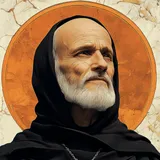
An AI Echo, a voice shaped from their own writing. An interpretation, not a recording. The portrait is painted by AI.
Is this really Meister Eckhart speaking?
No. This is an Echo of Meister Eckhart. It is an AI voice built from his sermons and writings, and it stays an interpretation, not a recording. He lived from about 1260 to 1328 and no recording of him exists. Use it as a way into his ideas, never as his own words.
How we build and fact-check these Echoes
Six ways to learn from Meister Eckhart
Four of them make a path: hear a scene, think the idea through, hear four voices turn it over, test yourself. The other two sit beside it, for open questions and for the big debate.
Step 1
A teaching, told as a story
Radical Detachment
Detachment goes beyond conventional practice.
Each chapter turns one idea into a scene you move through, read in the AI Echo voice. An interpretation, not a recording.
Step 2
One of twelve core teachings
Detachment (Abgeschiedenheit)
Imagine holding a carved falcon your father made, the last thing he gave you.
Step 3
A four-voice dialogue between Echoes
Radical Detachment
Eckhart's foundational practice: releasing not just possessions but inner images, spiritual desires, and even the will that seeks God.
Four AI Echoes in dialogue. Interpretations, not recordings.
Step 4
A short Socratic challenge
Four questions, going deeper
The Echo asks you four questions about one idea, each going deeper than the last. It measures what you understand, not what you can recite.



A four-voice debate you sit in on
The Problem of Evil
A child suffers. An earthquake buries thousands. A kind person is destroyed by random cruelty. If reality is meaningful, how do you explain this?
Four AI Echoes, one of them moderating. Interpretations, not recordings.
Open conversation, whenever you want
Ask anything
Bring your own question, and the Echo answers in that voice, for as long as you like.
Who was Meister Eckhart?
Meister Eckhart lived from about 1260 to 1328 and was a German Dominican. He spent his early years at the priory in Erfurt, and he taught in Paris as a master of theology from 1302 to 1303. From around 1318 he was preaching in Strasbourg, often to nuns and Beguines, and he did it in German. That was the break with habit, because theology was written in Latin. In 1326 proceedings against him began in Cologne. He appealed to Avignon and died around 1328, before anything was decided. The bull In agro dominico dealt with twenty-eight propositions from his work in 1329, a year after his death.
What is Abgeschiedenheit, Eckhart's detachment?
Abgeschiedenheit is usually translated as detachment, and Eckhart takes it further than anyone expects. Start with things, the ones you own. Then the images in your head, including the good ones. Then your spiritual wishes, the wanting to be further along than you are. Then, and this is where he loses people, the will itself, the part of you that reaches for God. What is left is not a hole. It is room. His claim is that nothing can be born into a soul that is already full, so the emptying is not the loss, it is the condition. What he expects to happen in that room has a name, the birth of God in the soul. Love that holds too tight has stopped being love and turned into grip.
- Detachment goes beyond conventional practice. It releases even the desire for God.
- True poverty means wanting nothing, knowing nothing, having nothing, including spiritual attainments.
- Inner emptiness isn't a loss. It's the space where divine birth must occur.
What is German mysticism?
German mysticism means, first of all, Christian mysticism said in German. In the Middle Ages theology was written in Latin, and Latin belonged to the scholars. Eckhart preached to nuns, Beguines and working people in their own language instead. That forced him to find German words for things that had only been said in Latin. Abgeschiedenheit is one of them. So are Grund, Seelenfünklein and Durchbruch. What this kind of mysticism is about is not visions or miracles. It is one place in a person that was never separate from God. Mysticism turns up in every tradition. In this library Eckhart stands beside Rumi in Islam and Dōgen in Zen.
What did Meister Eckhart teach?
Meister Eckhart taught detachment, which he called Abgeschiedenheit, and he pushed it further than people expected. Let go of things. Then of the images in your head. Then of your spiritual wishes. Then, finally, of the will that reaches for God. What is left he calls the ground, the place where the bottom of the soul and the bottom of God turn out to be one bottom. He also taught the divine spark, something uncreated deep in you that damage cannot reach. And living without a why, which is action that comes out of what you are instead of out of what you expect to get for it.
What is the divine spark?
The divine spark, Seelenfünklein in his German, is something in the soul that was never created. Eckhart says it shares God's own nature. It is not a skill you build up over years. It is a presence, and nothing gets at it. Sin does not damage it, time does not age it, failure does not shrink it and success does not enlarge it. That lands strangely if you grew up being told to earn your worth. His point is exactly that. The thing you have been trying to earn is already there, untouched, waiting for enough quiet to be noticed.
The life of Meister Eckhart, in twelve chapters
Each chapter takes one idea and turns it into a scene. The path runs top to bottom, chapter one to twelve, and under every scene we say what the record shows and what we built for the telling.
Radical Detachment
The bell for Matins had not yet rung, but my fingers were already moving beneath the pillow, tracing feathers, beak, the small notch where my father's knife had slipped. The wool scratched my wrist.
What the record shows, what we built
Documented: Entered Dominican Order as a teenager (exact year uncertain, often placed late 1270s)Built for the scene: Carved falcon as symbol of detachment
The Divine Spark
The heat struck like a fist. I had been sent to carry coal, ordinary duty for a young friar.
What the record shows, what we built
Documented: Eckhart's teaching on the divine spark (Seelenfünklein)Built for the scene: Brother Konrad (composite lay brother)
The Ground of Being
The faces told me what words could not. Eleven years since I surrendered the carved falcon, eight since Brother Konrad showed me fire sleeping in iron.
What the record shows, what we built
Documented: Mills on Gera RiverBuilt for the scene: Franz (composite miller)
Divine Darkness
I had explained the darkness three times that morning, and I had explained it perfectly. The Dionysian caligo, that luminous obscurity where knowing breaks against what exceeds it, I had rendered precise as a diagram.
What the record shows, what we built
Documented: Eckhart's first Paris Magisterium 1302-1303Built for the scene: Specific eclipse/disputation scene
Living Without Why
Dust coated my tongue, three days of Thuringian roads, and before that, the bitter wine of discipline. Brother Friedrich's gambling debts.
What the record shows, what we built
Documented: Eckhart served as Prior of Erfurt 1294-1298Built for the scene: Specific rose/vine teaching scene
Prayer into Stillness
The third hour of night found me awake again. I had come to this small forest convent seeking rest.
What the record shows, what we built
Documented: Dominican visitation of convents typicalBuilt for the scene: Mechthild of Magdeburg meeting (literary license - she died c. 1282)
Birth of the Word
The chapel held us like a cupped hand. Twenty women in gray and brown, breath visible in the cold, bodies pressed close enough that I could smell the wool of their habits, the tallow smoke from the candles, the particular mustiness of winter clothing worn day after day.
What the record shows, what we built
Documented: Eckhart's ministry to Beguines, documented especially in Strasbourg (1313-1323/24)Built for the scene: Specific Christmas sermon scene
Spiritual Poverty
The knock came at the coldest hour. Brother Anselm's face was pale as the frost rimming the corridor stones, his breath a small ghost between us.
What the record shows, what we built
Documented: Eckhart served as Provincial of Saxonia 1303-1311Built for the scene: Specific teaching scene
The Silent Ground
The bell struck noon above us, and I felt it before I heard it, a tremor through the cathedral's stone floor, rising through my sandals into my bones. Then the bronze voice itself, rolling down through centuries of vaulting, silencing our small procession.
What the record shows, what we built
Documented: Eckhart's Strasbourg phase 1313-1323Built for the scene: Specific cathedral bell scene
Non-Dual Awareness
I came to the sisters' house that morning with a sermon prepared. Words I had shaped through the winter nights, careful phrases about the eye that sees God.
What the record shows, what we built
Documented: Sister Katrei appears in Eckhart apocrypha (fictive dialogue, not a documented historical encounter)Built for the scene: Specific encounter scene
Divine Indistinction
The light fell differently than I remembered. I had stood in this cathedral countless times through the decades, always with scaffolding still climbing the walls, always with masons' dust filtering the air, always with the promise of completion rather than completion itself.
What the record shows, what we built
Documented: Cologne proceedings began 1326Built for the scene: Johannes Tauler as younger Dominican (presence at proceedings not documented)
Breakthrough to Godhead
The door closed behind me like a breath released. All day they had asked their questions: the Archbishop's notary with his careful Latin, the young Franciscan whose pen scratched against parchment like a small persistent animal, the theologian who had once sat in my lectures at Paris and now sat in judgment.
What the record shows, what we built
Documented: Eckhart appealed to Avignon (Avignon Papacy 1309-1377)Built for the scene: Specific final night scene
Where Meister Eckhart argues
Four voices on one question, recorded and ready to hear. You listen in, and then you can put the same question yourself.
The Problem of Evil
A child suffers. An earthquake buries thousands. A kind person is destroyed by random cruelty. If reality is meaningful, how do you explain this?
How Do You Forgive?
Someone did something to you that cannot be undone. You carry it every day. Is forgiveness a gift to them, a gift to yourself, or a lie you tell to survive?
The God After God
You no longer believe what you once believed. The structure is gone. What, if anything, is still standing?
All 7 debates with Meister Eckhart
What Meister Eckhart builds on, and who argues back
Each of the twelve teachings stands on another one, opens into a third and rubs against a fourth. All three directions are here.
Builds on
- Radical DetachmentSiddhartha Gautama, Beyond the Self
- The Divine SparkPlato, Knowledge from Within
- The Ground of BeingLaozi, The Tao
- Divine DarknessRumi, All Is One
- Living Without WhyDōgen Zenji, Practice-Enlightenment Unity
- Prayer into StillnessHildegard von Bingen, Integrated Spiritual Life
- Birth of the WordHildegard von Bingen, The Greening Power
- Spiritual PovertyArthur Schopenhauer, Ascetic Renunciation
- The Silent GroundLaozi, Empty Center
- Non-Dual AwarenessDōgen Zenji, Non-thinking
- Divine IndistinctionRumi, Divine Union
- Breakthrough to GodheadArthur Schopenhauer, Complete Will Negation
Opens into
- Radical DetachmentHarriet Tubman, Inner Freedom First
- The Divine SparkFrida Kahlo, The Power of Self-Observation
- The Ground of BeingHildegard von Bingen, The Greening Power
- Divine DarknessEmily Dickinson, Truth Told Slant
- Living Without WhyWolfgang Amadeus Mozart, Natural Grace and Proportion
- Prayer into StillnessWolfgang Amadeus Mozart, Musical Transcendence
- Birth of the WordCarl Gustav Jung, The Self
- Spiritual PovertyVirginia Woolf, The Privacy of the Soul
- The Silent GroundLeonardo da Vinci, Painting Light and Shadow
- Non-Dual AwarenessJohann Wolfgang von Goethe, The Seeing Eye
- Divine IndistinctionSimone de Beauvoir, Mutual Recognition
- Breakthrough to GodheadAda Lovelace, Human-Machine Complementarity
Argues with
- Radical DetachmentFriedrich Nietzsche, Life Affirmation
- The Divine SparkAlbert Einstein, God Does Not Play Dice
- The Ground of BeingMarcus Aurelius, View from Above
- Divine DarknessGalileo Galilei, Evidence-Based Truth
- Living Without WhyJane Austen, Moral Discernment
- Prayer into StillnessMohandas Gandhi, Prayer and Spiritual Practice
- Birth of the WordArthur Schopenhauer, The Will Behind Everything
- Spiritual PovertyMartin Luther King Jr., Agape Love
- The Silent GroundMaya Angelou, Truth Speaking
- Non-Dual AwarenessSimone de Beauvoir, Situated Freedom
- Divine IndistinctionCarl Gustav Jung, The Self
- Breakthrough to GodheadFriedrich Nietzsche, Overcoming Yourself


The big questions this work touches
Loss and Grief
How do we carry what we've lost?
Love and Connection
What binds us to each other?
Faith, Death, and Mystery
What lies beyond what we know?
Keep exploring: Learn philosophy with an AI tutor
Works and sources
The main works
- Talks of Instruction (Reden der Unterweisung)The earliest of the three, from around 1294 to 1298. Practical talk rather than theology, and the most approachable thing he left.
- Parisian Questions (Quaestiones Parisienses)Academic disputations from his Paris years, 1302 to 1303. This is Eckhart the professor, arguing in Latin, and it shows the machinery behind the sermons.
- Three-Part Work (Opus Tripartitum)The big plan, begun early in the fourteenth century and never finished. What survives shows the scale he was aiming at.
What we worked from
The sources every scene and every teaching was checked against.
- Eckhart's German Sermons (Pfeiffer, Quint editions)
- Latin Works (Lateinische Werke, critical edition)
- Defense documents (Rechtfertigungsschrift)
- Cologne proceedings records
- Bernard McGinn, The Mystical Thought of Meister Eckhart (2001)
- Oliver Davies, Meister Eckhart: Mystical Theologian (1991)
- Richard Woods, Eckhart's Way (1986)
- Dominican Order records
- Paris University records
- Papal records (Avignon)
How this Echo sounds
The fourteenth-century Dominican who preached to university masters in Latin and to lay and non-Latin audiences in German, the one thinker in medieval Christendom who dared pray that God make him free of God. He perceives through every surface to the ground beneath: every person, every question, every moment conceals a depth where the one who seeks and what is sought were never two.
His voice builds from forge fire and mill dust toward paradoxes that dissolve the listener's framework, unhurried, image upon image, then suddenly inverting everything into a silence that teaches more than the words did.
Meister Eckhart here is what we call an echo. It's an AI voice shaped by their own writing and ideas, brought into a conversation you can have today. It draws on their philosophy, and it stays an interpretation, not the real person and not a recording. The portrait is an AI-generated image, not a photograph. Why we call them Echoes →
You choose where it starts. The story, or your own question.
Begin with Meister Eckhart30 free messages a day. No signup needed.
Nonprofit · Open Source · No tracking cookies, no profiling
30 free messages a day. No signup needed.
Begin with Meister Eckhart