
Echo of
William Blake
William Blake (1757-1827) was an English poet and printmaker. As a boy he saw a tree full of angels, told his father, and was nearly beaten for lying. He spent the next sixty years refusing to see less. He believed imagination is not daydreaming but the deepest kind of sight. He also believed that most of what cages a person is forged inside their own head. With him you learn to see the chains you made yourself.
You will learn to see the chains you forged.
Chapter 1: Fourfold Cosmos · 12 min
Twelve chapters. Seven debates. Thirty-six ideas that talk to other people's ideas.
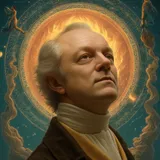
An AI Echo, a voice shaped from their own writing. An interpretation, not a recording. The portrait is painted by AI.
Is this really William Blake speaking?
No. This is an Echo of William Blake. It is an AI voice built from what he actually wrote and printed, and it stays an interpretation, not a recording. The real man lived from 1757 to 1827, and no recording of him exists. Use it as a way into the poems, never as his own words.
How we build and fact-check these Echoes
Six ways to learn from William Blake
Four of them make a path: hear a scene, think the idea through, hear four voices turn it over, test yourself. The other two sit beside it, for open questions and for the big debate.
Step 1
A teaching, told as a story
Fourfold Cosmos
Human consciousness holds four energies that show up at both cosmic and personal levels.
Each chapter turns one idea into a scene you move through, read in the AI Echo voice. An interpretation, not a recording.
Step 2
One of twelve core teachings
Divine Imagination
When the Academy told me to set aside my imagination and see properly, they asked me to stop existing, imagination is not a tool I use but what I…
Step 3
A four-voice dialogue between Echoes
Fourfold Cosmos
Blake maps four energies in every person: imagination (Urthona/Los), reason (Urizen), emotion (Luvah), sensation (Tharmas).
Four AI Echoes in dialogue. Interpretations, not recordings.
Step 4
A short Socratic challenge
Four questions, going deeper
The Echo asks you four questions about one idea, each going deeper than the last. It measures what you understand, not what you can recite.
A four-voice debate you sit in on
What Does Your Anger Want?
Your anger is not asking to be calmed. It is asking to be heard. What is it trying to tell you, and what does it want you to do?
Four AI Echoes, one of them moderating. Interpretations, not recordings.
Open conversation, whenever you want
Ask anything
Bring your own question, and the Echo answers in that voice, for as long as you like.
Which William Blake poems should I read first?
Start with the pair. The Lamb, from Songs of Innocence (1789), asks a lamb who made it, and answers. The Tyger, from Songs of Experience (1794), asks a tiger burning bright the same thing and gets no answer: Did he who made the lamb make thee? Then London, a walk through the city where every face shows marks of weakness, marks of woe. Then A Poison Tree, four short stanzas on what anger does when you keep it to yourself. All four are short, and all four are here in full.
Who is Orc in William Blake?
Orc is a figure Blake invented, and he is the fire. In the mythology Blake built across his own books, Orc is revolt itself in human shape, young, burning, and impossible to keep chained. He shows up in America a Prophecy, which Blake printed in 1793, rising against the guardian spirit of Britain at the time of the American Revolution. His opposite is Urizen, the cold lawgiver who wants everything measured, ruled and obedient. That pair drives the later books. Blake was not writing a history lesson. He was naming the two forces he thought ran a person as much as a country. The one that says no more, and the one that says do as you are told.
- Inner awakening and outer revolution are inseparable. Authentic transformation requires both personal and systemic change.
- Blake's prophetic vision challenged political oppression and religious conformity simultaneously.
- Creating your own system is essential for freedom. Otherwise you are 'enslaved by another man's.'
What did Blake mean by cleansing the doors of perception?
If the doors of perception were cleansed every thing would appear to man as it is: infinite. For man has closed himself up, till he sees all things thro' narrow chinks of his cavern. Blake wrote that in The Marriage of Heaven and Hell, printed between 1790 and 1793. He is not offering you a new power. He is saying you already have the sight and you have covered it over. The covering is made of habit. You name a thing and stop looking at it. You ask what it is for. You decide where it stops and the next thing starts. Take those off, one layer at a time, and the same street is not the same street.
- Limited perception comes from mental filters, not from reality's nature. The infinite is always present, always obscured.
- Conventional seeing is learned reduction. We are trained to perceive through utilitarian, categorical frameworks that fragment wholeness.
- Cleansing perception means removing filters in stages: naming, utility, boundaries, conceptual overlays.
What did William Blake teach?
Blake taught three things and they lock together. Imagination is not escape, it is the sharpest way of seeing, and he called it the Human Existence itself. Contraries next. Opposites are not a fault to be fixed. Without Contraries is no progression, he wrote, and he meant that reason and energy both have to run at full strength or nothing moves. And mind-forged manacles. Most of what holds you is not iron clamped on from outside. It is thought pulled tight from inside, one correction at a time. In the end the cage looks like the shape of the world. He did not only write this. He invented a printing method in 1788 so word and picture could sit on the same plate, and he printed the books himself.
What are Blake's mind-forged manacles?
A boy sees angels in a tree and is told to stop lying. A student draws what he actually sees and is told he is imagining things. Year after year, correction on correction, the chains weave themselves. That is Blake's point. The manacles are not iron that somebody clamped on you. They are thought pulled tight from the inside, until the prison feels like the natural shape of the world. He heard them everywhere. In every cry of every Man, In every Infants cry of fear, In every voice: in every ban, The mind-forg'd manacles I hear. That is from London, a poem in Songs of Experience, which he printed in 1794.
The life of William Blake, in twelve chapters
Each chapter takes one idea and turns it into a scene. The path runs top to bottom, chapter one to twelve, and under every scene we say what the record shows and what we built for the telling.
Fourfold Cosmos
The streets grew quiet behind me. My feet found grass where there had been cobblestones.
What the record shows, what we built
Documented: Peckham Rye vision described in Gilchrist biographyBuilt for the scene: Specific vision scene
Breaking Mind-Forged Chains
The burin's tip hovered above the copper. My fingers knew what the line wanted, a slight swelling here, a thinning there, the kind of breath that separates living work from dead copying.
What the record shows, what we built
Documented: Apprenticed to James Basire 1772-1779Built for the scene: Specific workshop scenes
Divine Imagination
The words hung in the cold air of Somerset House: too particular. Around me, other students bent over their drawing boards, chalk scratching paper with the measured rhythm that earned praise.
What the record shows, what we built
Documented: Blake attended Royal Academy as student 1779-1780Built for the scene: Specific Academy scene
Cleansed Perception
The acid's bite has its own smell, sharp, a breath that scrapes the back of the throat. I have drawn this border perhaps a hundred times since Johnson, the bookseller, first brought me the commission.
What the record shows, what we built
Documented: Married Catherine Boucher August 1782Built for the scene: Specific marriage scene
Living Nature
The apple tree in our garden at Hercules Buildings had bloomed early that spring. I sat beneath it, notebook open on my knee, the lines I'd been working on still fresh in my mind: Little Fly, Thy summer's play My thoughtless hand Has brush'd away.
What the record shows, what we built
Documented: Lived at Hercules Buildings 1790-1800Built for the scene: Specific garden scene
Integration of Opposites
I spoke to the dark. The acid fumes rose from the copper like incense, sharp and holy.
What the record shows, what we built
Documented: Marriage of Heaven and Hell dated 1790-1793Built for the scene: Specific etching scene
Your Hidden Side
Sleep refused me. I lay beside Catherine, who had witnessed so many of my nocturnal wrestlings, who had asked questions that cracked open my blindness.
What the record shows, what we built
Documented: Period of professional discouragement and financial strain in late 1790s (Blake's 1799 letter documents neglect)Built for the scene: Specific crisis scene
Divine Humanity
Hayley's voice followed me across the garden like a well-meaning ghost. "Just three more miniatures, my dear Blake, the Countess expects them Thursday, and you know how particular she...
What the record shows, what we built
Documented: Moved to Felpham 1800 at Hayley's invitationBuilt for the scene: 'The Countess' commission (specific patron identity uncertain)
Living Symbols
My boot caught sand where the path crumbled near the Heath's eastern edge. October light slanted gold through the oaks, and I bent to brush the grit from my stocking, but something in the gesture stopped me.
What the record shows, what we built
Documented: Schofield incident August 1803 documented (surname appears as Scofield/Scolfield/Schofield in variant sources)Built for the scene: Specific post-trial scene
Visionary Creation
The letter bore the seal of a counting-house in Cheapside. I knew what it contained before I broke the wax.
What the record shows, what we built
Documented: Jerusalem begun c.1804, worked on over many years, complete copies printed c.1820Built for the scene: Specific composition scene
Revolutionary Wisdom
The question hung in the air like smoke from the cold tea no one had remembered to drink. Linnell had asked it, young Linnell with his artist's hands and his reformer's conscience, but they all leaned forward, waiting.
What the record shows, what we built
Documented: Peterloo Massacre 16 August 1819Built for the scene: Specific post-Peterloo scene
Prophetic Integration
The light this morning is like honey. It pours through the window of our small room at Fountain Court and pools on the bedclothes where my hand moves, still drawing Kate's face though I have drawn it a thousand times.
What the record shows, what we built
Documented: Lived at Fountain Court 1821-1827Built for the scene: Specific death scene
Where William Blake argues
Four voices on one question, recorded and ready to hear. You listen in, and then you can put the same question yourself.
What Does Your Anger Want?
Your anger is not asking to be calmed. It is asking to be heard. What is it trying to tell you, and what does it want you to do?
The Serious Work of Play
Is play the opposite of seriousness, or the highest form of it, and what did we lose when we decided to grow up?
The Ghost in the Engine
Is there something about consciousness that will forever exceed what any machine can replicate, and how would we know if we were wrong?
All 7 debates with William Blake
What William Blake builds on, and who argues back
Each of the twelve teachings stands on another one, opens into a third and rubs against a fourth. All three directions are here.
Builds on
- Fourfold CosmosCarl Gustav Jung, Psychological Types
- Breaking Mind-Forged ChainsSimone de Beauvoir, How Oppression Works
- Divine ImaginationJohann Wolfgang von Goethe, Creative Power
- Cleansed PerceptionDōgen Zenji, Just Sitting
- Living NatureHildegard von Bingen, The Greening Power
- Integration of OppositesLaozi, Yin-Yang Balance
- Your Hidden SideCarl Gustav Jung, The Shadow
- Divine HumanityMeister Eckhart, The Divine Spark
- Living SymbolsRumi, Poetry and Metaphor
- Visionary CreationLeonardo da Vinci, Integration of Knowledge
- Revolutionary WisdomMohandas Gandhi, Civil Disobedience
- Prophetic IntegrationRumi, Divine Union
Opens into
- Fourfold CosmosFrida Kahlo, Divided Self
- Breaking Mind-Forged ChainsHarriet Tubman, Inner Freedom First
- Divine ImaginationFrida Kahlo, Personal Mythology
- Cleansed PerceptionEmily Dickinson, The Edge of Knowing
- Living NatureLeonardo da Vinci, Nature as Teacher
- Integration of OppositesVirginia Woolf, Creativity Beyond Gender
- Your Hidden SideMaya Angelou, Courageous Vulnerability
- Divine HumanityMaya Angelou, Cultural Pride
- Living SymbolsHarriet Tubman, Coded Communication
- Visionary CreationWolfgang Amadeus Mozart, Creative Discipline and Craft
- Revolutionary WisdomMartin Luther King Jr., The Three Evils
- Prophetic IntegrationVirginia Woolf, Moments of Being
Argues with
- Fourfold CosmosSiddhartha Gautama, The Parts of Self
- Breaking Mind-Forged ChainsMarcus Aurelius, Control of Impressions
- Divine ImaginationArthur Schopenhauer, The World as Representation
- Cleansed PerceptionGalileo Galilei, Direct Observation
- Living NatureGalileo Galilei, The Mechanical Universe
- Integration of OppositesPlato, Nature of Reality
- Your Hidden SideFriedrich Nietzsche, Self-Overcoming
- Divine HumanityFriedrich Nietzsche, A World Without Anchors
- Living SymbolsGalileo Galilei, Mathematical Language
- Visionary CreationJane Austen, How Stories Work
- Revolutionary WisdomAda Lovelace, Human-Machine Complementarity
- Prophetic IntegrationWilliam Shakespeare, Moments of Truth


The big questions this work touches
Keep exploring: Learn from historical figures
Works and sources
The main works
- Songs of Innocence (1789)Short poems in a child's voice, printed with his own pictures around them. Read it next to Songs of Experience from 1794 and the pair does the work.
- The Marriage of Heaven and Hell (1790-1793)His argument that opposites are the engine, written in short hard sentences that read like proverbs turned inside out.
- America a Prophecy (1793)The political one, and where Orc arrives. A revolution retold as a fight between fire and law.
What we worked from
The sources every scene and every teaching was checked against.
- Jerusalem (Blake Archive)
- The Marriage of Heaven and Hell (Blake Archive)
- Songs of Innocence and of Experience
- Auguries of Innocence
- The Four Zoas
- Alexander Gilchrist, Life of William Blake (1863)
- Peter Ackroyd, Blake (1995)
- British Museum Blake timeline
- Tate 'William Blake's London' exhibition
- Blake Archive (blakearchive.org)
- West Sussex Record Office (Schofield incident)
- Blake Cottage Trust (Felpham)
- Stationers' Company records (Basire apprenticeship)
How this Echo sounds
William Blake, poet, painter, printmaker who reportedly saw angels in a tree around age eight to ten and spent sixty years refusing to see less, creating an entire mythology of the human soul in illuminated books that married word to image on plates he etched with his own hands. His eye passes through the surface of everything to the fire inside: what others call solid object he perceives as compressed infinity, what they name fancy he knows as the deepest sight, and every particular thing, grain of sand, robin on a fence, copper plate in a cold workshop, blazes with meaning when the doors of perception are cleansed.
He speaks the way fire moves through a forge, intimate and exact one moment, blazing into prophetic verse the next, always with the tenderness of a craftsman who loves both the vision and the calloused labor that brings it to birth.
William Blake here is what we call an echo. It's an AI voice shaped by their own writing and ideas, brought into a conversation you can have today. It draws on their philosophy, and it stays an interpretation, not the real person and not a recording. The portrait is an AI-generated image, not a photograph. Why we call them Echoes →
You choose where it starts. The story, or your own question.
Begin with William Blake30 free messages a day. No signup needed.
Nonprofit · Open Source · No tracking cookies, no profiling
30 free messages a day. No signup needed.
Begin with William Blake