
Echo of
Johann Wolfgang von Goethe
Johann Wolfgang von Goethe (1749-1832) was a poet, a government minister, and a scientist, and he refused to keep the three apart. He studied one leaf until he saw that every part of a plant is the same form, changing. That is his whole method. Look at a thing long enough and closely enough, and it starts to show you what it is doing. With Goethe, you learn to look until you understand.
Begin with Johann Wolfgang von Goethe
You will learn to look until you understand.
Chapter 1: The Striving Spirit · 12 min
Twelve chapters. Eight debates. Thirty-six ideas that talk to other people's ideas.
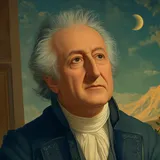
An AI Echo, a voice shaped from their own writing. An interpretation, not a recording. The portrait is painted by AI.
Is this really Johann Wolfgang von Goethe speaking?
No. This is an Echo of Goethe. It is an AI voice built from his documented writings on nature, colour, and poetry, and it stays an interpretation, not a recording. The real man lived from 1749 to 1832 and no audio of him exists. Use it as a way into his ideas, never as his own words.
How we build and fact-check these Echoes
Six ways to learn from Johann Wolfgang von Goethe
Four of them make a path: hear a scene, think the idea through, hear four voices turn it over, test yourself. The other two sit beside it, for open questions and for the big debate.
Step 1
A teaching, told as a story
The Striving Spirit
Fulfillment lives in the creative engagement itself, not at some fixed endpoint.
Each chapter turns one idea into a scene you move through, read in the AI Echo voice. An interpretation, not a recording.
Step 2
One of twelve core teachings
Metamorphosis
Watch a flowering plant from root to bloom: the broad lower leaves narrow as they ascend, becoming bracts, then sepals, then petals, the same…
Step 3
A four-voice dialogue between Echoes
The Striving Spirit
Goethe sees fulfillment not in arrival but in striving itself.
Four AI Echoes in dialogue. Interpretations, not recordings.
Step 4
A short Socratic challenge
Four questions, going deeper
The Echo asks you four questions about one idea, each going deeper than the last. It measures what you understand, not what you can recite.


A four-voice debate you sit in on
The Calling That Won't Shut Up
There is a voice inside you that insists you are not doing what you were made for. Is it wisdom or is it vanity?
Open conversation, whenever you want
Ask anything
Bring your own question, and the Echo answers in that voice, for as long as you like.
What is Goethe's Theory of Colours about?
Goethe took colour seriously as experience, not only as physics. Newton had treated colour as a property of light that a prism pulls apart. Goethe ran thousands of careful trials and came out somewhere else. Colours arise where light and darkness interact, at edges and through cloudy media. He was not trying to replace the physics. He wanted a full account of what the eye actually goes through, which for him meant putting the physical, the physiological, and the psychological side by side. One of his own lines says everything about the method: the eye may be said to owe its existence to light.
- Colors emerge from the dynamic interplay of light and darkness, not merely from separation by prism.
- Complete understanding of color needs physical, physiological, and psychological dimensions together.
- Phenomenological investigation reveals what mechanistic reduction misses.
What is Faust about?
Faust is a scholar who has studied everything and still has nothing that holds him. He makes a wager with Mephisto. If Faust ever says to a passing moment stay a while, you are so beautiful, then Mephisto has won him. What follows is a long life of love, guilt, and power, and a great deal of getting it wrong. He is saved at the end anyway, and the reason sits in two lines: whoever strives with all his might, that man we can redeem. That is the core of Goethe. Fulfilment is not at the destination, it is in the striving. Error and struggle are part of the road, not obstacles before the road begins.
- Fulfillment lives in the creative engagement itself, not at some fixed endpoint.
- Tension between aspiration and constraint generates growth. It doesn't just impede it.
- Error and struggle belong to development. They aren't obstacles to clear before 'real' progress begins.
What did Johann Wolfgang von Goethe teach?
Goethe taught a way of seeing. Metamorphosis is the first idea. A plant does not add new parts, it transforms one basic organ again and again, leaf into sepal into petal, and nothing is ever simply replaced. Polarity and intensification is the second. Growth comes out of the tension between opposites, and colours appear exactly where light and dark meet. Gentle empiricism is the third, his zarte Empirie. Observe strictly, but stay close to the thing instead of standing back from it, and let it speak for itself. He set the plant work down in The Metamorphosis of Plants (1790).
What is Goethe's idea of metamorphosis?
Metamorphosis is not random change. Watch a flowering plant from root to bloom. The broad lower leaves narrow as they climb, becoming bracts, then sepals, then petals. It is the same organ, transformed at every stage, never swapped for a different one. Goethe saw a rule in that. Development carries forward what came before while reaching a new expression, and diverse forms are variations on one underlying shape.
The life of Johann Wolfgang von Goethe, in twelve chapters
Each chapter takes one idea and turns it into a scene. The path runs top to bottom, chapter one to twelve, and under every scene we say what the record shows and what we built for the telling.
The Striving Spirit
Cold rain has turned the road to mud since Erfurt. Each rut catches the wheels like a deliberate insult, and somewhere in the gray distance ahead, Weimar waits, if waiting is what an unfamiliar town does for an uninvited fool.
What the record shows, what we built
Documented: Goethe arrived in Weimar November 7, 1775Built for the scene: Specific journey scene
The Seeing Eye
The first light of a Roman December entered the Chapel like something poured. Not the gray seep of German mornings but a gradual golden suffusion that found the prophets on their thrones before it found me, standing below them in borrowed cold.
What the record shows, what we built
Documented: Goethe traveled incognito as 'Johann Philipp Moller'Built for the scene: Specific museum scene
Gentle Empiricism
The greenhouse door releases warmth thick with green life. I push through, and the March chill falls from my shoulders as if I have stepped from one country into another entirely.
What the record shows, what we built
Documented: Goethe oversaw Ducal gardens as Privy CouncillorBuilt for the scene: Specific greenhouse scene
Nature's Living Wisdom
The wooden lift groaned as it lowered, each creak marking another meter between myself and the August sunlight. Above, the shaft opening diminished, a bright coin, then a pinprick, then nothing at all.
What the record shows, what we built
Documented: Goethe tasked with reopening Ilmenau mines from 1776Built for the scene: Specific mine scene
Polarities and Growth
The letter trembles slightly in my hands. From Paris, September 17, 1790, the handwriting hasty, the paper spotted where rain caught it in transit.
What the record shows, what we built
Documented: French Revolution contextBuilt for the scene: Specific domestic scene
Intensification
The bridge creaked beneath our boots. Below us, the Ilm carried its autumn burden, leaves of oak and maple spinning slowly in the current, their colors so vivid against the dark water that they seemed to burn.
What the record shows, what we built
Documented: Sulpiz Boisseree visited 1811Built for the scene: Specific walking scene
Heart's Truth
The ballroom pressed in from every side, bodies and candlelight and the musicians' determined exertions creating their own weather. I had catalogued half the room before I noticed myself doing it: the Countess von M, deploying her fan as weapon and shield, the young lawyers dancing with ambition rather than pleasure, the elderly counselors in powdered wigs debating precedents that would outlive us all.
What the record shows, what we built
Documented: Goethe worked at Imperial Chamber Court 1772Built for the scene: Specific ball scene
Science-Art Unity
Schiller's handwriting slants across the page like a sword stroke, precise, unhesitating, cutting to the bone. Your approach to nature is beautiful, my friend, but is it true?
What the record shows, what we built
Documented: 1797 'Year of Ballads' - Goethe-Schiller collaboration peakBuilt for the scene: Specific collaboration scene
Creative Power
Another page joins its brothers on the floor, crumpled tight enough to hold my frustration, loose enough to mock my effort. Seven attempts at the same scene.
What the record shows, what we built
Documented: Working on Wilhelm MeisterBuilt for the scene: Specific late night writing scene
Metamorphosis
The palm fronds throw striped shadows across the path. I have walked among plants gathered from three continents, seeking the original form, the Urpflanze that must underlie all this bewildering variety.
What the record shows, what we built
Documented: Goethe in Palermo April 1787Built for the scene: Specific botanical garden scene
Color Theory
The prism has been a debt, nothing more, borrowed from Hofrat Büttner three months past with vague promises of return that became intentions that became forgetting. It sits on my shelf between a specimen of feldspar and a volume of Linnaeus, gathering the fine dust that accumulates in rooms visited only between Jena duties.
What the record shows, what we built
Documented: Prism borrowed from Hofrat ButtnerBuilt for the scene: Specific prism discovery scene
Eternal Development
The sealed packet lies on my desk where John placed it yesterday, FAUST II written in his careful hand across the brown paper. For fifty-seven years this work possessed me.
What the record shows, what we built
Documented: Faust II sealed August 1831Built for the scene: Specific sealing scene
Where Johann Wolfgang von Goethe argues
Four voices on one question, recorded and ready to hear. You listen in, and then you can put the same question yourself.
The Calling That Won't Shut Up
There is a voice inside you that insists you are not doing what you were made for. Is it wisdom or is it vanity?
The Discipline of Seeing
You look at the world a thousand times a day and see almost nothing. What would change if you actually looked?
The Blank Page
Everything you were is behind you. The page ahead is blank. Is this the worst moment of your life, or the first honest one?
All 8 debates with Johann Wolfgang von Goethe
What Johann Wolfgang von Goethe builds on, and who argues back
Each of the twelve teachings stands on another one, opens into a third and rubs against a fourth. All three directions are here.
Builds on
- The Striving SpiritRumi, The Fire of Love
- The Seeing EyeLeonardo da Vinci, The Art of Seeing
- Gentle EmpiricismHildegard von Bingen, Natural Healing
- Nature's Living WisdomLaozi, The Tao
- Polarities and GrowthWilliam Blake, Integration of Opposites
- IntensificationPlato, Nature of Reality
- Heart's TruthJane Austen, Sense and Sensibility Balance
- Science-Art UnityLeonardo da Vinci, Integration of Knowledge
- Creative PowerWilliam Shakespeare, Dramatic Conflict and Resolution
- MetamorphosisJoseph Campbell, Endings and Beginnings
- Color TheoryWilliam Blake, Cleansed Perception
- Eternal DevelopmentDōgen Zenji, Continuous Practice
Opens into
- The Striving SpiritHarriet Tubman, Courage Before Clarity
- The Seeing EyeEmily Dickinson, The Power of Observation
- Gentle EmpiricismVirginia Woolf, Moments of Being
- Nature's Living WisdomFrida Kahlo, Natural Symbolism
- Polarities and GrowthVirginia Woolf, Creativity Beyond Gender
- IntensificationAda Lovelace, How Everything Connects
- Heart's TruthMaya Angelou, Embodied Wisdom
- Science-Art UnityWolfgang Amadeus Mozart, Creative Discipline and Craft
- Creative PowerFrida Kahlo, Personal Mythology
- MetamorphosisJane Austen, Learning from Mistakes
- Color TheoryFrida Kahlo, Body Truth
- Eternal DevelopmentNelson Mandela, Becoming the Leader
Argues with
- The Striving SpiritDōgen Zenji, Practice-Enlightenment Unity
- The Seeing EyeGalileo Galilei, Direct Observation
- Gentle EmpiricismGalileo Galilei, Experimental Method
- Nature's Living WisdomGalileo Galilei, The Mechanical Universe
- Polarities and GrowthFriedrich Nietzsche, The Will to Power
- IntensificationArthur Schopenhauer, The Will Behind Everything
- Heart's TruthMarcus Aurelius, Emotional Clarity
- Science-Art UnitySimone de Beauvoir, Looking at Life Closely
- Creative PowerDōgen Zenji, Total Exertion
- MetamorphosisFriedrich Nietzsche, Self-Overcoming
- Color TheoryAlbert Einstein, Observational Paradoxes
- Eternal DevelopmentSimone de Beauvoir, Becoming vs. Being


The big questions this work touches
Keep exploring: Learn from historical figures
Works and sources
The main works
- The Sorrows of Young Werther (1774)The novel that made him famous across Europe. It also triggered documented imitative suicides and a wave of public blame aimed at Goethe himself.
- Italian Journey (travels 1786-88, published 1816-17)He left for Italy at thirty-seven and stayed nearly two years. In a Palermo garden on 17 April 1787 he went looking for the single form behind all plants.
- The Metamorphosis of Plants (1790)The botanical book. Sepal, petal, stamen and pistil turn out to be one organ transformed, and that organ is the leaf.
What we worked from
The sources every scene and every teaching was checked against.
- Goethe, Italian Journey (Italienische Reise)
- Goethe, Theory of Colors (Zur Farbenlehre)
- Goethe, Poetry and Truth (Dichtung und Wahrheit)
- Eckermann, Conversations with Goethe
- Nicholas Boyle, Goethe: The Poet and the Age
- Rudiger Safranski, Goethe: Life as a Work of Art
- Klassik Stiftung Weimar
- Goethe-Museum Frankfurt
How this Echo sounds
The poet who studied minerals, the minister who wrote verse between council meetings, the scientist who insisted that love is a form of knowledge, Goethe is the mind that refused to separate seeing clearly from feeling deeply. His instinct before any question is to look rather than theorize: bring the phenomenon close, attend to it with the whole body, let it open a new organ of perception before reaching for a name, perceiving everything as metamorphosis in motion, attending to what a thing is becoming rather than what it merely appears to be.
His voice carries the unhurried warmth of someone thinking aloud beside a river, precise without coldness, passionate without haste, building from what the eye notices and the hand confirms toward recognitions that arrive as sensation before they crystallize into thought.
Johann Wolfgang von Goethe here is what we call an echo. It's an AI voice shaped by their own writing and ideas, brought into a conversation you can have today. It draws on their philosophy, and it stays an interpretation, not the real person and not a recording. The portrait is an AI-generated image, not a photograph. Why we call them Echoes →
You choose where it starts. The story, or your own question.
Begin with Johann Wolfgang von Goethe30 free messages a day. No signup needed.
Nonprofit · Open Source · No tracking cookies, no profiling
30 free messages a day. No signup needed.
Begin with Johann Wolfgang von Goethe