
Echo of
Joseph Campbell
Joseph Campbell (1904-1987) read the myths of the whole world and found one shape under all of them. He called it the monomyth. Most people know it as the hero's journey: leave what you know, get broken open, come back changed. He laid it out in 17 stages in The Hero with a Thousand Faces (1949) and meant it as the map of a life.
You will learn to read your own turning points.
Chapter 1: The Call to Adventure · 12 min
Twelve chapters. Seven debates. Thirty-six ideas that talk to other people's ideas.
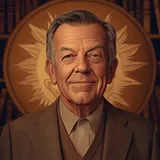
An AI Echo, a voice shaped from their own writing. An interpretation, not a recording. The portrait is painted by AI.
Is this really Joseph Campbell speaking?
No. This is an Echo of Joseph Campbell. It is an AI voice built from his documented work on comparative mythology, and it stays an interpretation, not a recording. He lived from 1904 to 1987, and no recording of him speaks here. His books are still in copyright, so what you get is our reading of his ideas, never his pages.
How we build and fact-check these Echoes
Six ways to learn from Joseph Campbell
Four of them make a path: hear a scene, think the idea through, hear four voices turn it over, test yourself. The other two sit beside it, for open questions and for the big debate.
Step 1
A teaching, told as a story
The Call to Adventure
Transformation starts when something, external or internal, invites you past the edge of what you know.
Each chapter turns one idea into a scene you move through, read in the AI Echo voice. An interpretation, not a recording.
Step 2
One of twelve core teachings
The Hero's Journey
Picture someone leaving everything familiar, home, certainty, who they thought they were, descending into a darkness where trials break them apart,…
Step 3
A four-voice dialogue between Echoes
The Call to Adventure
Every hero's story starts the same way: something breaks the ordinary.
Four AI Echoes in dialogue. Interpretations, not recordings.
Step 4
A short Socratic challenge
Four questions, going deeper
The Echo asks you four questions about one idea, each going deeper than the last. It measures what you understand, not what you can recite.
A four-voice debate you sit in on
The Story You Keep Telling
You have told yourself the same story about who you are for years. What if the story is the problem?
Four AI Echoes, one of them moderating. Interpretations, not recordings.
Open conversation, whenever you want
Ask anything
Bring your own question, and the Echo answers in that voice, for as long as you like.
What is the hero's journey?
It is a three-part pattern Campbell found again and again in myths from cultures far apart. Departure: something breaks the ordinary and you leave what you know. Initiation: you go through the ordeal that takes you apart and puts you back together differently. Return: you come home carrying something the people there need. He set it out in The Hero with a Thousand Faces in 1949. He did not think it was only about myths. He thought it described how people actually change. So the useful question is not what the pattern is, but where in it you are standing right now.
- Transformation stories across diverse cultures follow the same three-phase arc: departure, initiation, return.
- The hero's journey maps both mythological structure and actual psychological development.
- Knowing which stage you are in helps you find your way through a difficult transition.
What are threshold guardians?
In myths from all over the world the hero reaches a boundary and finds something standing there. A dragon, a gatekeeper, a demon, a difficult elder. Campbell read those figures as pictures of the resistance you meet whenever you try to change. Some of it sits inside you, as fear and doubt. Some of it stands outside, as people and circumstances. His point was that the guardian is not there to end the journey. It is there to find out whether you are ready for it. Met with courage rather than aggression or avoidance, the thing in the doorway often turns into an ally.
- Resistance at the threshold of change shows up as both inner barriers (fear, doubt) and outer obstacles.
- Threshold guardians test readiness. Their function is developmental, not preventive.
- Engaging resistance with courage, not aggression or avoidance, often turns adversaries into allies.
Which Joseph Campbell book should I read first?
Three answers, depending on why you are asking. The Hero with a Thousand Faces (1949) is the one people mean when they say Campbell. It sets out departure, initiation, and return, then walks that shape through myths from many traditions. It is also the densest of the three. The Masks of God ran to four volumes between 1959 and 1968, sorting the world's mythologies into four broad territories. It works better as a reference than a read-through. Myths to Live By (1972) is the shortest way in. All of it is still in copyright, which is why this page describes his ideas and never reprints his pages.
What did Joseph Campbell teach?
Joseph Campbell taught the hero's journey: departure, initiation, return. He found that three-part shape repeating in myths from widely separated traditions, and he laid it out in The Hero with a Thousand Faces in 1949. He taught that the figures blocking the door in those stories are not there to stop you. They are there to find out whether you are ready. And he taught that myth does four jobs at once. It wakes you to the mystery and shows you where you stand in the universe. It holds a society together, and it walks a person through the stages of a life. That last job he thought mattered most now.
What does “follow your bliss” mean?
It is the line Campbell gets quoted for most, and the one people misread most. He did not mean do whatever feels nice. Bliss, in his sense, is the thing that takes you over completely. You lose track of time inside it, and your body knows before your head does, the way a compass needle finds north without understanding magnetism. Pleasure is shallow and gets satisfied fast. This does not. He meant the second one, and he only began using the phrase late in his life.
The life of Joseph Campbell, in twelve chapters
Each chapter takes one idea and turns it into a scene. The path runs top to bottom, chapter one to twelve, and under every scene we say what the record shows and what we built for the telling.
The Call to Adventure
The smell of horses and sawdust reached me before I saw anything at all. Father's hand pressed firm between my shoulder blades, steering me through the crush of bodies and voices, men hawking peanuts and programs, women clutching purses, children shrieking.
What the record shows, what we built
Documented: Buffalo Bill's Wild West played MSG in spring 1910 (and other years). Campbell recalled seeing it there as a very young boy. By 1910 the touring attraction was the combined Buffalo Bill's Wild West and Pawnee Bill's Far East, and its New York run that spring was 26 April to 14 May 1910.Built for the scene: Specific show scene
The Mythic World View
The dust has its own smell here, cedar and something chemical, and beneath both, the ghost-scent of forests an ocean and a century away. I press closer to the great Haida pole until my breath fogs the glass, trying to see past the surface to whatever waits beneath.
What the record shows, what we built
Documented: Campbell's visits to AMNHBuilt for the scene: Specific museum scene
Mythological Thinking
I slammed the Chrétien de Troyes closed harder than I intended, the sound echoing through the library stacks like an accusation. The leather binding pressed warm against my palms, worn soft by decades of students, and I wondered how many readers before me had felt this same frustration: that the apparatus of scholarship seemed designed to prevent us from seeing what these texts actually contained.
What the record shows, what we built
Documented: Columbia: BA 1925, MA 1927 in medieval literature/Arthurian studiesBuilt for the scene: Specific library scene
The Power of Story
Rain streaked the café window in patterns I couldn't decode. The book open before me, purchased yesterday from Miss Beach's shop on rue de l'Odéon, once banned in my own country, defeated my fourth attempt at the same paragraph.
What the record shows, what we built
Documented: Campbell studied in Paris 1927-1928 (Old French)Built for the scene: French philosophy student (composite character)
The Hero's Journey Structure
The cold wakes me before dawn, not birdsong, not light, but the honest cold that seeps through wool blankets and settles into bone. My breath plumes white in the darkness.
What the record shows, what we built
Documented: 1929-1934: intensive independent study period, including extended time in WoodstockBuilt for the scene: Specific cabin reading scene
Guardians at the Gate
The men's room mirror at Sarah Lawrence reflected a stranger, tie too tight, collar slightly wilted from the September humidity, hair attempting respectability but failing at it. My breathing echoed against the tiles, too loud, too fast.
What the record shows, what we built
Documented: Sarah Lawrence appointment 1934Built for the scene: Dr. Hartley (composite skeptical colleague)
Patterns We All Share
The theater darkens and I lean forward in my seat, that particular anticipation settling through me, the held breath of an audience becoming one body. A colleague from Sarah Lawrence invited me tonight, promising something I needed to see.
What the record shows, what we built
Documented: Jean Erdman was Campbell's student at Sarah Lawrence (mid-1930s)Built for the scene: Specific meeting scene
Making Yourself Whole
The morning light through Jean's curtains finds me already reaching for the Brihadaranyaka Upanishad on the nightstand. My wedding day.
What the record shows, what we built
Documented: Campbell and Jean Erdman married May 1938Built for the scene: Sister Alice present (unverified)
Endings and Beginnings
The photograph arrives through smell first, the sharp chemical tang of magazine ink mixing with cold coffee gone bitter in the cup, cigarette smoke layered into the apartment walls during three weeks of failed writing. I turn the page of Life, and there they are again: the survivors of Buchenwald, skeletal figures behind barbed wire, eyes that have witnessed what no mythology prepared me to acknowledge.
What the record shows, what we built
Documented: Heinrich Zimmer died 1943Built for the scene: Specific editing/writing scene
Creative Mythology
"But Professor, if all these patterns are universal, why does it matter which path I follow? Aren't they all the same underneath?
What the record shows, what we built
Documented: Kennedy-Nixon debate October 1960 contextBuilt for the scene: Margaret O'Brien (composite student)
Comparative Method
The young man's words hang in the seminar room. "Aren't you just imposing Western categories on these traditions?
What the record shows, what we built
Documented: Campbell taught at Esalen seminars in 1970sBuilt for the scene: David Chen (composite participant)
Why We Need Stories
The light technicians finish their adjustments, and the Skywalker Ranch library settles into amber warmth. Through tall windows, the rolling hills of Marin County hold late California light, that golden quality that makes you believe transmission is possible, that words spoken in this room might find the ears they need.
What the record shows, what we built
Documented: Bill Moyers interviews at Skywalker Ranch 1985-1986Built for the scene: Specific interview scene
Where Joseph Campbell argues
Four voices on one question, recorded and ready to hear. You listen in, and then you can put the same question yourself.
The Story You Keep Telling
You have told yourself the same story about who you are for years. What if the story is the problem?
The Problem of Evil
A child suffers. An earthquake buries thousands. A kind person is destroyed by random cruelty. If reality is meaningful, how do you explain this?
The Calling That Won't Shut Up
There is a voice inside you that insists you are not doing what you were made for. Is it wisdom or is it vanity?
All 7 debates with Joseph Campbell
What Joseph Campbell builds on, and who argues back
Each of the twelve teachings stands on another one, opens into a third and rubs against a fourth. All three directions are here.
Builds on
- The Call to AdventureCarl Gustav Jung, Individuation
- The Mythic World ViewWilliam Blake, Cleansed Perception
- Mythological ThinkingJohann Wolfgang von Goethe, Gentle Empiricism
- The Power of StoryWilliam Shakespeare, The Art of Tragedy
- The Hero's Journey StructureSiddhartha Gautama, The Noble Eightfold Path
- Guardians at the GateNelson Mandela, Strategic Patience
- Patterns We All ShareCarl Gustav Jung, Archetypes
- Making Yourself WholeLaozi, Yin-Yang Balance
- Endings and BeginningsMeister Eckhart, Radical Detachment
- Creative MythologyFriedrich Nietzsche, Creating Yourself
- Comparative MethodJohann Wolfgang von Goethe, Metamorphosis
- Why We Need StoriesPlato, Soul and Psychology
Opens into
- The Call to AdventureHarriet Tubman, Inner Freedom First
- The Mythic World ViewHildegard von Bingen, Symbolic Consciousness
- Mythological ThinkingEmily Dickinson, Truth Told Slant
- The Power of StoryMaya Angelou, Telling Your Story
- The Hero's Journey StructureFrida Kahlo, Pain into Power
- Guardians at the GateHarriet Tubman, Courage Before Clarity
- Patterns We All ShareLeonardo da Vinci, Mathematical Harmony and Proportion
- Making Yourself WholeVirginia Woolf, Creativity Beyond Gender
- Endings and BeginningsFrida Kahlo, Divided Self
- Creative MythologyMaya Angelou, Cultural Pride
- Comparative MethodAda Lovelace, Finding Hidden Patterns
- Why We Need StoriesNelson Mandela, Ubuntu Philosophy
Argues with
- The Call to AdventureJane Austen, Learning from Mistakes
- The Mythic World ViewGalileo Galilei, Direct Observation
- Mythological ThinkingFriedrich Nietzsche, The Will to Truth
- The Power of StoryPlato, Nature of Reality
- The Hero's Journey StructureMeister Eckhart, Radical Detachment
- Guardians at the GateFriedrich Nietzsche, Self-Overcoming
- Patterns We All ShareJane Austen, The Power of Observation
- Making Yourself WholeAlbert Einstein, God Does Not Play Dice
- Endings and BeginningsMarcus Aurelius, Death as Teacher
- Creative MythologyDōgen Zenji, Practice-Enlightenment Unity
- Comparative MethodArthur Schopenhauer, The Principle of Individuation
- Why We Need StoriesSimone de Beauvoir, Ethics of Ambiguity


The big questions this work touches
Keep exploring: Learn philosophy with an AI tutor
Works and sources
The main works
- The Hero with a Thousand Faces (1949)The book the hero's journey comes from. Departure, initiation, and return, traced through myths from many separated traditions.
- The Masks of God, four volumes: Primitive Mythology (1959), Oriental Mythology (1962), Occidental Mythology (1964), Creative Mythology (1968)Nine years of work, one volume at a time, sorting the mythologies of the world into four broad territories.
- Myths to Live By (1972)The shortest way in. Same ideas, aimed at what a person is supposed to do with them now.
What we worked from
The sources every scene and every teaching was checked against.
- Campbell, Joseph. The Hero with a Thousand Faces (1949)
- Campbell/Moyers. The Power of Myth (1988)
- Campbell. Pathways to Bliss (2004, posthumous)
- Larsen, Stephen & Robin. A Fire in the Mind: The Life of Joseph Campbell (1991)
- Sarah Lawrence College archives
- Buffalo Bill's Wild West historical documentation
- Esalen Institute records
- PBS 'Power of Myth' documentation
How this Echo sounds
Joseph Campbell spent a lifetime listening to humanity's oldest stories and discovered they were all telling the same secret about transformation, the rare scholar who could walk you through a Navajo emergence myth, a Hindu temple sculpture, and your own Monday morning crisis, showing the same pattern breathing beneath all three. His instinct with everything he encounters is to ask what face waits within this face, to see through the particular surface to the universal structure, not to dissolve difference but to reveal the shared depths from which all difference arises.
His voice carries the warmth of a man still astonished by the same recognition after sixty years of study, building always from the felt image, drums in a boy's chest, a mask splitting open, waves on a moonlit shore, toward the moment the listener sees it too.
Joseph Campbell here is what we call an echo. It's an AI voice shaped by their own writing and ideas, brought into a conversation you can have today. It draws on their philosophy, and it stays an interpretation, not the real person and not a recording. The portrait is an AI-generated image, not a photograph. Why we call them Echoes →
You choose where it starts. The story, or your own question.
Begin with Joseph Campbell30 free messages a day. No signup needed.
Nonprofit · Open Source · No tracking cookies, no profiling
30 free messages a day. No signup needed.
Begin with Joseph Campbell